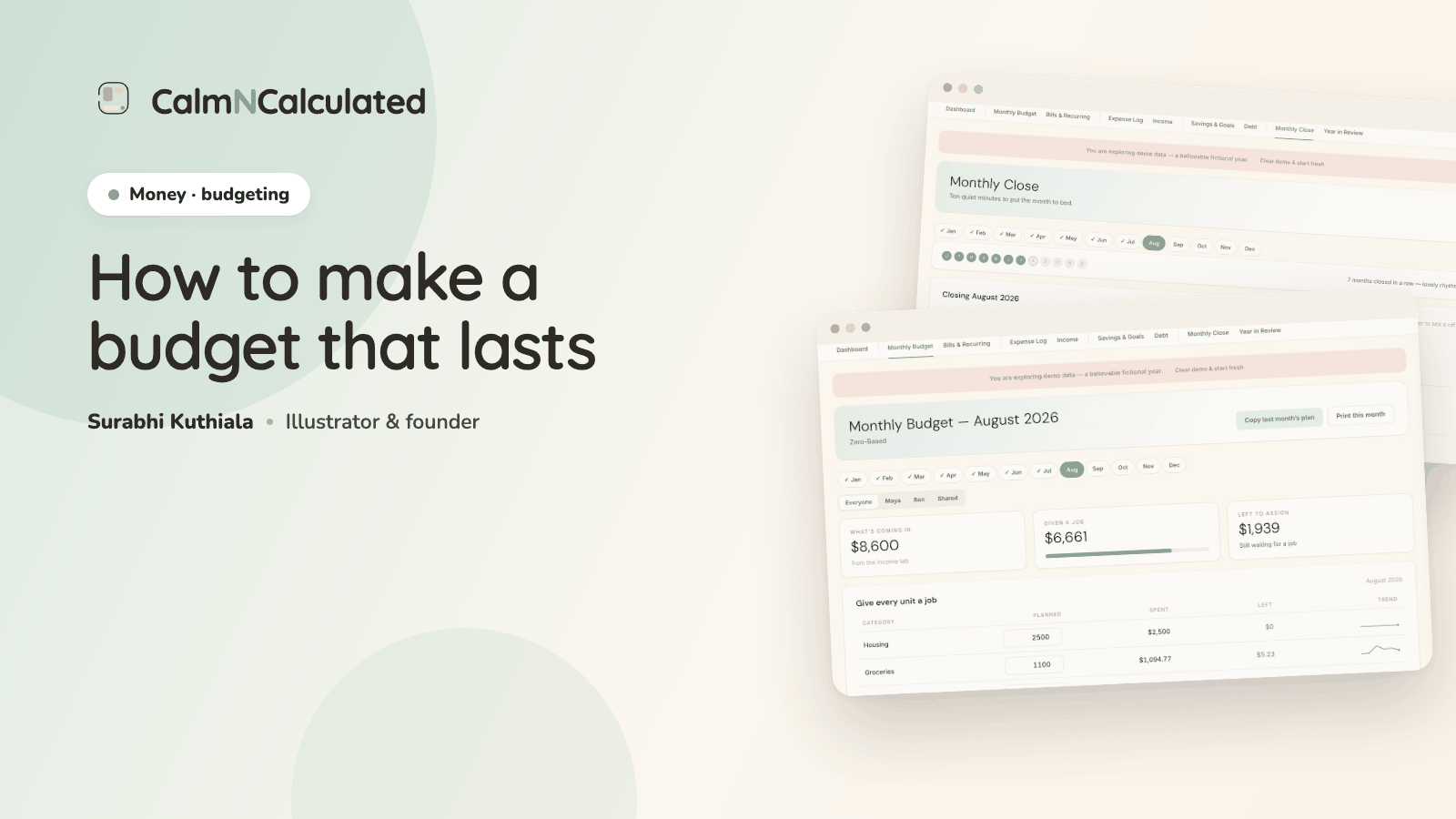
Pick one method and use it for three months before judging it. Zero-based suits variable income, 50/30/20 suits a steady salary, envelope suits overspending in a few specific categories. Then do the part nobody does: close the month. A budget that is never reconciled is a wish, and it will not survive contact with a real month.
I am not going to open this by telling you that budgeting is easy if you just try, because that has never been the problem. Most people who want a budget have already made one. Several, probably. The difficulty is not writing the numbers down. It is that the thing you wrote in the first week has no relationship to the month you actually had, and by week three you have quietly stopped looking at it.
So this is about the mechanism rather than the motivation. Which method to choose and why, and the single step that decides whether any of them lasts.
How do you choose a budgeting method?
By your situation, not by which one sounds most disciplined. There are three that people actually use, and each one is good at a different problem.
Judge them on four things: how steady your income is, how much detail you will genuinely keep up, whether you are trying to save or to stop overspending, and whether more than one person is spending from the same pot. Those four decide it. Everything else is preference.
| Method | How it works | Best when | Where it breaks |
|---|---|---|---|
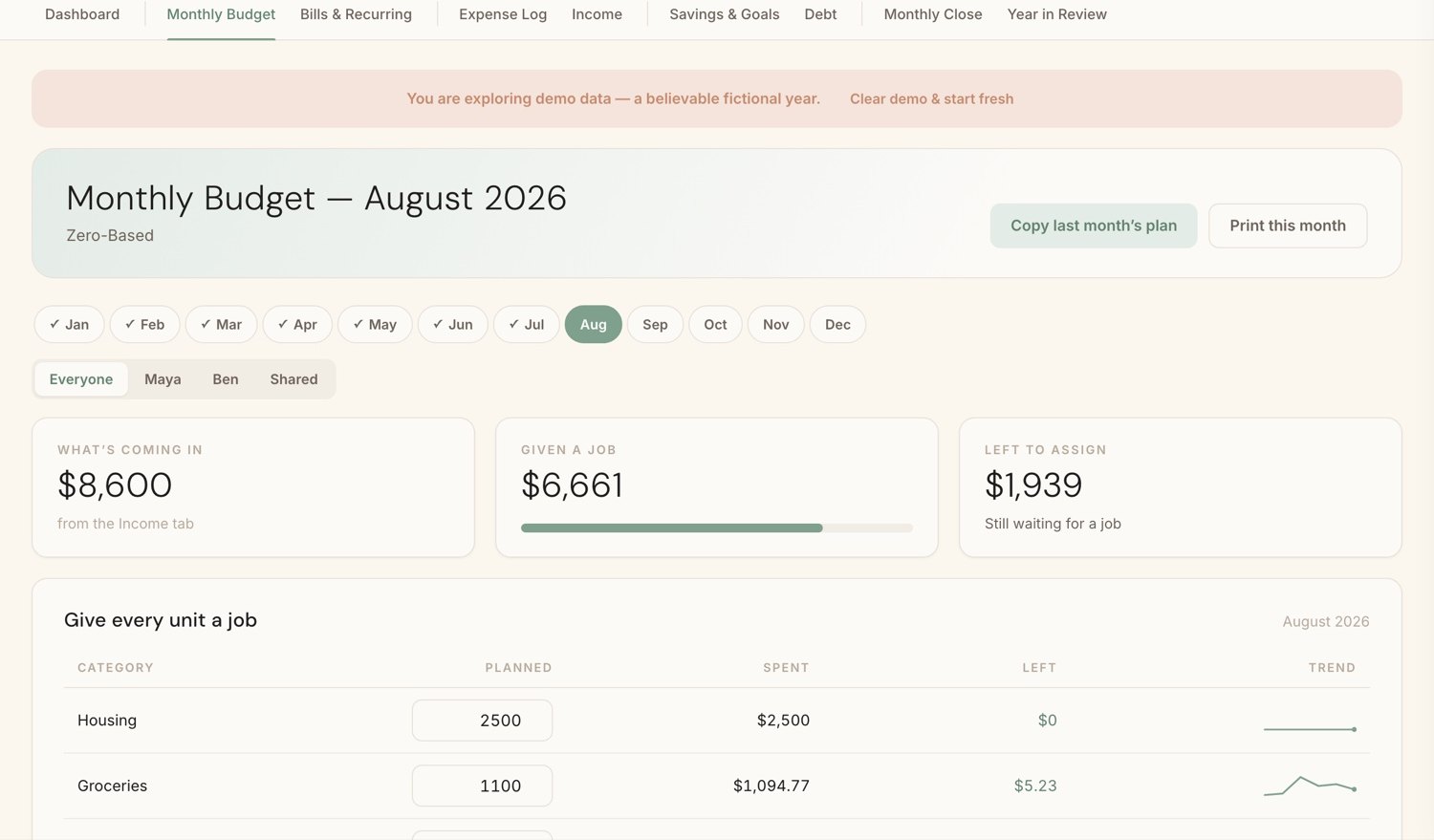
| Zero-based | Every unit of income is assigned a job until nothing is unallocated. | Income varies month to month, or you want to know exactly where everything went. | It asks the most of you. Miss two weeks of entries and the whole month is unusable. |
| 50/30/20 | Half to needs, a third to wants, a fifth to saving and debt. | A steady salary, and you want a budget you will still be running in a year. | Too coarse to catch a specific leak. It will tell you that "wants" is too high, not why. |
| Envelope | A fixed amount per category; when it is gone, it is gone. | Overspending is concentrated in two or three categories you can name. | Rigid. An unusual month forces you to break your own rule, which is where people quit. |
My own preference, for what it is worth, is 50/30/20 for a first budget and zero-based only once you already know your numbers. Starting with zero-based is like learning to cook by attempting a soufflé — it is not that it cannot be done, it is that failing at it teaches you the wrong lesson.
What actually makes a budget fail?
Not the setup. The ending.
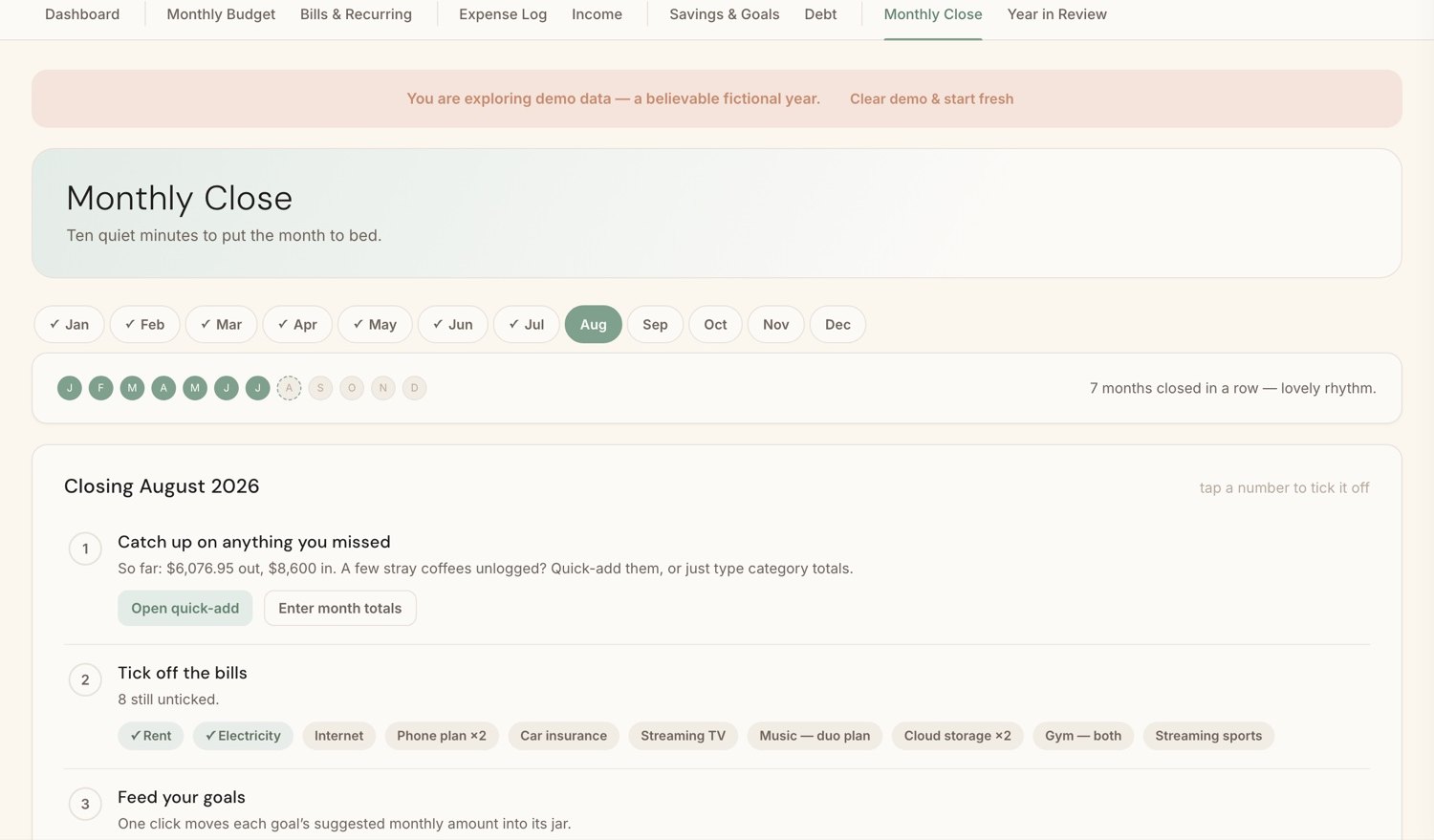
This is the thing I only saw properly when I had to build one. Almost every budgeting tool I have looked at has a screen for planning the month and a screen for recording what you spent, and then simply nothing. The month runs out and a new one begins, with the same optimistic numbers as the last one, because nothing ever forced you to look at the gap between what you planned and what happened.
A budget you never close is a budget you can never learn from. The month needs an ending, and almost nothing gives it one.
Closing a month takes about ten minutes and consists of three questions. What did I plan. What actually happened. What do I change for next month. That is the entire mechanism by which a budget gets more accurate instead of staying a wish, and it is the step every abandoned budget in history skipped.
What should be in a budget before you start?
Three months of your own history, if you have it. A budget built from what you imagine you spend is a work of fiction and it will be wrong in the same direction every time — always too optimistic, usually on food and on the small recurring things.
If you have not got three months of history, use one, and treat the first three months of budgeting as the measuring exercise rather than the discipline exercise. You are not failing; you are collecting data.
Then set the categories. Fewer than you think — eight to twelve is plenty. Every extra category is another decision at the moment you are entering a receipt, and the more decisions entry requires, the sooner entry stops.
How do you budget with someone else?
The arithmetic is the easy half. The hard half is that a shared budget is a shared set of judgements about what money is for, and those are rarely stated out loud until they collide.
Two things help more than any method. The first is agreeing a figure below which nobody has to explain anything — a personal allowance, however small — because a budget that requires you to justify a coffee is a budget that becomes an argument. The second is that both of you look at the close, not just the person who keeps the spreadsheet. Otherwise one person owns the numbers and the other person receives verdicts about them, which is not a shared budget at all.
Where the subscriptions go
Worth its own paragraph, because it is the single most common leak and the hardest to see. Recurring payments are designed not to be noticed: individually small, annually significant, and renewed by default. They are also the only category where you can save real money in one afternoon without changing how you live at all.
Once a year, list every recurring payment, put the yearly figure next to each one rather than the monthly figure, and read the list. The yearly figure is the honest one. A few of them will look very different in that column.
Where the planner fits
All of this works in a spreadsheet, and a spreadsheet is a perfectly respectable answer. The Budget Planner exists because of the closing problem — it runs twelve months, with a monthly close and a year in review built in, so the month has an ending and the next one starts from what actually happened. It supports all three methods above, holds bills, expenses, income, savings and debt in the same file, and runs in your browser with nothing to install and no account to make. Nothing you type leaves your device. You can try the whole thing free first.
If your budget question is really a debt question, that is a different shape of problem and worth treating separately. And if the reason you are budgeting is a specific event, the arithmetic is the same but the horizon is not — there is a version of it in how to plan a wedding and another in how to plan for a baby, both of which are mostly budgeting problems wearing a costume.
The rest of what we make is on the planners page.
Common questions
Which budgeting method should I use?
Judge them on four things: how steady your income is, how much detail you will genuinely keep up, whether you are trying to save or to stop overspending, and whether two people spend from the same pot. Zero-based suits variable income, 50/30/20 suits a steady salary, envelope suits overspending concentrated in a few categories you can name.
Why do budgets stop working after a few weeks?
Because the month never ends. Most tools have a screen for planning and a screen for recording, and nothing that compares the two. So a new month starts with the same optimistic numbers as the last one and the budget never gets more accurate. Closing the month takes about ten minutes and is the step every abandoned budget skipped.
How many budget categories should I have?
Eight to twelve is usually enough. Every extra category is another decision at the moment you are entering a receipt, and the more decisions entry requires, the sooner entry stops. You can always split a category later, once you know it is hiding something.
How do you budget when your income changes every month?
Zero-based handles it best, because it assigns whatever actually arrived rather than assuming a fixed figure. The other common approach is to budget on your lowest recent month and treat anything above that as a separate decision when it lands, rather than spending it in advance.
How do couples budget together without arguing?
Two things help more than any method. Agree a figure below which neither of you has to explain anything, because a budget that requires justifying a coffee becomes an argument. And make sure both of you look at the month-end review, not only the person who keeps the numbers — otherwise one person owns the budget and the other receives verdicts.
What is the fastest way to find money in a budget?
List every recurring payment once a year and write the annual figure next to each one rather than the monthly figure. Subscriptions are designed not to be noticed: small each month, significant each year, renewed by default. It is the only category where an afternoon of work saves real money without changing how you live.
This is not financial advice. It is a method for keeping track of your own money. Anything to do with debt you cannot service, a mortgage, tax or investing belongs to a qualified adviser in your own country.
Try the Budget Planner
Twelve months, a monthly close and a year in review, with the budget, bills, expenses, income, savings and debt — as a browser app, an Excel and Google Sheets workbook, or a printable pack. Nothing to install, no account to create.
Open the planner