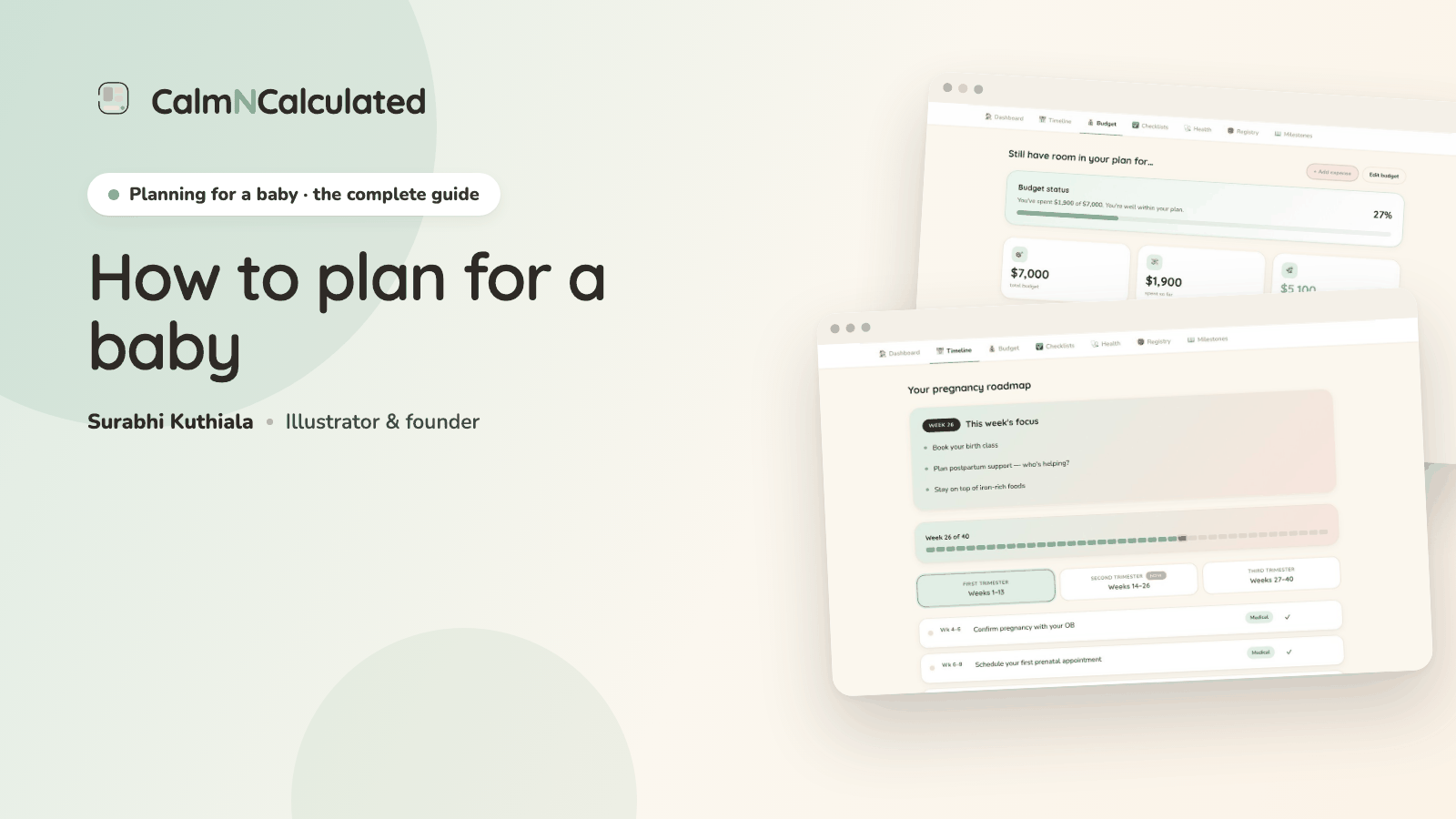
Plan a baby's arrival in three passes. The first trimester is medical and administrative only. The second is when you decide the big things — nursery, pram, budget, registry. The third is when you finish: hospital bag by week 35, and a plan for the first weeks at home. Everything else can wait, and most of it should.
I have two children. Both times I planned the way most people do — a diary, a list in my phone, a folder of screenshots, and a running total I recalculated every few weeks and never quite trusted. It worked, in the sense that a baby arrived and we had somewhere to put them. It was also much harder than it needed to be, and for a reason I only understood properly years later, when I sat down to build a planner and had to describe pregnancy to a computer.
This is the guide I would have wanted. It is not medical advice — anything about your body, your baby or your care belongs to your midwife or doctor, and I will point at them rather than pretend otherwise. This is about the other job: the forty weeks of decisions, money and admin that nobody hands you a system for.
When should you start planning for a baby?
Later than you think. Most of it can wait until the second trimester, around week 14.
The first trimester has its own short list and it is almost entirely medical and administrative: confirm the pregnancy, book your first appointment, start antenatal care, and work out who at work needs telling and when. That is genuinely it. It is also the stretch when you are most likely to feel dreadful, which is a poor moment to be comparing prams.
The urge to start everything at once in week 6 is very strong and I would gently ignore it. Decisions made in the first trimester tend to be remade in the second anyway, once you know more — the room, the dates, how you are actually feeling. Starting early mostly buys you the work twice.
What actually needs planning, and when?
Here is the whole forty weeks on one page. Weeks are approximate and every pregnancy runs its own schedule — this is a shape, not a prescription.
| Weeks | What this stretch is for | The things worth doing |
|---|---|---|
| 1–13 First trimester |
Medical and administrative. Nothing else. | Confirm the pregnancy · book your first appointment · start antenatal care · decide who to tell at work and when · check what leave and cover you are entitled to |
| 14–26 Second trimester |
The deciding stretch. You feel better and you know more. | Set a total budget · choose pram and car seat · plan the nursery · start a registry · book antenatal classes · sort childcare if you will need it |
| 27–35 Early third |
Buying and building, while you can still move comfortably. | Buy the big items · fit the car seat · assemble the furniture · wash and sort the first clothes · write the birth preferences · agree who is doing what after the birth |
| 35–40+ Late third |
Finishing. No new decisions. | Hospital bag packed · route and parking known · pets and older children arranged · freezer stocked · phone list written down somewhere that is not your phone |
If you take one thing from that table, make it the second row. The second trimester is the only stretch where you have information, energy and time at once. Almost everything that goes wrong later is something that could have been decided in it.
Why do pregnancy checklists go stale?
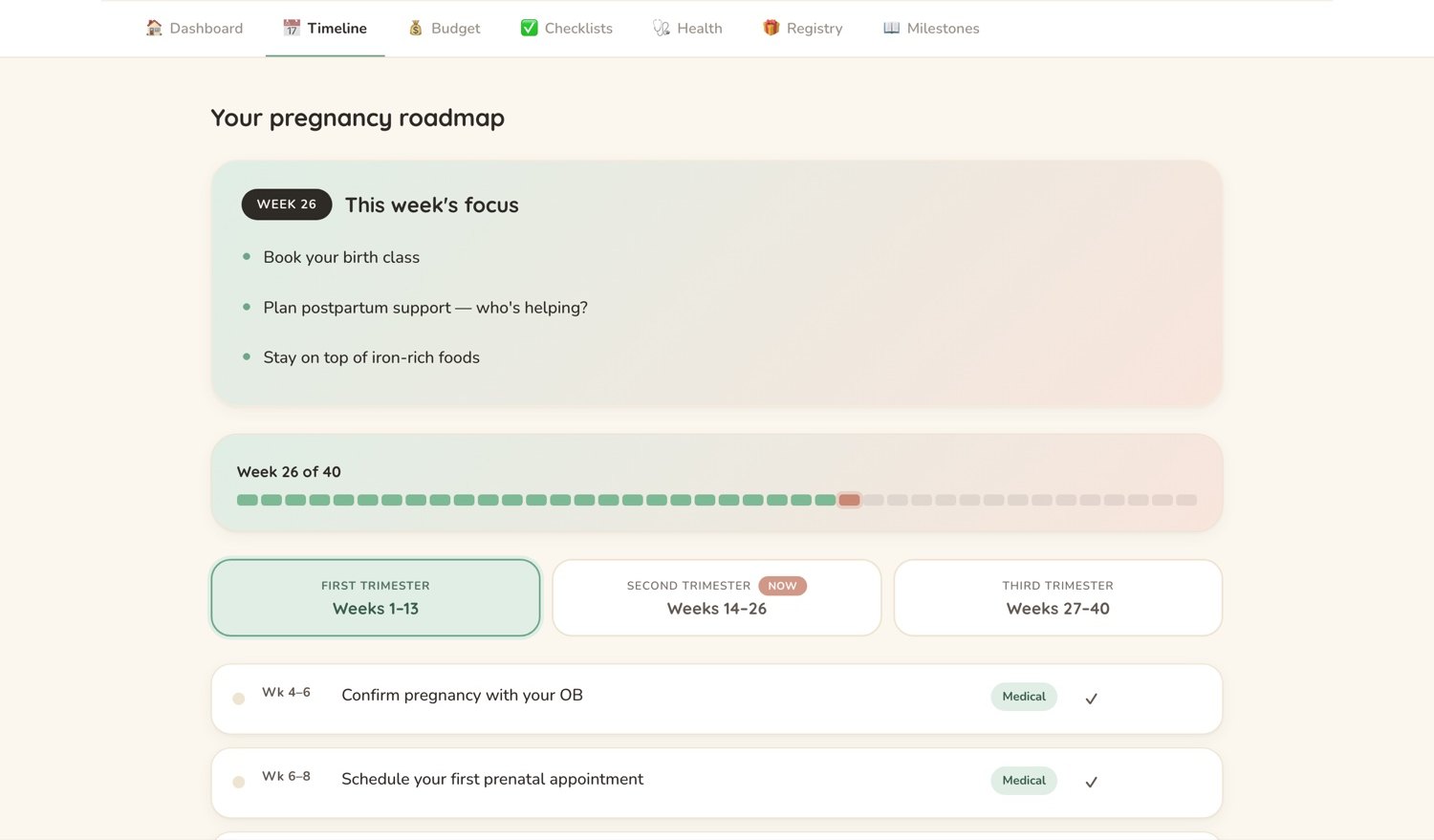
Because they are written against dates, and a pregnancy does not run on dates. It runs on week numbers, and the week numbers move.
This is the thing I only saw clearly when I had to model it. Every printable pregnancy checklist I have ever bought — and I have bought a lot of them, from the other side of the counter — pins each task to a date. Buy the pram by the 14th of June. Pack the bag by the 2nd of September. Then you have a scan, your due date moves by nine days, and every single date on that list is now wrong. Not obviously wrong, either. Quietly wrong, in a way you will keep half-noticing and not fixing.
So people stop trusting the list, and once you stop trusting a list you stop opening it. That is the real reason so many pregnancy plans are abandoned somewhere around week 20. Not forgetfulness. A file that went out of date and could not update itself.
A printed checklist cannot recount the weeks. That is the whole problem, and it is the reason I stopped making printables and started making this instead.
The fix is not a better list. It is storing everything against the week rather than the date, so that moving the due date moves the entire plan at once. That is one line of arithmetic. It is also the single most useful thing a planner can do for you, and paper physically cannot do it.
How much does it cost to get ready for a baby?
I am not going to give you a number, because any single figure is somebody else's. It depends on your country, on how much you buy new, and on how much arrives second-hand from people who are quietly delighted to be rid of it.
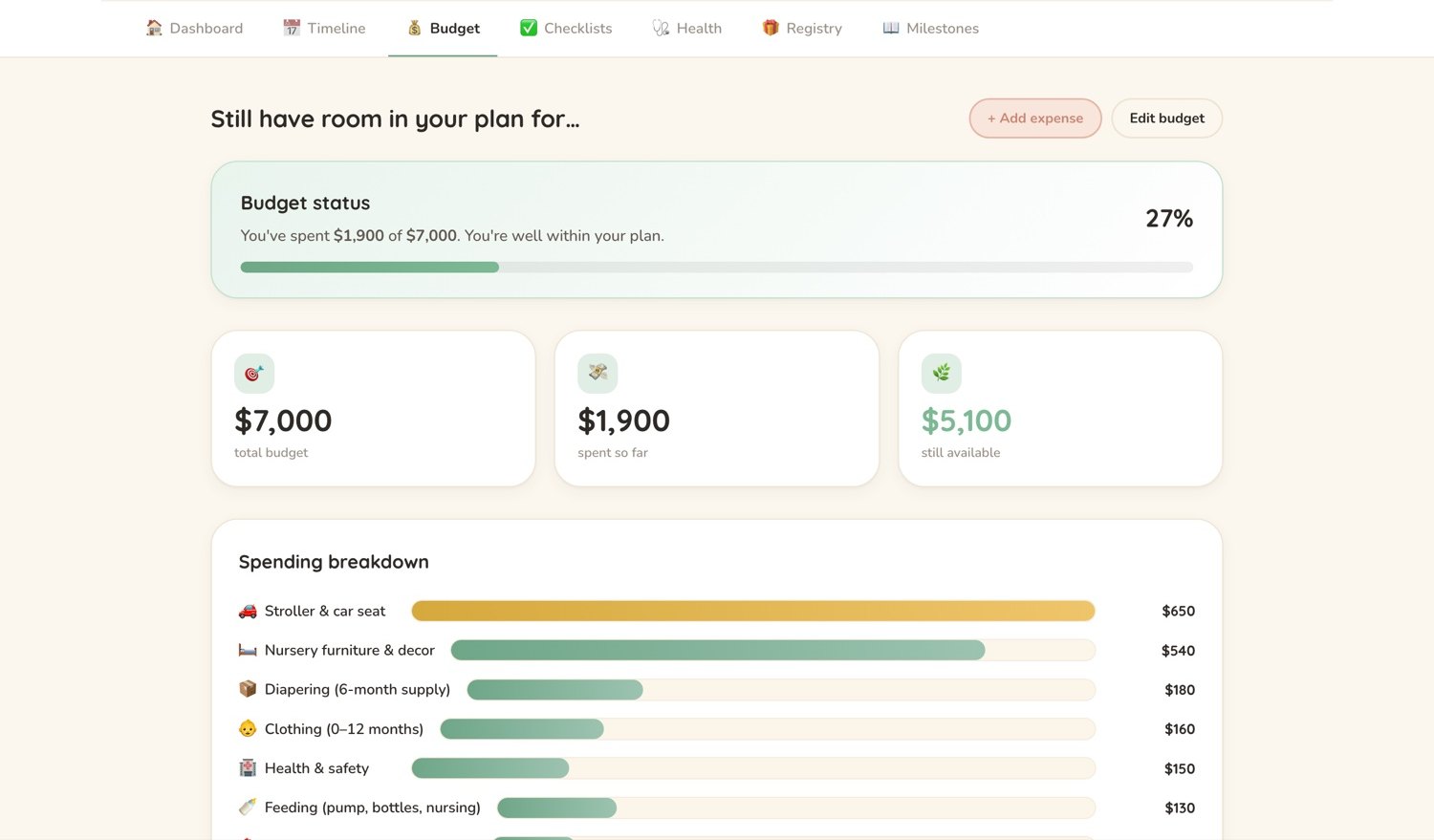
What does help is a breakdown. Six categories cover almost everything: the pram and car seat, nursery furniture, nappies for the first months, clothes for the first year, feeding, and health and safety. Put your own figure against each of those six and you have a budget. Add the gifts people are giving you, and you have a real one.
That last part matters more than it sounds. A registry kept separately from the budget just makes two lists. Kept together, a gift removes a line from your own spending instead of quietly adding to your pile. It is the difference between knowing what is left and hoping.
What goes in the hospital bag, and when should you pack it?
Pack it by week 35. Early enough that it is done before you are uncomfortable, and before an early arrival makes the decision for you.
Pack it as three groups rather than one long list, because three is how you will reach into it: for labour (documents, whatever you want to wear, drinks and snacks, a charger with a long cable), for afterwards (a change of clothes, toiletries, whatever you need for feeding), and for the baby (clothes in two sizes, nappies, a blanket, and the going-home outfit). Your hospital or midwife will have their own list of what they want you to bring — theirs wins over mine, every time.
Two things that are not on most lists and should be. Write your phone numbers down on paper, because a dead phone is a real and common problem. And put the car seat in the car before the bag is packed, not after — a surprising number of people discover on the day that fitting one takes longer than they assumed.
What can you safely not do?
Quite a lot, actually. This is the part nobody writes down.
- You do not need the nursery finished. Most babies sleep in your room at first. A finished nursery in week 30 is a lovely thing and an urgent thing it is not.
- You do not need newborn clothes in quantity. They are worn for a few weeks and many babies skip the size entirely.
- You do not need every gadget. Buy the things you are certain about and leave the rest until you have met the actual baby and know what your actual problem is.
- You do not need to decide everything about feeding in advance. Have what you need for the first week and take advice from someone qualified after that.
What you do need is the boring one nobody plans: the first fortnight at home. Who is coming, who is cooking, who is looking after the older child or the dog. Decide it in the third trimester while you still have the attention span, because you will not want to organise a rota in the first week and someone will have to.
Where the planner fits
Everything above is doable with a notebook, and I did it with a notebook, twice. The Pregnancy Planner exists because of that one structural problem — the counting. It holds the timeline, the budget, the registry and the checklists in one file, paced by week rather than by date, so that moving the due date moves the plan. There are seven sections and it runs in your browser with nothing to install and no account to make. You can try the whole thing free before deciding anything.
When the baby actually arrives, the job changes completely and the planner is the wrong shape for it — feeds, sleep and nappies on a twenty-four-hour clock, not a forty-week one. That is what the Newborn Baby Tracker is for. And if the budget above is the part making you anxious, the Budget Planner handles the whole household rather than just the arrival.
If you want the longer story of why a shop that sold drawings for ten years started making things that add up instead, that is in the first post on this blog.
Common questions
When should you start planning for a baby?
Most of the planning can wait until the second trimester, around week 14. The first trimester is for the medical side — confirming the pregnancy, booking your first appointments and starting antenatal care — and for telling whoever needs to know at work. Nursery, registry and hospital bag all belong later.
What is the hardest part of planning for a baby?
Keeping the plan current. Nearly every list you can buy is written against dates, and a pregnancy runs on week numbers. The moment a scan moves a due date, every date on a fixed list is wrong and quietly stays wrong. That is why so many people abandon a checklist somewhere in the second trimester.
How much does it cost to get ready for a baby?
It varies enormously by country and by how much you buy new, so any single figure you read is somebody else's number. What helps is not a total but a breakdown: pram and car seat, nursery furniture, the first months of nappies, clothes for the first year, feeding, and health and safety. Set a figure for each, then track against it.
When should you pack a hospital bag?
By around week 35, so it is done before you are uncomfortable and before an early arrival makes the decision for you. Pack it as three groups — one for labour, one for after, one for the baby — because that is how you will actually reach into it.
Do you need a baby registry?
Only if people are asking what to give you, which they usually are. A registry is less about the gifts than about preventing three of the same thing. Set it up once the big items are decided, and keep it in the same place as your budget so a gift removes a line from your own spending rather than adding to it.
Should you plan the first weeks after the birth?
Yes, and it is the part most often skipped. Who is coming, who is cooking, who is holding the fort — decided in the third trimester, while you still have the attention span for it. Nobody wants to organise a rota in the first fortnight.
This is not medical advice. Everything here is about organising, money and admin. Anything to do with your body, your baby, your care or your medication belongs to your midwife, doctor or health visitor — and where their advice differs from anything above, follow theirs.
Try the Pregnancy Planner
The whole thing runs free in your browser — the timeline, the budget, the registry and the checklists, paced by week. Nothing to install, no account to create.
Open the planner