Plan a wedding in three passes. First fix the three things everything else hangs on — the date, the budget and roughly how many people. Then book the suppliers whose diaries run out first: venue, photographer, catering. Only then start on the parts everyone begins with, which are flowers, stationery and what anybody is wearing.
The hard part of a wedding is not any individual task on the list. It is knowing what to do first — and almost every wedding checklist you can buy answers that with two hundred tasks in no particular order.
What follows is the order, not the list. I have not planned a large wedding myself, so I am not going to pretend to war stories. What I do have is the experience of having to describe a wedding to a computer, in enough detail that the arithmetic came out right, and that turns out to teach you something specific: which decisions are load-bearing and which ones only feel like it.
When should you start planning a wedding?
As soon as you have a rough date and a rough number. Twelve months is the figure everyone quotes and it is a reasonable default, but the date is not really set by you.
It is set by whichever supplier you most want and can least replace. Popular venues and well-known photographers are booked a year or more ahead in season, and everything else in the wedding will bend to fit around them. So the honest first move is not to fix a date and then find a venue. It is to find out what your must-have supplier has free, and let the date follow.
If you have less than a year, nothing is lost. Short-notice weddings work perfectly well. You simply have a smaller pool to choose from, and the pool shrinks fastest at the top end.
What order should you plan a wedding in?
Here is the whole thing on one page. The months are approximate and every wedding runs its own schedule — this is a shape, not a prescription.
| When | What this stretch is for | The things worth doing |
|---|---|---|
| 12+ months The three anchors |
Fixing the things everything else is measured against. | Agree a total budget and who is contributing · draft the guest list to a number · shortlist venues · pick a date that a venue can actually offer |
| 9–12 months The diaries that run out |
Booking the suppliers you cannot get later. | Book the venue · book catering · book the photographer · book music · book the officiant · take out insurance if you are using it |
| 6–9 months The middle |
The decisions that need the venue settled first. | Outfits ordered · save-the-dates sent · flowers and cake · transport · accommodation blocks · registry opened |
| 2–6 months Committing |
Turning a plan into a set of confirmed numbers. | Invitations sent · menu tasting · fittings · order of the day drafted · final supplier meetings · chase replies |
| Final month Finishing |
No new decisions. Confirmations only. | Final numbers to the caterer · seating done · timeline sent to every supplier · balances paid · a printed copy of everything, held by someone who is not you |
If you take one row from that, take the first. Almost everything that goes badly later is something that was left unsettled at the top — usually the budget, and usually because it felt rude to discuss it.
Why do wedding budgets go wrong?
Because most of a wedding is not a set of costs. It is a set of costs multiplied by the number of guests, and the number of guests is the last thing anybody wants to be firm about.
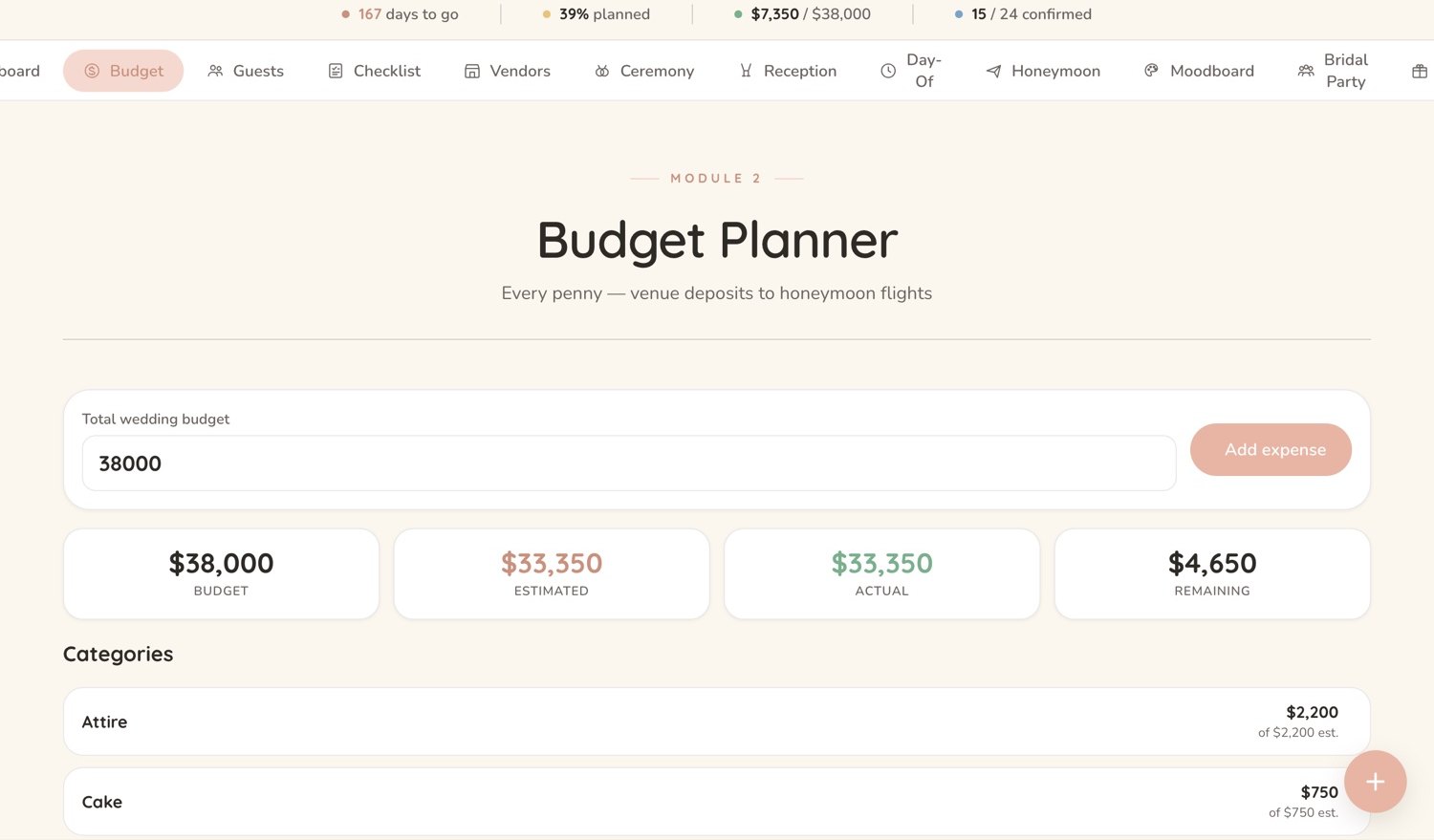
This is the thing I only saw clearly when I had to model it. When you write the arithmetic down properly, the lines separate into two kinds. A photographer costs what they cost whether forty people come or a hundred and forty. But catering, drinks, favours, stationery, table linen, chairs, cake and often the venue itself are all quietly per head. Adding twenty people does not add a line to the budget. It multiplies half of it.
The guest list is not a separate document from the budget. It is the budget, written in names instead of numbers.
Which is why the two should never live in different files, and in most people's planning they do — a spreadsheet for the money, a document or a shared note for the names, and no connection between them. So the guest list grows by ones and twos over several months, each addition feeling like nothing, and the total is only recalculated at the very end when it is far too late to do anything but cut something you cared about.
How do you handle the guest list?
Start from the number, not the names. Decide what you can seat and afford, then fill it. Doing it the other way round produces a list of a hundred and eighty people and a venue for a hundred, and someone has to be removed from a list they were already on.
Three things worth knowing before you start:
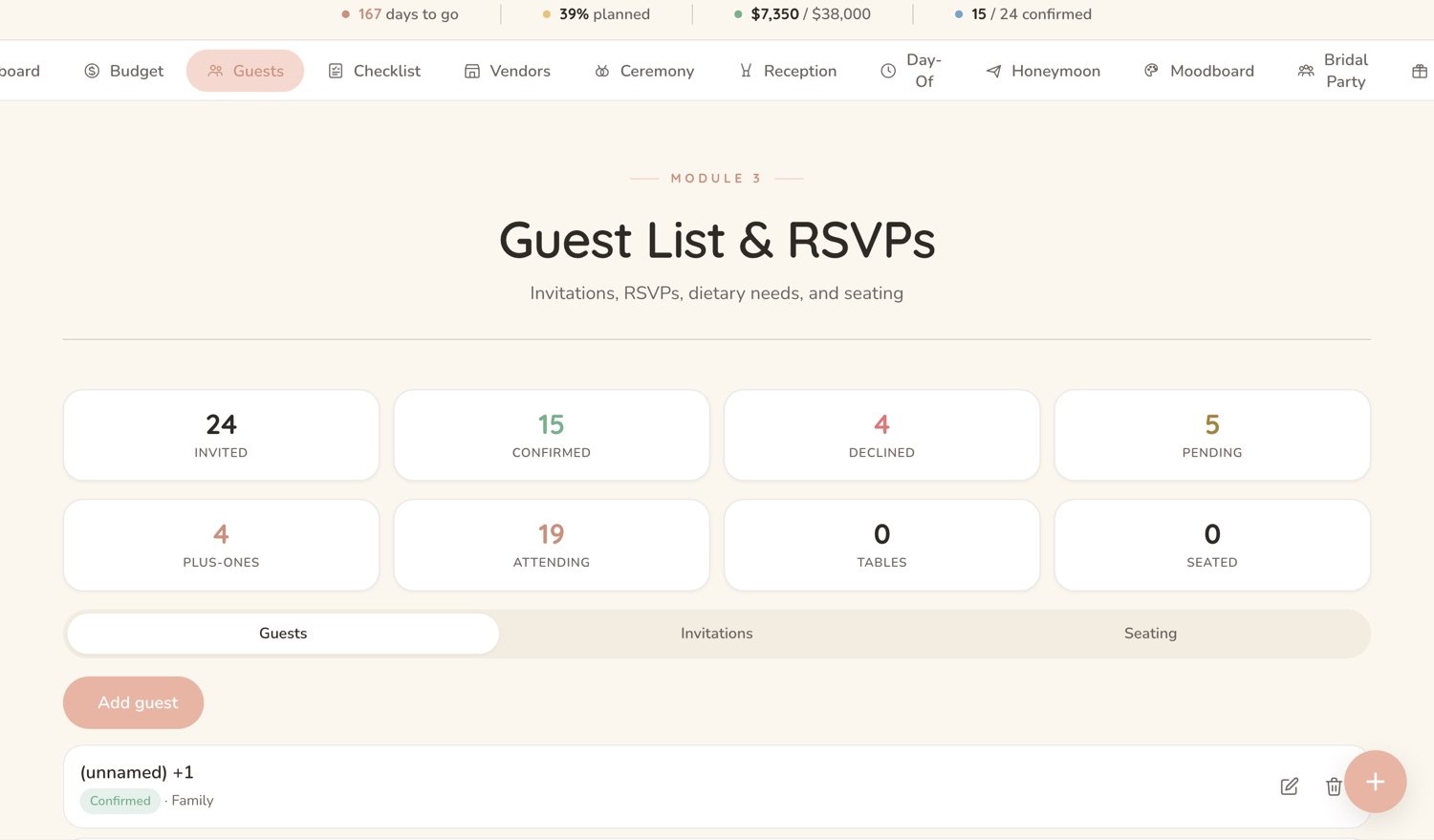
- Invited is not attending. Some proportion will not come, and that proportion depends entirely on how far people have to travel. Do not spend the gap before you have it — count on it only once the replies are in.
- Track who invited whom. If two families are contributing, the list will be negotiated, and it is much easier to negotiate when everyone can see whose names are whose.
- Chase in writing, once, politely. Replies stall at about seventy per cent and then stop dead. The last thirty per cent are not offended; they have forgotten.
What can safely wait?
More than you would think. This is the part nobody writes down, because every list is written as though everything on it is urgent.
- Anything decorative. Flowers, table styling, favours, signage. These are priced close to the day anyway and choosing them early only means changing your mind twice.
- The seating plan. It cannot be finished until the replies are in, and attempting it early is genuinely wasted work.
- The honeymoon. Worth booking, not worth planning in detail while the wedding is live. It will still be there in the quiet fortnight afterwards.
- Anything you are only doing because it was on a list. A surprising amount of a standard wedding checklist is optional, and nobody at the wedding will audit it.
What cannot wait, and often does, is the order of the day — the actual timings, given to every supplier in the same form. Photographers, caterers and musicians all plan from it, and if they each have a slightly different version of it, the day is where you find out.
Where the planner fits
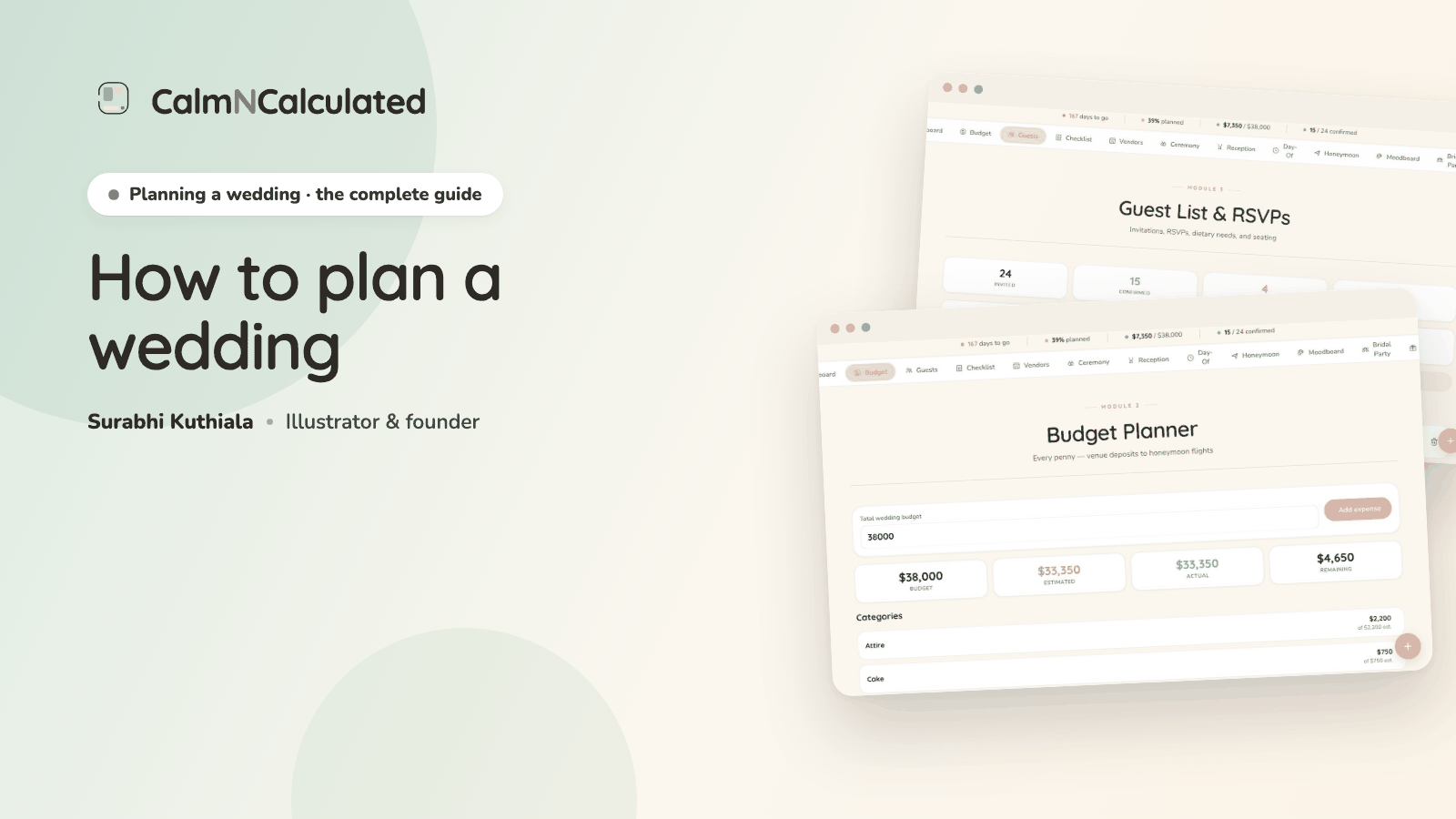
All of this is doable with a spreadsheet and a shared document, and plenty of people do exactly that. The Wedding Planner exists because of the structural problem above — it keeps the guest list and the budget in the same file, so the head count and the money move together instead of being reconciled at the end. There are twelve sections, covering the budget, guests and RSVPs, seating, vendors, the checklist and the day-of timeline, and it runs in your browser with nothing to install and no account to make. You can try the whole thing free before deciding anything.
The rest of what we make is on the planners page — the same idea applied to other stretches of life that arrive with too many moving parts at once.
If you want the longer story of why an illustrator started making things that add up, that is in the first post on this blog.
Common questions
How far in advance should you plan a wedding?
Twelve months is the usual answer and a reasonable default, but the date is really set by whichever supplier you most want and can least replace. Popular venues and photographers book a year or more ahead in season. Find out what they have free first, and let the date follow. Shorter notice works fine; the choice is simply narrower.
What should you book first for a wedding?
The suppliers whose diaries run out first — venue, catering, photographer, music and the officiant. Everything decorative can be decided far later than most checklists suggest, because it is priced close to the day anyway. Deciding flowers before you have a venue usually means deciding them twice.
Why do wedding budgets go over?
Because most of a wedding is not a set of costs but a set of costs multiplied by the guest count. Catering, drinks, stationery, linen, chairs, cake and often the venue are all per head. Adding twenty guests does not add a line to the budget, it multiplies half of it — and it usually happens in ones and twos over several months.
How do you decide how many guests to invite?
Start from the number rather than the names. Work out what you can seat and afford, then fill that number. Starting from names produces a list far longer than the room, and somebody then has to be removed from a list they were already on.
When should you send wedding invitations?
Save-the-dates around six to nine months out, invitations around two to three months out, and expect replies to stall at roughly seventy per cent and then stop. One polite written chase recovers most of the rest. The people who have not replied have almost always forgotten rather than declined.
What is the one thing most couples leave too late?
The order of the day — the actual timings, given to every supplier in the same form. Photographers, caterers and musicians all plan from it, and if each of them holds a slightly different version, the day itself is where that gets discovered.
Try the Wedding Planner
The budget, the guest list, the seating chart, the vendors and the day-of timeline — as a browser app, a spreadsheet workbook (.xlsx) or a printable pack. Nothing to install, no account to create.
Open the planner