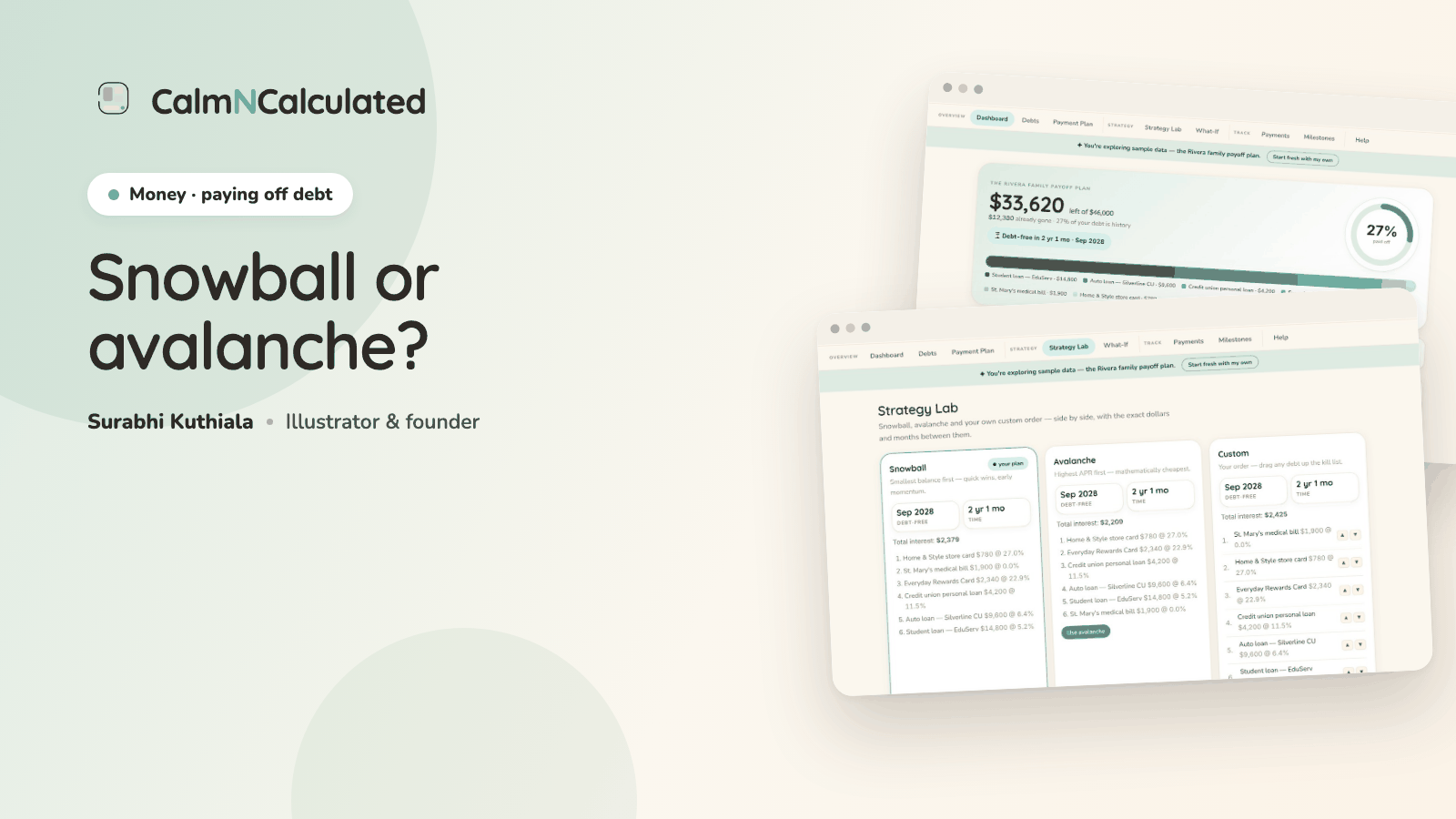
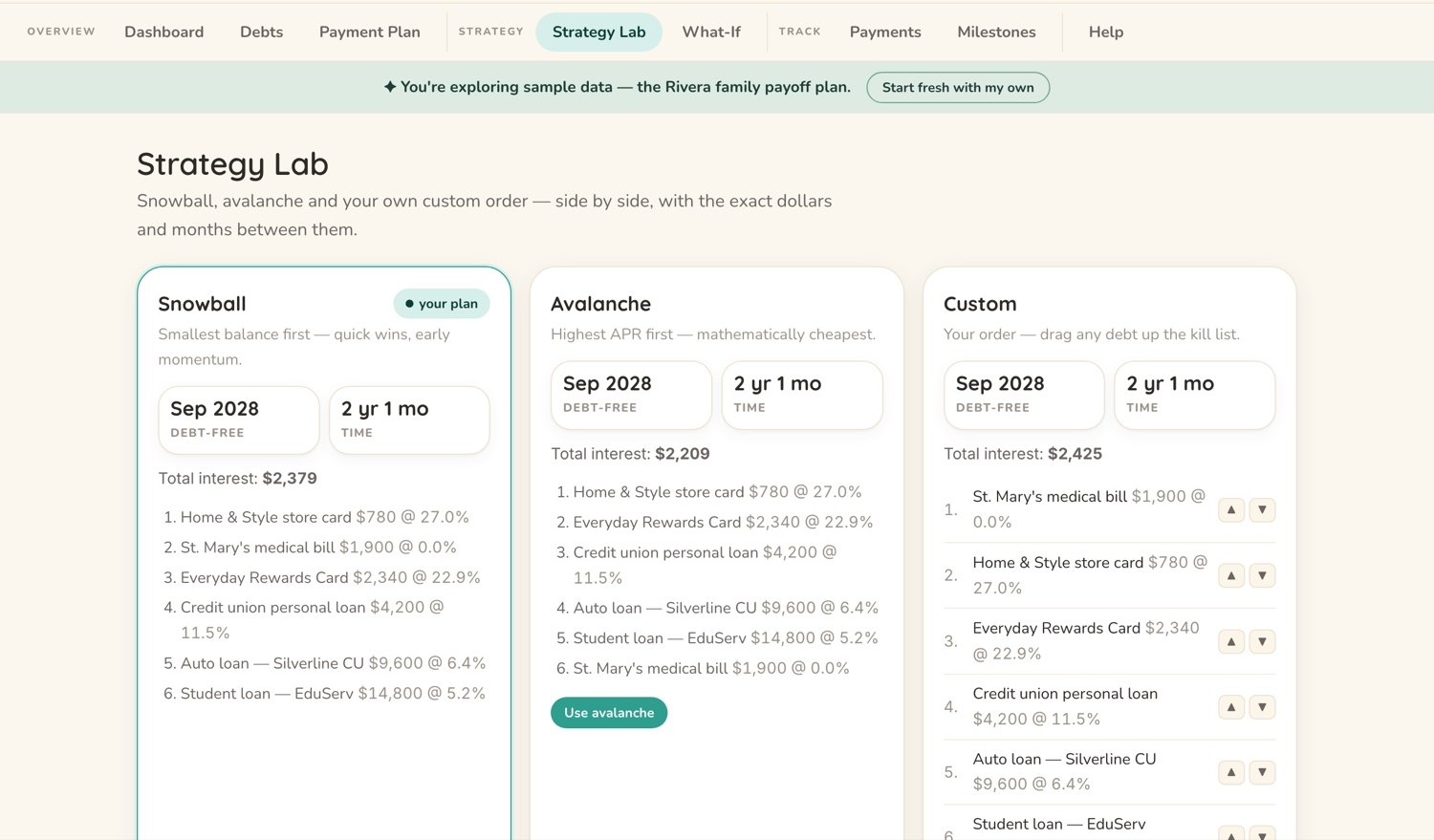
Both methods pay the minimum on everything and put everything they can spare at one debt. Avalanche targets the highest interest rate and costs least. Snowball targets the smallest balance and gets finished more often. Choose avalanche if the rates differ sharply, snowball if you have started and stopped before. The gap between them is usually smaller than the argument.
This is the one debt question people actually argue about, and both sides are right, which is why the argument never ends. One camp points at the arithmetic. The other points at the fact that a plan you abandon in month four saves nothing at all.
What I can add is a look at the actual numbers, because we built the side-by-side comparison and I have spent a fair amount of time looking at what it produces. The interesting part is not which one wins. It is how much it wins by.
What are the two methods?
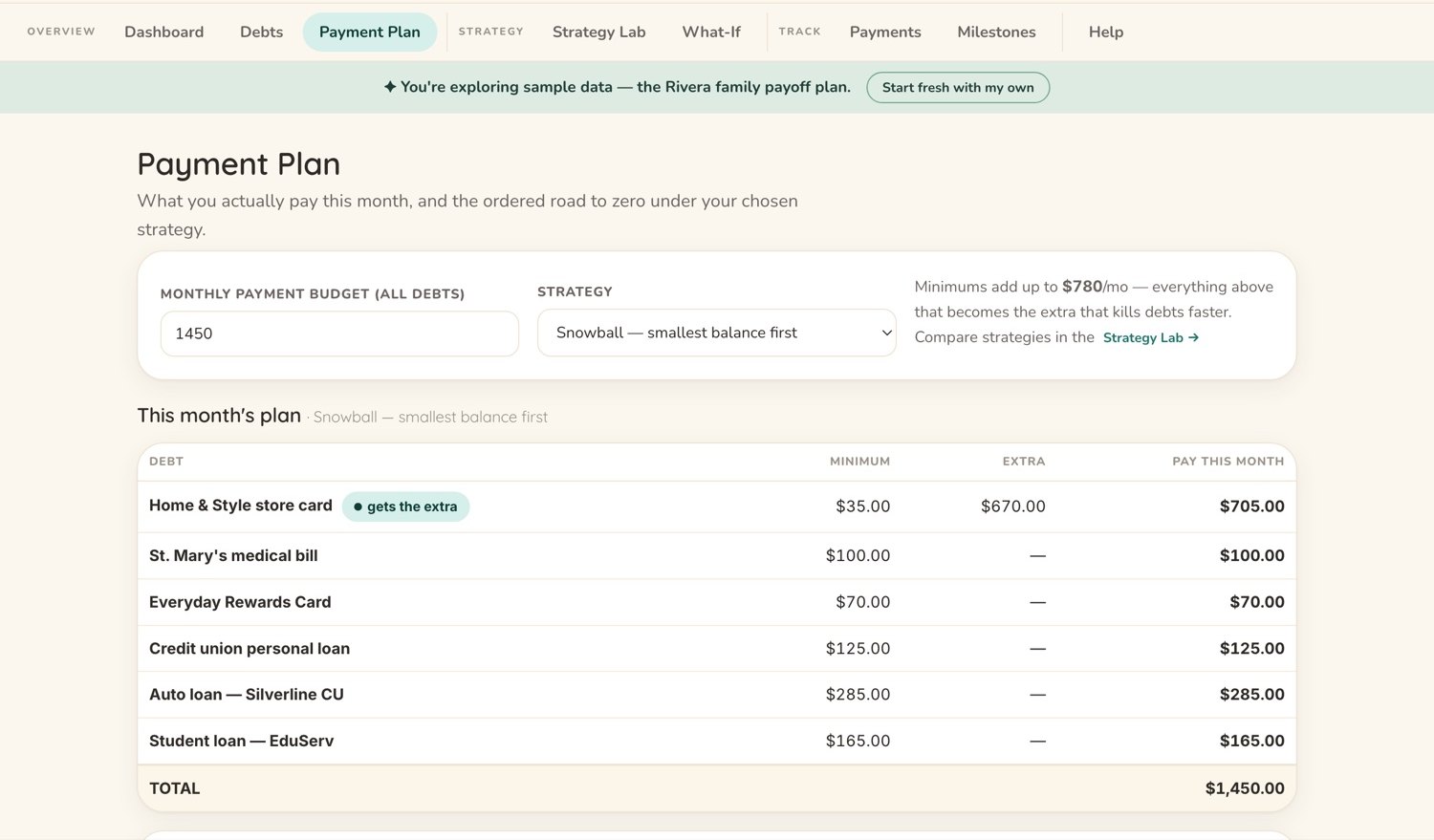
Identical, apart from one decision. Both start the same way: list every debt, pay the minimum on all of them, and put everything you can spare at exactly one. When that one is cleared, its whole payment rolls into the next. That rolling-up is what does the work, and it is why both methods accelerate as they go.
The only difference is which debt you point at.
| Avalanche | Snowball | |
|---|---|---|
| Target | Highest interest rate first | Smallest balance first |
| Optimises for | Money. It is the mathematically cheapest order. | Completion. The first debt disappears soonest. |
| First win arrives | Whenever the expensive debt happens to clear — sometimes many months in | Usually within the first few months |
| Choose it when | The rates differ sharply, and you know you will keep going | You have started a payoff plan before and stopped, or the balances are similar sizes |
| The risk | Nothing visibly changes for a long time, which is when people quit | You pay more interest — sometimes trivially, sometimes not |
How much does avalanche actually save?
It depends almost entirely on how far apart your interest rates are, and that is the part the argument usually leaves out.
If your debts are all at broadly similar rates — several cards within a few points of each other — the two methods produce nearly the same total and nearly the same finish date. In that situation the arithmetic is not really an argument for anything, and you should pick whichever you will keep doing.
If one debt is at a much higher rate than the rest, the picture changes and avalanche pulls clearly ahead. That is the case where the maths deserves to win, and it is worth checking rather than assuming: people are often surprised which of their debts is the expensive one, because the largest balance and the highest rate are frequently not the same debt.
Run both before choosing. Not to settle the argument in general — to find out how much it is worth in your case, which is the only version of the question that matters.
What matters more than the method?
The extra payment. By a very long way.
The order in which you clear debts changes the total by some percentage. The amount you put at them changes it by considerably more, and it also changes the finish date, which is the number people care about even when they say they care about interest.
So if you are going to spend an evening on this, spend it on finding the extra payment rather than optimising the order. Twenty a month more does more for the finish date than any reordering will. That is not a motivational statement, it is just how the arithmetic falls out — the ordering decision is bounded by the difference between your rates, and the payment decision is not bounded by anything.
Which number should you actually watch?
The date. Not the balance.
Total owed is a discouraging number to look at, because it moves slowly at the start and it gives you no information about whether you are doing well. The debt-free date does something different: it moves visibly when you pay extra, and it tells you what a decision is worth before you make it. Skipping a takeaway is abstract. Skipping a takeaway and watching the date come forward by a few days is not.
It is also the honest measure of a bad month. If you miss an extra payment, the date moves back a little and then continues. Nothing is ruined, and having that visible is worth more than any amount of resolve.
What about consolidation and balance transfers?
They are a different kind of tool and they are worth understanding before you use one. A consolidation loan or a zero-rate transfer does not reduce what you owe. It changes the price of the time you take to repay it, and sometimes the shape of the repayment.
Three things worth checking, honestly, before treating one as progress. What the fee is, in money rather than as a percentage. What the rate becomes when any promotional period ends, and what your plan is for that date. And whether the total you will repay is genuinely lower — a lower monthly payment over a longer term is frequently a higher total.
The other one, which nobody enjoys being asked: does the old account stay open. A transfer that clears a card you then start using again has not reduced your debt, it has doubled your available credit. That is the most common way a good decision turns into a worse position.
What should you do first?
- List every debt with its balance, rate and minimum. All of them, including the ones you would rather not look at. You cannot plan around a debt you have left off the list.
- Cover the minimums first. Non-negotiable — missed minimums cost fees and damage far more than any ordering strategy saves.
- Find one extra payment, however small, and make it the same amount every month so it becomes a bill rather than a decision.
- Pick a method and stop revisiting it. Switching between the two every few months costs you the compounding benefit of both.
Where the tracker fits
All of this can be done in a spreadsheet, and the arithmetic is not complicated. The Debt Payoff Tracker exists because running both methods against your own numbers is the part that is fiddly by hand — it holds every debt in one place, runs snowball and avalanche side by side, produces a payment plan that says who gets the extra this month, and has a what-if lab so you can see what another twenty a month does to the date before you commit to it. There are seven sections and it runs in your browser with nothing to install and no account to make. You can try the whole thing free first.
The extra payment has to come from somewhere, and that is an ordinary budgeting job rather than a debt one — how to make a budget that survives the month covers the mechanism, and the Budget Planner has a debt section that feeds off the same monthly numbers.
Common questions
What is the difference between the debt snowball and the debt avalanche?
Only which debt you point the extra money at. Both pay the minimum on everything and put everything they can spare at one debt, rolling that payment onward as each is cleared. Avalanche targets the highest interest rate, which costs least. Snowball targets the smallest balance, which produces a win soonest.
Which debt payoff method is better?
Avalanche is cheaper and snowball is finished more often, and the right answer depends on your rates and your history. If your rates are similar the two produce nearly the same result, so pick the one you will keep doing. If one debt is at a much higher rate than the others, avalanche pulls clearly ahead.
How much does the avalanche method actually save?
It depends entirely on the spread between your interest rates, which is the part the argument usually leaves out. Similar rates mean a small difference in both total and finish date. One much more expensive debt means a large one. It is worth running both on your own numbers rather than assuming.
Does the order matter more than the amount?
No. The order changes the total by a percentage bounded by the spread between your rates. The amount you pay is not bounded by anything, and it moves the finish date as well as the total. If you have one evening to spend on this, spend it finding an extra payment rather than optimising the sequence.
Should you consolidate debts or do a balance transfer?
It can help, but it does not reduce what you owe — it changes the price of the time you take to repay. Check the fee in money rather than as a percentage, check what the rate becomes when any promotional period ends, and check whether the total repaid is genuinely lower. A lower monthly payment over a longer term is often a higher total.
What number should you track while paying off debt?
The debt-free date rather than the balance. Total owed moves slowly and tells you nothing about whether you are doing well. The date moves visibly when you pay extra, so it tells you what a decision is worth before you make it — and when you miss a month it shows that the date moved slightly rather than that anything was ruined.
This is not financial advice. It is arithmetic and a way of keeping track. If you cannot meet minimum payments, or the debt involves arrears on a home, a court order or anything you are frightened of, speak to a qualified adviser or a free debt charity in your own country first — that is a different situation and it has different answers.
Try the Debt Payoff Tracker
Every debt in one place, snowball and avalanche side by side, a payment plan you can follow, a what-if lab for paying extra, and a debt-free date — as a browser app, an Excel and Google Sheets workbook, or a printable pack. Nothing to install, no account to create.
Open the planner