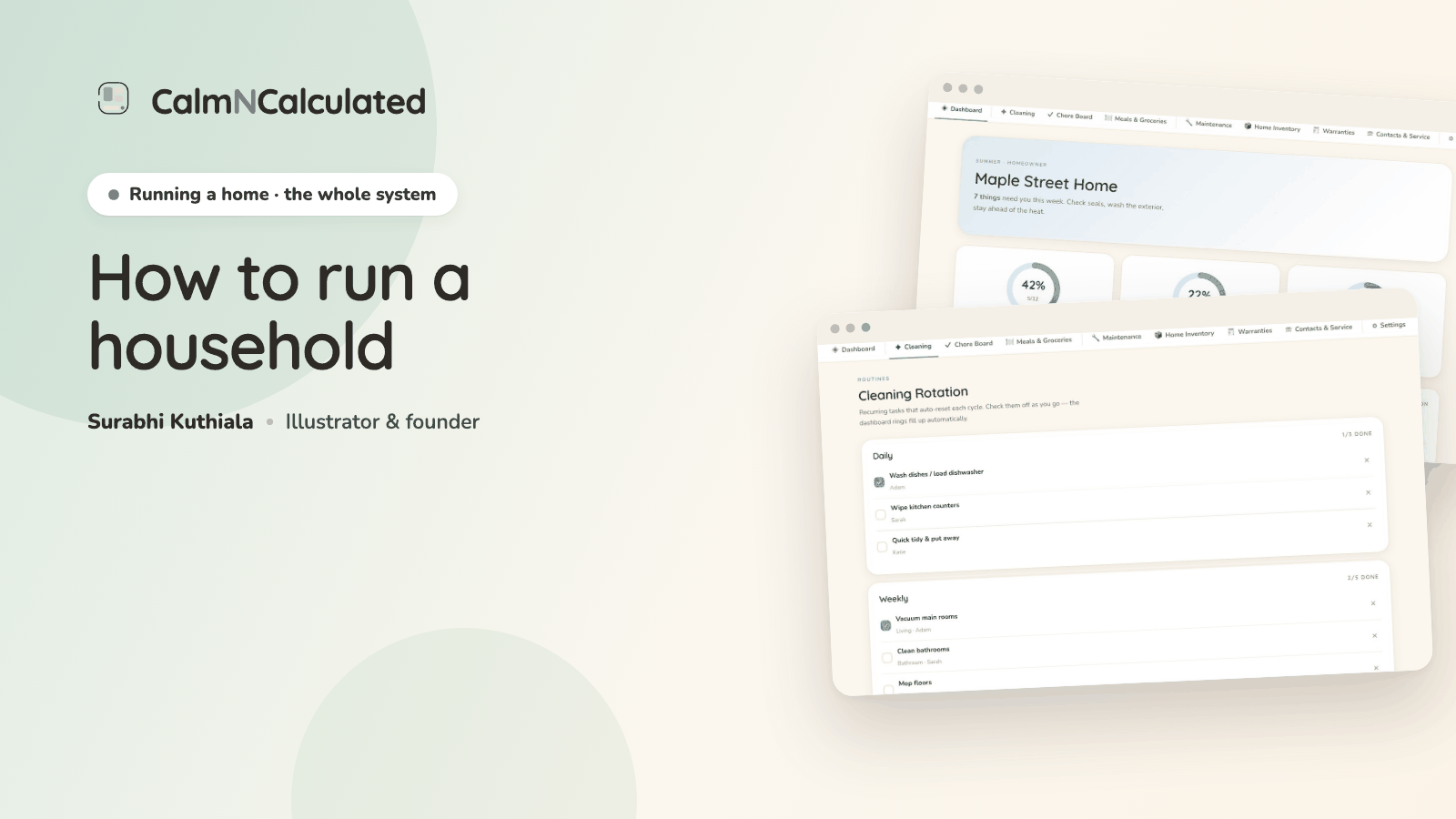
Organise a household by how often things happen, not by which room they happen in. Five bands: daily, weekly, monthly, seasonal and annual. The daily and weekly bands look after themselves because the mess is visible. The seasonal and annual bands are where houses actually go wrong, because nothing in the room reminds you.
Running a home is not one job. It is about forty small recurring jobs that mostly nobody assigned to anybody, arriving at completely different frequencies, and the whole schedule usually lives in a single person's head.
That last part is the bit worth staring at, because it is the actual problem and it is almost never described as one.
Why does one person end up carrying it all?
Because the schedule is stored in a head rather than in a place, and the head it is stored in becomes the only place anyone can query.
This is what people mean by mental load, and framing it as a storage problem is more useful than framing it as a fairness problem — not because fairness does not matter, but because storage is fixable in an afternoon. If the only way to find out whether the bins go out tonight, whether the filter has been changed, or what is for dinner on Thursday is to ask one specific person, then that person is doing an unpaid full-time job as a database. They will still be doing it however evenly you divide the actual chores.
Splitting the tasks does not split the load. The load is being the only copy of the schedule, and you only fix that by writing it down somewhere everyone can read.
The test is simple and slightly uncomfortable. If that person went away for a fortnight without their phone, what would stop happening? Whatever the answer is, that is the list which needs to exist outside their head.
Why organise by frequency instead of by room?
Because rooms are how you clean, and frequency is how you forget.
Nearly every household system I have seen is arranged by room — the kitchen list, the bathroom list — which is sensible when you are standing in the room with a cloth. It is useless for the things that go wrong, because those are almost never daily jobs. Nobody forgets to wash up. People forget the annual things: the boiler service, the gutters, the smoke alarm batteries, the insurance renewal, the filter that should have been changed in March.
| Band | Examples | How it fails |
|---|---|---|
| Daily | Dishes · surfaces · post · a fifteen-minute reset before bed | Rarely fails. The mess is visible and someone will do it. |
| Weekly | Floors · bathrooms · laundry · bins · the shop | Fails only when nobody owns it. Fixed by assigning, not by reminding. |
| Monthly | Fridge out · under furniture · appliance filters · a look at what is running low | Slips quietly. Nothing looks wrong for a while, and then several things do. |
| Seasonal | Gutters · heating checked before it is needed · outside taps · garden · wardrobes swapped | Remembered late — usually on the first cold night, which is the worst moment to discover it. |
| Annual | Boiler service · alarms tested · insurance and warranties · chimney · deep clean · meter and appliance records | The expensive band. Missing these turns a small maintenance job into a repair. |
The two bottom rows are the whole argument. They are cheap, quick and dull, they have no natural trigger, and skipping them is what turns a serviceable boiler into a replaced boiler.
How do you share the work without nagging?
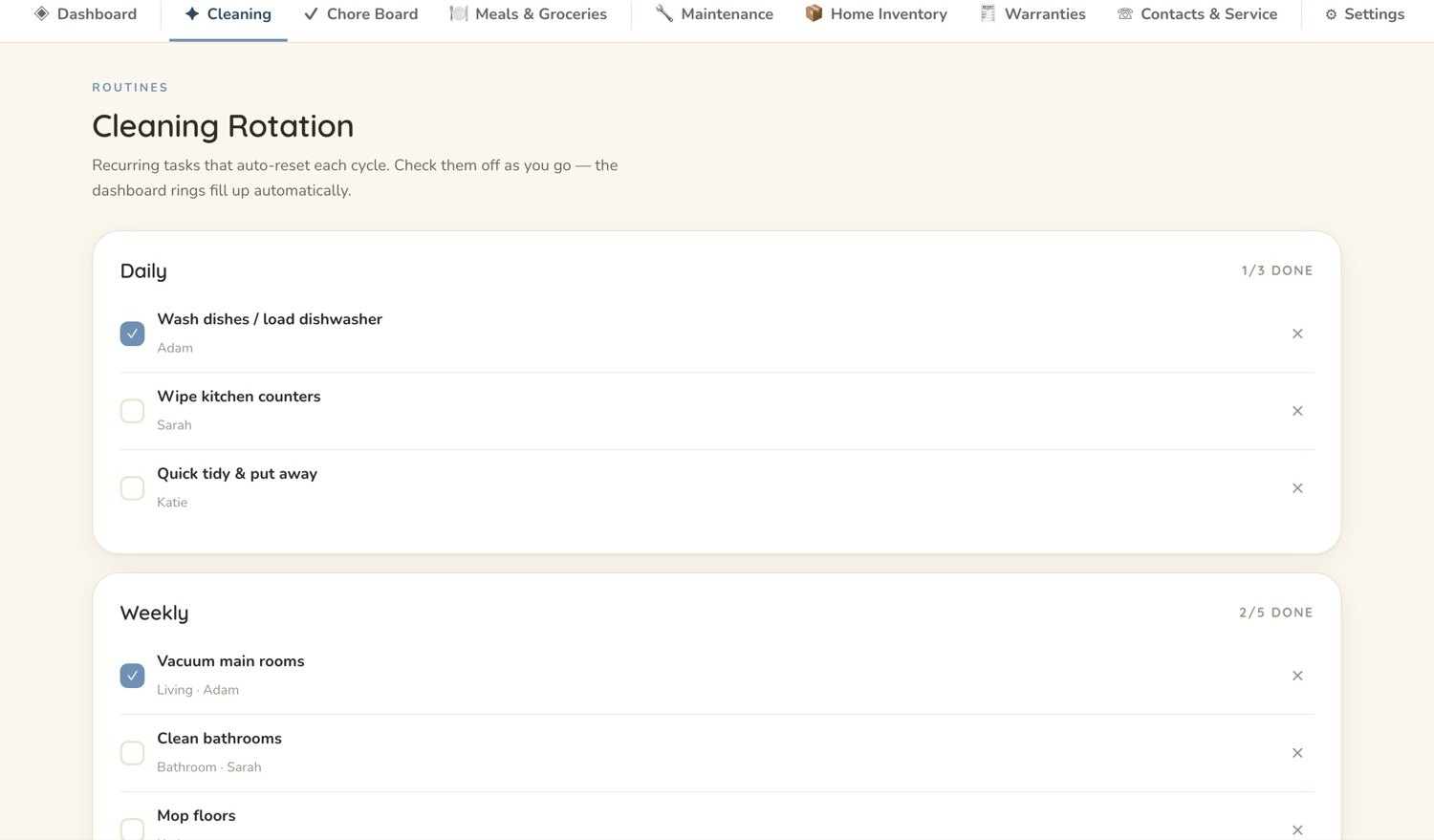
Assign by task, not by request. The difference is that a named owner is a fact and a request is an interruption, and only one of those needs repeating every week.
Three things that help, none of which are about effort:
- Give each recurring job one owner. Not "we should keep on top of the recycling" but a name against the job. Shared responsibility for a small task reliably means nobody's.
- Let children own whole jobs, badly. A job done to seventy per cent by somebody else is a job off the list. Redoing it teaches everyone that it was never really theirs.
- Write down the invisible ones. Booking things, remembering birthdays, knowing what size shoes everyone takes, noticing that the shampoo is nearly out. This is the real content of mental load and it is not on any chore chart ever printed.
What about meals?
Meal planning is the highest-return household habit there is, and the reason is not the cooking. It is that a week of meals decided in advance removes five separate decisions taken at six in the evening by someone who is tired and hungry, which is when the expensive choices get made.
The mechanism that makes it stick is joining the plan to the shopping list. Plan the meals, and let the list come out of the plan rather than being written separately from memory. When those are two documents, the plan survives about a fortnight — you shop for the plan, half of it is missing, and by Thursday you are improvising anyway.
Six planned meals a week is plenty. Leave one deliberately blank for leftovers or for the evening that goes wrong, because it always does, and a plan with no slack breaks at the first contact with a real week.
What is worth recording once and keeping?
The house facts, which almost nobody writes down and everybody hunts for.
Paint colours and codes. Appliance models and their serial numbers. When the boiler was last serviced and by whom. Which plumber was good and which was not. Warranty end dates. Filter sizes. Where the stopcock is. Meter numbers.
Each of these takes ten seconds to record at the moment you learn it and about forty-five minutes to reconstruct two years later, usually at the worst possible time. This is the quietest and highest-return part of running a home, and it is not really housework at all — it is keeping the manual for a machine you happen to live in.
Where the planner fits
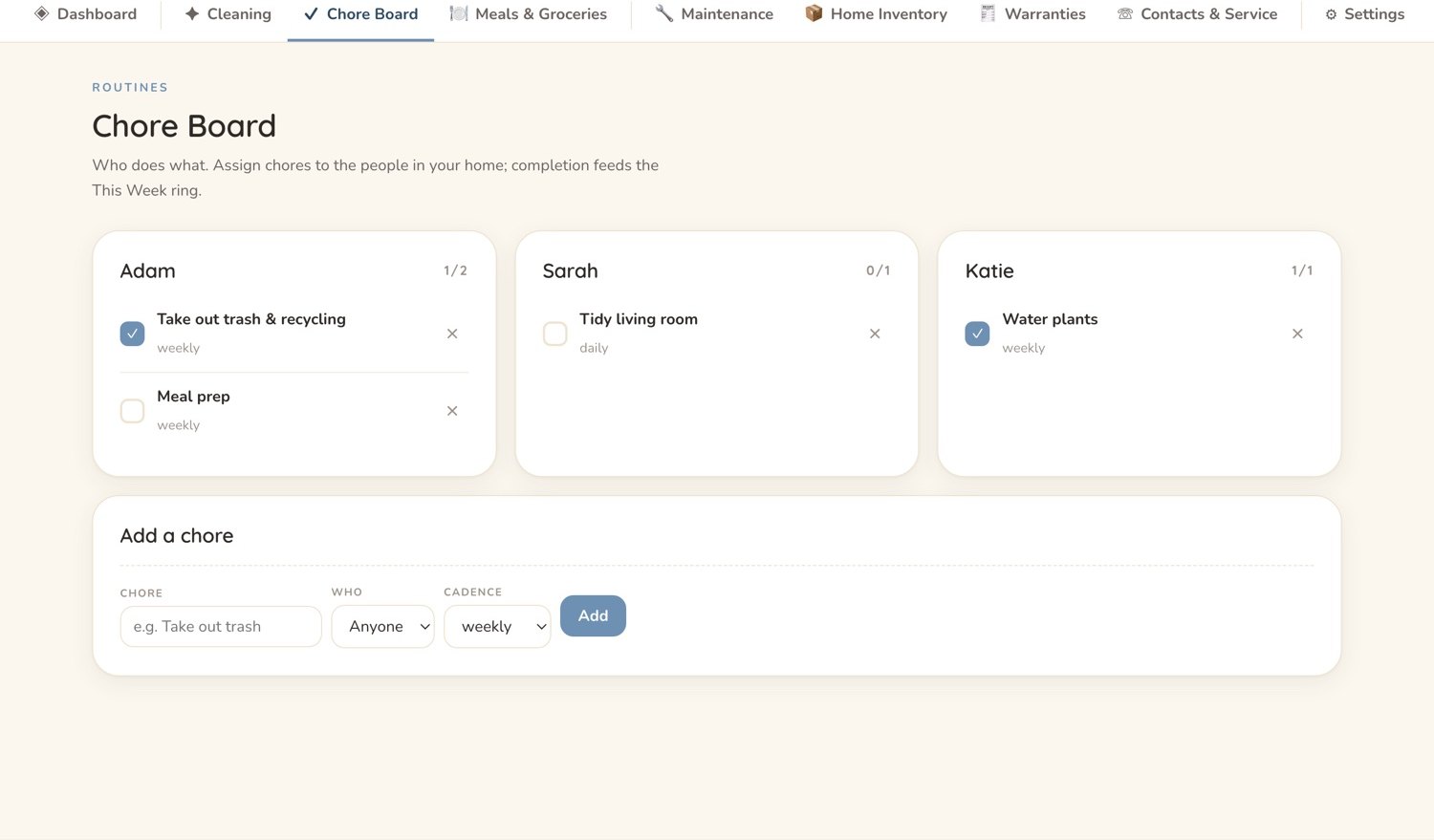
All of this works on a whiteboard in the kitchen, and a whiteboard has the great advantage of being unavoidable. The Home Management Planner exists because of the frequency problem — it holds all five bands in one file, so the annual jobs are in the same place as the weekly ones instead of nowhere. There are eight sections, covering cleaning, a chore board, meals and groceries, seasonal maintenance, a home inventory, warranties and service contacts, and it runs in your browser with nothing to install and no account to make. You can try the whole thing free first.
If you are setting a household up rather than running one, the first weeks have their own order and that is covered in how to plan a house move, with the Moving Planner alongside it. And the household spending that all of this generates is an ordinary budgeting problem — how to make a budget that survives the month covers the mechanism.
Common questions
How do you organise household chores?
By how often they happen rather than by which room they are in. Five bands work well: daily, weekly, monthly, seasonal and annual. Rooms are how you clean, but frequency is how you forget — nobody forgets the washing up, and everybody forgets the boiler service.
What is mental load and how do you actually reduce it?
It is being the only copy of the household schedule. If the only way to find out whether the bins go out tonight is to ask one particular person, that person is working as a database, and dividing the chores evenly does not change it. The fix is writing the schedule somewhere everyone can read.
What household jobs are most often forgotten?
The seasonal and annual ones — gutters, the boiler service, alarm batteries, filters, insurance renewals. They are cheap, quick and dull, they have no natural trigger, and skipping them is what turns a maintenance job into a repair.
How do you share chores without nagging?
Put one name against each recurring job rather than agreeing to keep on top of things together. A named owner is a fact; a request is an interruption, and only one of them needs repeating every week. Shared responsibility for a small task reliably means nobody's.
Does meal planning actually help?
Yes, and mostly not because of the cooking. A week decided in advance removes five separate decisions taken at six in the evening by someone tired and hungry, which is when the expensive choices get made. Plan six meals rather than seven and let the shopping list come out of the plan rather than being written separately.
What is worth writing down about a house?
Paint colours and codes, appliance models and serial numbers, when the boiler was last serviced and by whom, warranty dates, filter sizes, meter numbers, where the stopcock is, and which tradespeople were good. Ten seconds to record, and about forty-five minutes to reconstruct two years later.
Try the Home Management Planner
Cleaning, chores, meals and groceries, seasonal maintenance, a home inventory, warranties and service contacts — as a browser app, an Excel and Google Sheets workbook, or a printable pack. Nothing to install, no account to create.
Open the planner