
Work backwards from moving day in four blocks. Eight weeks out: confirm the date, get quotes, start decluttering. Six weeks: gather supplies and begin packing rooms you barely use. Four weeks: address changes and utilities. The final fortnight: essentials only, and a box that travels with you rather than on the van.
Moving is the only major life event where the difficulty is almost entirely logistical. There is no ceremony to design and nobody to please. It is a volume problem with a deadline, and it still goes wrong for nearly everybody — which suggests the problem is not effort.
When we built the moving planner I had to lay the whole thing out as a sequence, and the sequence made something obvious that I had never seen written down anywhere. A move is two projects, not one. There is the leaving, and there is the arriving. Every moving checklist I have read is about the leaving.
What should you do, and when?
Here is the countdown on one page. Weeks are approximate and a move that is exchanging contracts runs to somebody else's calendar rather than yours — this is a shape to adapt.
| When | What this stretch is for | The things worth doing |
|---|---|---|
| 8 weeks out | Decisions, before anything is in a box. | Confirm the moving date · get two or three quotes, or book the van · start decluttering room by room · measure the big furniture against the new rooms |
| 6 weeks out | Starting to pack the things you will not miss. | Gather boxes and materials · pack the rooms you barely use · book time off · arrange care for children or pets on the day · start eating the freezer |
| 4 weeks out | The administrative half. This is the one that slips. | Notify every address change · schedule utilities off at the old place and on at the new · redirect post · transfer or cancel services · sort schools and registrations |
| 2 weeks out | Down to what you are using. | Pack everything but essentials · confirm the movers in writing · label by destination room · take meter readings and photograph them · pack the box that travels with you |
| The first week in | Arriving, which is a plan of its own. | Beds up first · find the stopcock and the fuse box · check the alarms · unpack the kitchen before anything decorative · register locally · meet whoever you need to meet |
Why does the paperwork always get left?
Because it is the only part of a move with no forcing function.
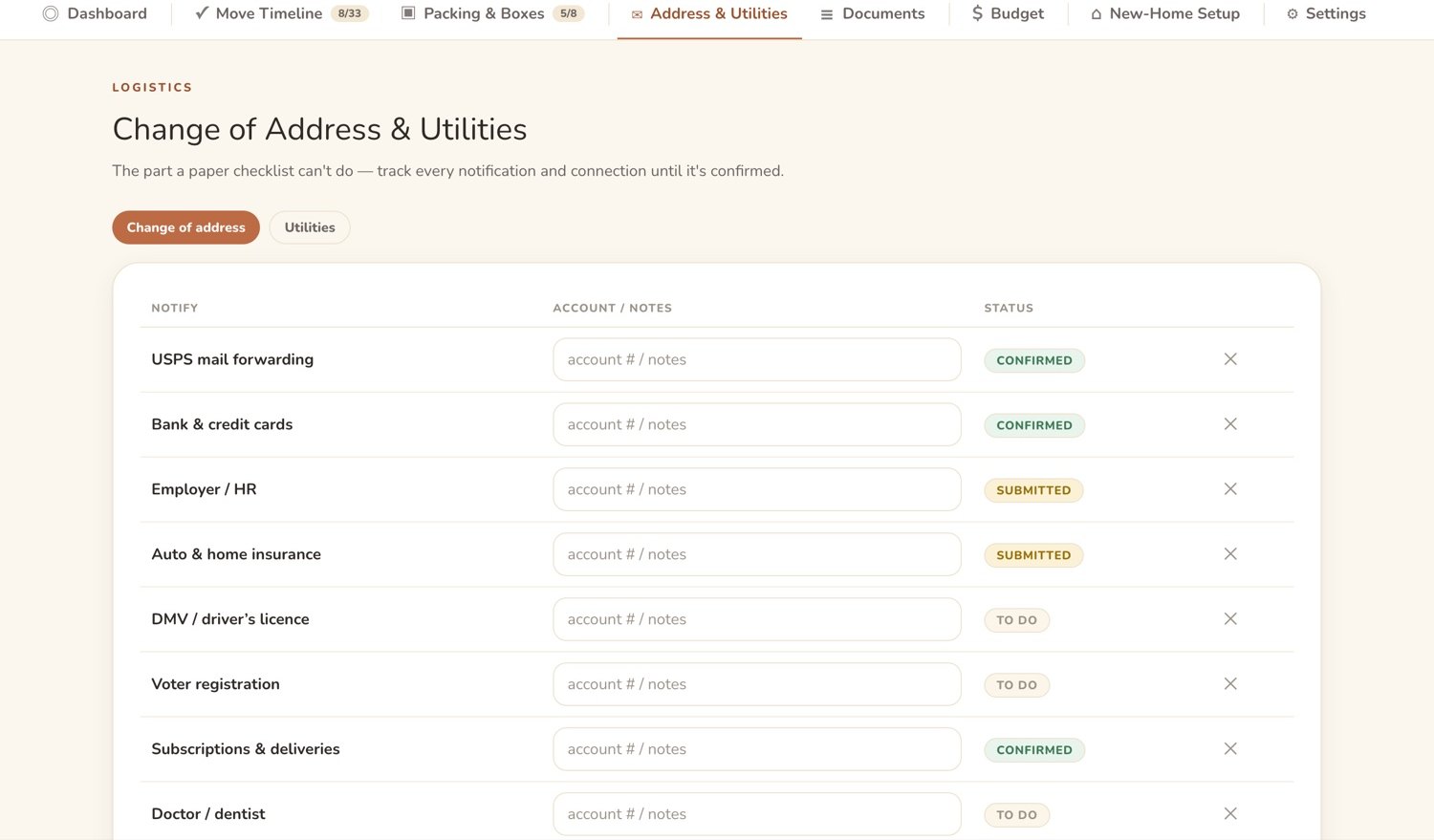
Everything else pushes back at you. Unpacked boxes are physically in the room. The van arrives whether you are ready or not. But nothing at all happens if you have not told your bank, your insurer, the licensing authority, the doctor's surgery, the vet or your employer — nothing happens for weeks, and then several things happen at once, usually as a letter that went to your old address about something with a deadline.
Every other part of a move has a deadline that shouts. The address changes have a deadline that whispers, and that is exactly why they are the part that goes wrong.
The fix is unglamorous: write the list once, early, and tick it as you go. It is usually twenty to thirty entries and it takes an hour spread over a fortnight. What it is not is a thing you can hold in your head, because the entries are unrelated to each other and there is no natural order to remember them in.
How should you pack and label boxes?
Label by where the box is going, not by where it came from. This sounds like a small distinction and it is the difference between unpacking and excavating.
A box marked "spare room" is telling you about a house you no longer live in. A box marked "kitchen — top cupboards" is an instruction to the person carrying it, and it means the box is put down in the right place once instead of moved twice. Movers will follow a destination label without being asked. They cannot follow a memory.
Three more things worth doing, all of which cost minutes and save hours:
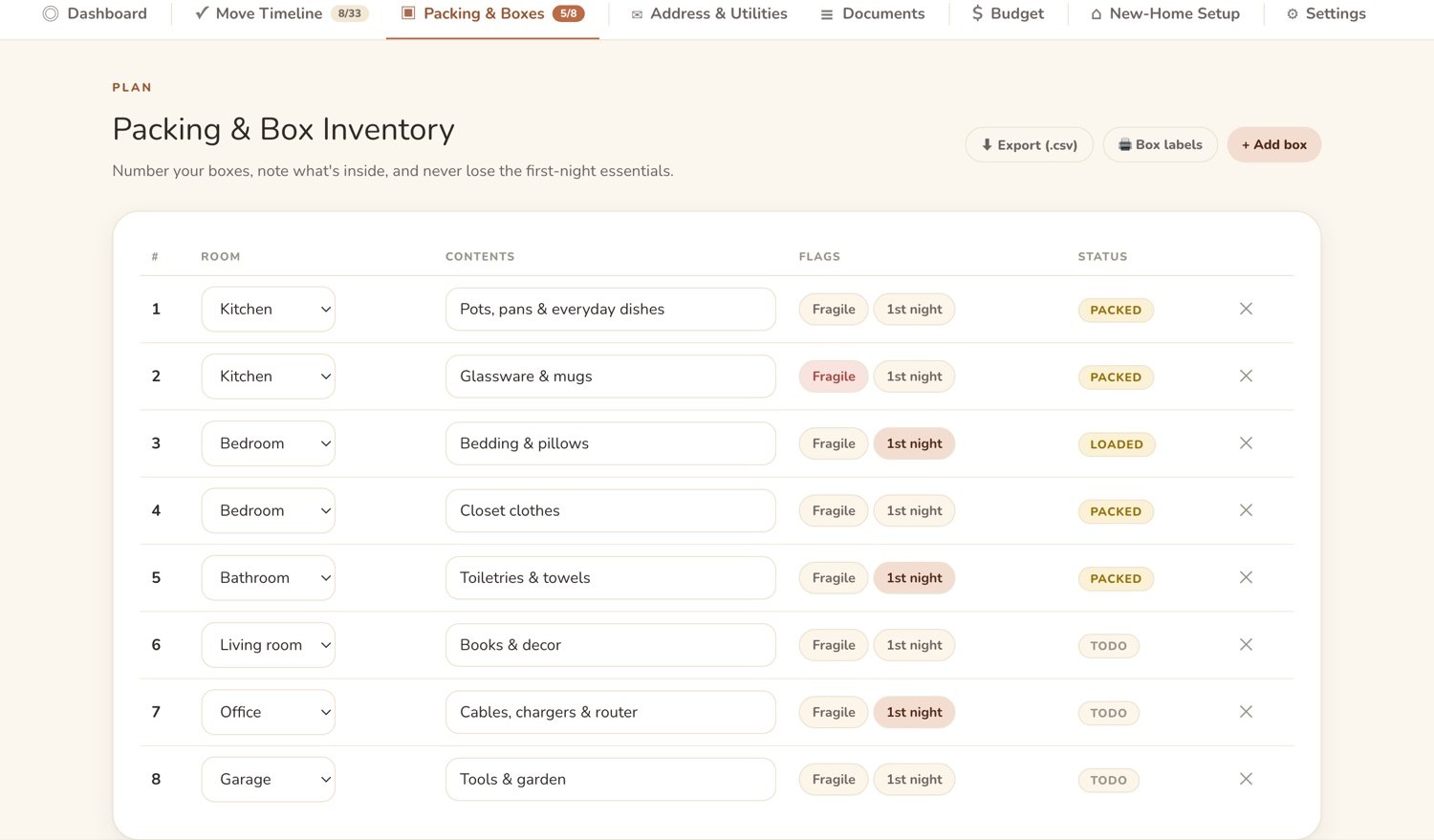
- Number the boxes and keep a list of what is in each. Not a full inventory — five words per box. It is the only way to answer "which box has the kettle in it" without opening nine of them.
- One box travels with you. Kettle, mugs, tea, toilet roll, soap, phone chargers, a knife, medication, a change of clothes, the paperwork. It does not go on the van.
- Photograph anything you have to reassemble before you take it apart, and tape the screws to the underside of the thing they came out of.
What does the arrival need?
Its own short plan, written before you are tired.
The first week in a new home has a natural order and almost nobody follows it, because by the time you get there nobody is capable of deciding anything. So decide it in advance. Beds assembled first, because the day ends whether you are ready or not. Then the kitchen — a working kettle and one clean surface improves everything else. Then bathrooms. Everything decorative comes last and can wait weeks without harm.
Alongside that: find the stopcock, the fuse box and the meter, and test the smoke alarms. Not because anything is likely to go wrong on the first night, but because looking for a stopcock for the first time in an emergency, in an unfamiliar house, is a genuinely bad experience.
What does a move actually cost?
More than the quote, and the gap is fairly predictable. The removal firm is the visible number. The invisible ones are packing materials, cleaning at both ends, any overlap where you are paying for two places, connection fees, a locksmith, the first shop for a kitchen with nothing in it, and the two or three things that turn out not to fit and have to be replaced.
None of these are large on their own. Together they are frequently a third of the quoted figure again, and they are what makes a move feel more expensive than it was supposed to be. Write them down as their own lines before the move rather than discovering them one at a time afterwards.
Where the planner fits
All of this works on paper, and a taped-up list on the kitchen wall is a perfectly good system. The Moving Planner exists because of the two halves — it holds the leaving and the arriving in one file, so the change-of-address list, the packing, the budget and the first-week-in checklist are not four separate documents that stop agreeing with each other. There are seven sections and it runs in your browser with nothing to install and no account to make. You can try the whole thing free first.
Once you are in and the boxes are gone, the job changes into an ongoing one — cleaning rotas, maintenance, what needs doing seasonally — and that is what the Home Management Planner is for. If the cost of the move is the part worrying you, the mechanism in how to make a budget that survives the month applies directly, and the Budget Planner handles the household side.
Common questions
How far in advance should you start planning a move?
About eight weeks for a straightforward move. That gives you time to get quotes, declutter before anything is packed, and spread the address changes out. If your date depends on a sale or a chain, plan the work in the same order but expect the date itself to move — the sequence still holds.
What is the most commonly forgotten part of moving house?
The change-of-address list. It is the only part of a move with no forcing function: unpacked boxes are physically in the room and the van arrives regardless, but nothing at all happens if you have not told your bank, your insurer or your doctor. Nothing happens for weeks, and then several things happen at once.
How should you label moving boxes?
By where the box is going, not where it came from. A box marked “spare room” describes a house you no longer live in. A box marked “kitchen — top cupboards” is an instruction, and it means the box is put down in the right place once instead of moved twice. Number the boxes too, with five words about the contents.
What should be in the box that travels with you?
Kettle, mugs, tea or coffee, toilet roll, soap, phone chargers, a knife, any medication, a change of clothes and the paperwork. It should not go on the van. The first evening in a new house is much better with a working kettle and much worse without one.
What should you unpack first in a new home?
Beds, then the kitchen, then bathrooms. Everything decorative can wait weeks without harm. Also find the stopcock, the fuse box and the meter, and test the smoke alarms — not because anything is likely to go wrong, but because hunting for a stopcock for the first time during an emergency is a bad experience.
What does moving actually cost beyond the quote?
Packing materials, cleaning at both ends, any overlap where you pay for two places, connection fees, a locksmith, the first shop for an empty kitchen, and the two or three things that turn out not to fit. Individually small, and together often around a third of the quoted figure again.
Try the Moving Planner
The timeline, the packing list, the change-of-address checklist, the budget and a first-week plan for the new place — one file, in your browser, no account to create.
Open the planner