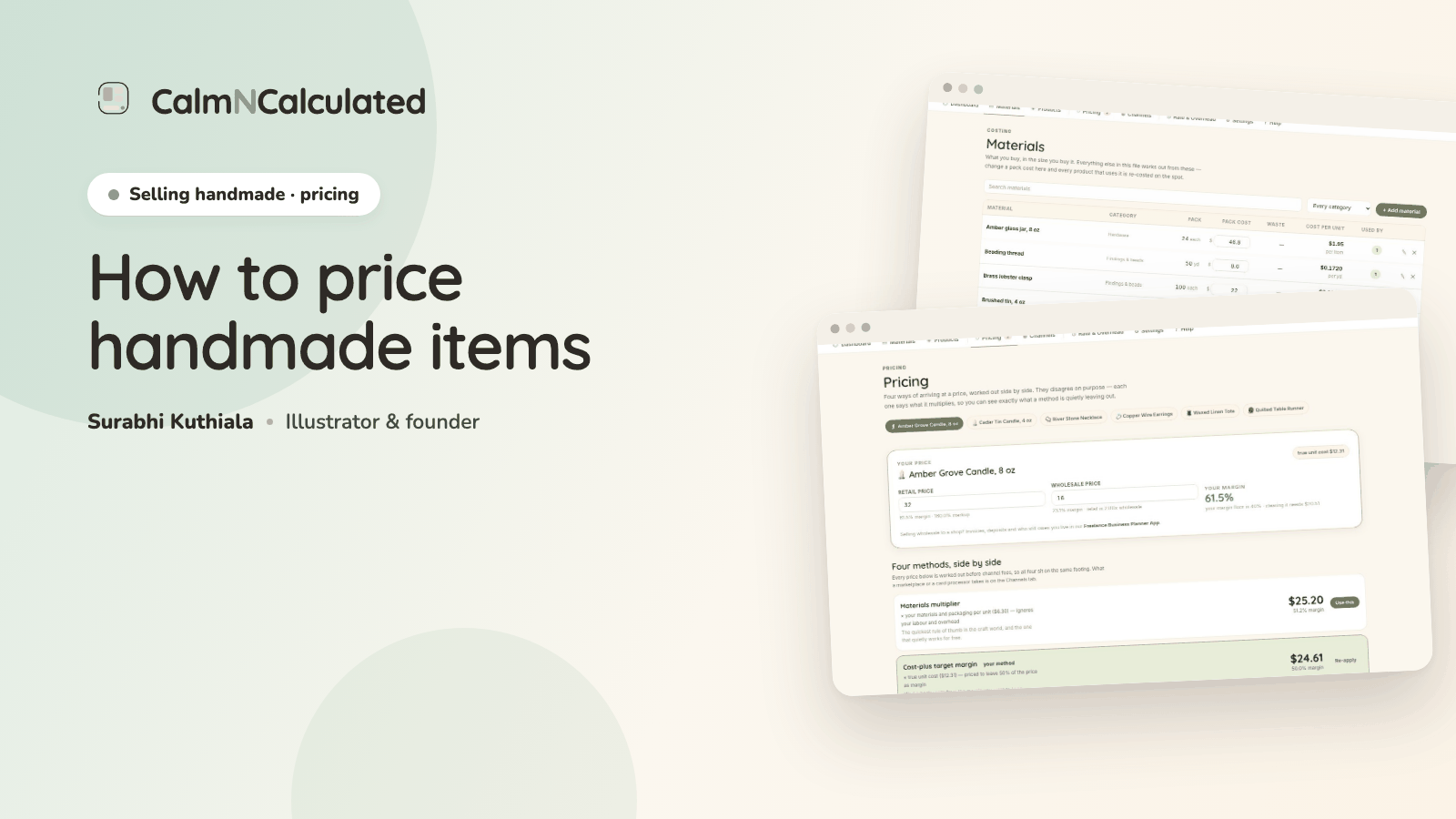
Work out the true cost of one sellable item first: materials, packaging, your time at a real hourly rate and a share of overhead, divided by the items you can actually sell rather than the items you made. Then set a price that leaves a margin on top, and check what still lands in your hands after each channel's fees.
I have sold my own illustrations on Etsy since 2015, and pricing is the part of selling that never quite feels finished. Most of the advice I have read starts with a formula. I think it should start with the cost, because every formula is only as honest as the number you feed it.
When we built the Craft Pricing Calculator I had to lay out how a handmade cost is put together, step by step, and the step that matters most is not the one people argue about. It is a division.
- Pack priceBecomes a cost per gram, per metre or per piece.
- Batch costMaterials, packaging and your minutes at a real rate.
- Divide by sellable itemsNot by the items you made.
- Add overheadWhat the business costs to exist.
- Price for a marginPrice = cost ÷ (1 − margin).
- Check after feesWhat lands, per channel.
What does the price of a handmade item need to cover?
Seven things. Most underpricing comes from leaving out one of the middle rows, not from choosing the wrong formula.
| Cost | What it is | How it gets left out |
|---|---|---|
| Materials | What one item uses, worked out from the pack price. | Rarely left out, but often guessed rather than measured. |
| Packaging | Box, tissue, label, card, tape. | Treated as a business expense that no product carries. |
| Waste | The items that crack, smudge or come out wrong. | The batch is divided by the items made, not the items sold. |
| Your time | Minutes per item at a real hourly rate. | Priced at zero, or at a rate picked to make the price feel comfortable. |
| Overhead | What the business costs to exist: space, tools wearing out, software, stall fees. | Left out entirely, because none of it belongs to any one item. |
| Margin | What the business keeps after every cost is paid. | Confused with markup, so it comes out smaller than intended. |
| Fees | What each place you sell takes from the price. | Taken off the sticker price after the price was set. |
Why divide by the items you can sell, not the items you make?
Because the ones you cannot sell still cost you, and the only place that cost can go is into the ones you can.
If a batch of twenty candles reliably gives you eighteen you would put your name to, the batch cost divides by eighteen. This is ordinary cost accounting rather than craft folklore — the expected spoilage in a process is carried by the good units. It moves the number more than people expect. Unit cost rises by one divided by your yield, so a 90% yield adds about 11% to the cost of every item, and an 80% yield adds 25%.
Offcuts are the same problem in a different shape. A metre of fabric that cuts three pieces costs a third of a metre per piece, not the area of the piece.
The candle that cracked is not a loss you absorb. It is a cost the other eighteen candles carry.
What hourly rate should you pay yourself?
Build it backwards from what you need to earn in a year, the weeks you actually work, and the hours a week you genuinely spend making — not answering messages, not at markets, not photographing and listing.
That last number is usually smaller than people think, which is why an honest rate usually comes out higher than a comfortable one. The calculator starts every new file at $25 an hour and keeps flagging it on the dashboard until you replace it, because minutes priced at a made-up rate are not really priced at all.
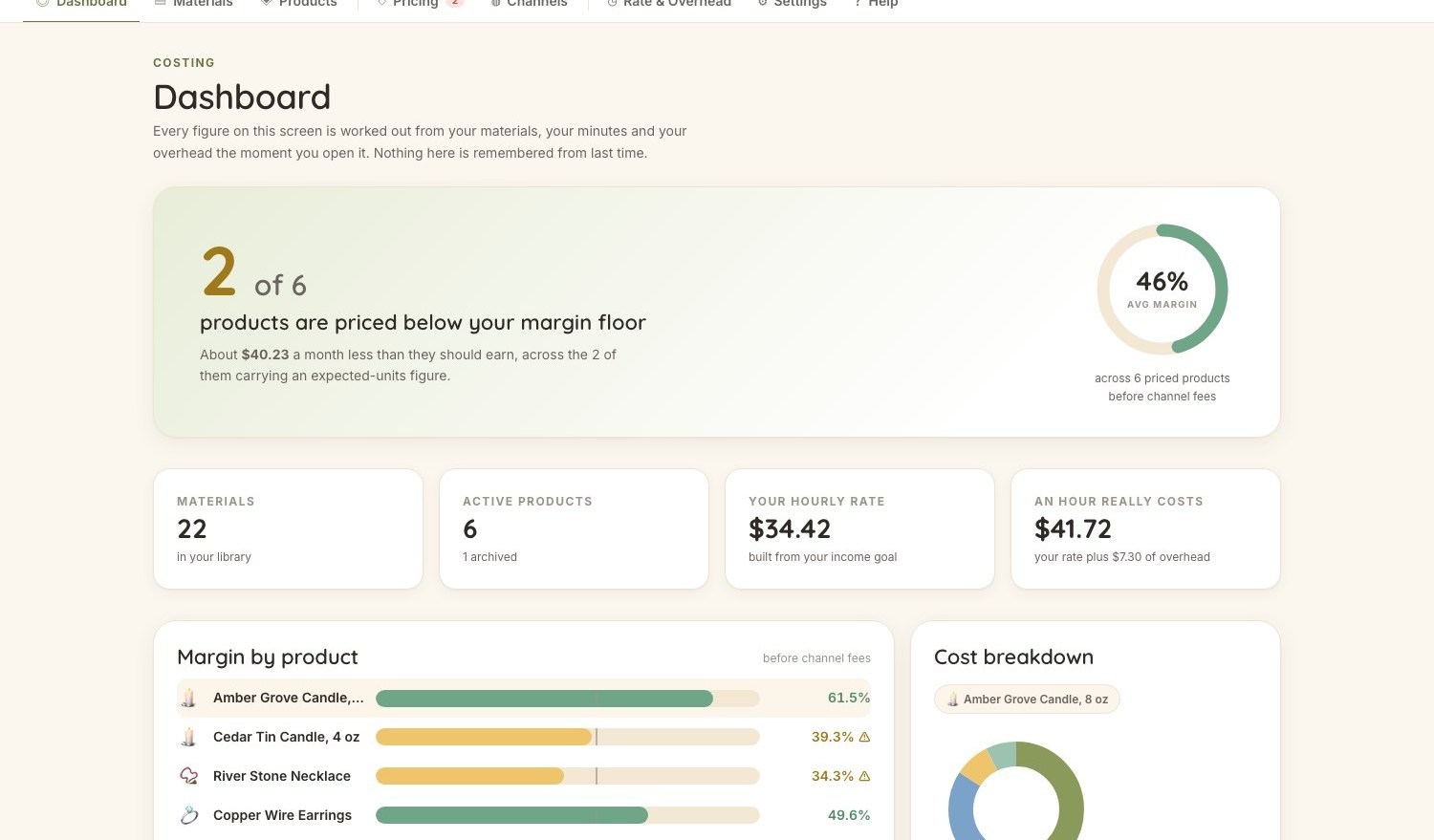
Then add overhead. Your rent, your tools wearing out and your software cost the same whether you sell this month or not, so they have to be spread across your working hours. In the app's sample data a $34.42 hourly rate becomes $41.72 once overhead is added. That second figure is what an hour of your work really costs the business.
Which pricing formula should you use for handmade items?
Look at more than one. They disagree on purpose, and the gap between them tells you what each one is leaving out.
| Method | How it works | What to watch |
|---|---|---|
| Materials multiplier | Materials and packaging per item, times a multiplier. | Quick, but it ignores your time and your overhead completely. |
| Cost-plus target margin | True unit cost, priced so a chosen share of the price is margin. | Only as good as the true cost underneath it. |
| Hourly-rate recovery | True unit cost, which already pays your rate, plus a markup for the business. | Pays you, then the business. Easy to set the markup too low. |
| Keystone | Cost times two for wholesale, and times two again for retail. | The two doublings compound to four times cost. |
My preference is to see all four side by side for the same item. The distance between the materials multiplier and the other three is exactly the labour and overhead it ignores, and seeing that distance in money is more persuasive than any argument about it.
What is the difference between margin and markup?
Markup is measured against the cost. Margin is measured against the price. The same item has a bigger markup than margin, always.
An item that costs $10 and sells for $20 has a 100% markup and a 50% margin. Margin equals markup divided by one plus markup. Going the other way, if you want a given margin, the price is the cost divided by one minus that margin. The confusion matters because someone who adds "50%" to their cost, meaning margin, ends up with a margin of only a third.
It helps to pick a margin floor — the lowest margin you will accept on anything — and check every product against it. The calculator starts that floor at 40%, and you can change it.
How do selling fees change your price?
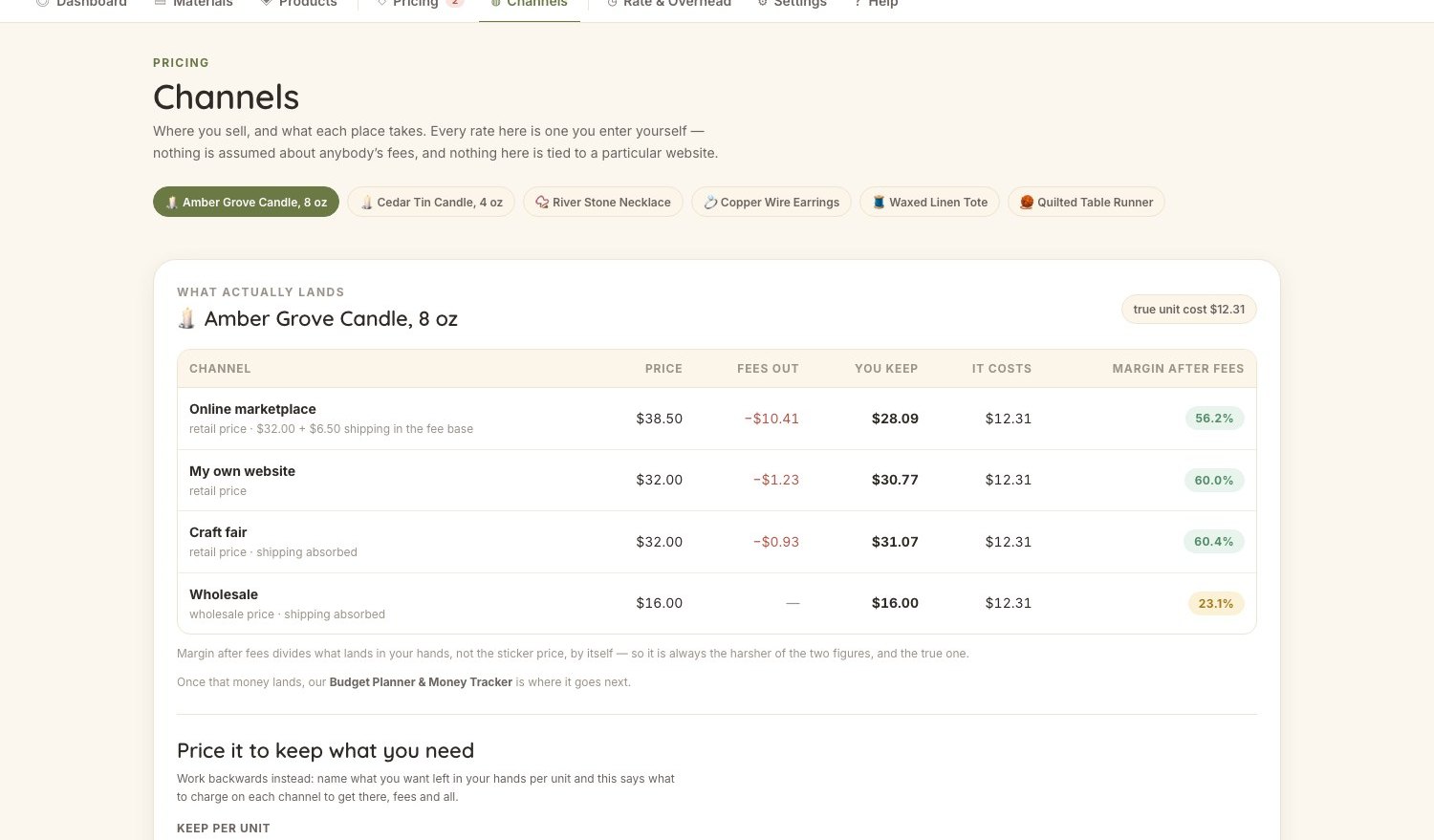
They come off the price, not the cost, so they hit harder than they look. Judge each channel by what actually lands in your hands.
A marketplace, your own website, a craft fair and a wholesale order each take a different slice, and the same $32 item can leave you a very different amount from each. The honest measure is margin after fees: what lands, minus the true cost, divided by the sticker price. Or work backwards — decide what you need to keep per item and price each channel to get there. Fee rates change, so enter your own rather than trusting a number from a blog post, including this one.
Where the calculator fits
A careful spreadsheet can do every step here. The Craft Pricing Calculator exists because the steps depend on each other — change the price of one pack of wax and every candle that uses it is re-costed, re-priced and re-checked against your margin floor and each channel's fees on the spot. It runs in your browser with nothing to install and no account to make, and you can try it free with sample data first.
If you also take commissions or freelance work, keeping track of those clients and invoices is covered in how to manage freelance clients and get paid. And once the money lands, the Budget Planner and how to make a budget that survives the month pick it up from there.
Common questions
How do you calculate the price of a handmade item?
Add up the true cost of one sellable item — materials, packaging, your time at a real hourly rate and a share of overhead — dividing batch costs by the items you can actually sell. Then price it to leave a margin on top, and check what is left after each channel's fees.
Why divide by sellable items instead of items made?
Because the items that fail still cost you, and their cost has to be carried by the ones you sell. Unit cost rises by one divided by your yield: a 90% yield adds about 11% to every item, and an 80% yield adds 25%.
What hourly rate should a maker charge?
Build it from what you need to earn in a year, the weeks you work, and the hours a week you genuinely spend making rather than on admin, markets or listing. Then add overhead per hour. The result is usually higher than a rate picked because it feels comfortable.
What is the keystone pricing method?
Cost times two for the wholesale price, and that wholesale price times two again for retail. The two doublings compound, so retail ends up at four times cost. It only works if the cost underneath it includes your time and overhead.
What is the difference between margin and markup?
Markup is measured against cost, margin against price. An item costing $10 and selling for $20 has a 100% markup and a 50% margin. Margin equals markup divided by one plus markup, so adding 50% to cost gives a margin of only a third.
Should selling fees be included in a handmade price?
Yes, and per channel. Fees come off the price, so the same item leaves you a different amount on a marketplace, your own website, at a fair or wholesale. Judge each one by margin after fees, using fee rates you have checked yourself, since they change.
Try the Craft Pricing Calculator
Materials, recipes, your hourly rate, overhead, four pricing methods and what each channel leaves you — an app in your browser, plus a workbook and printable pack, no account to create.
Open the planner