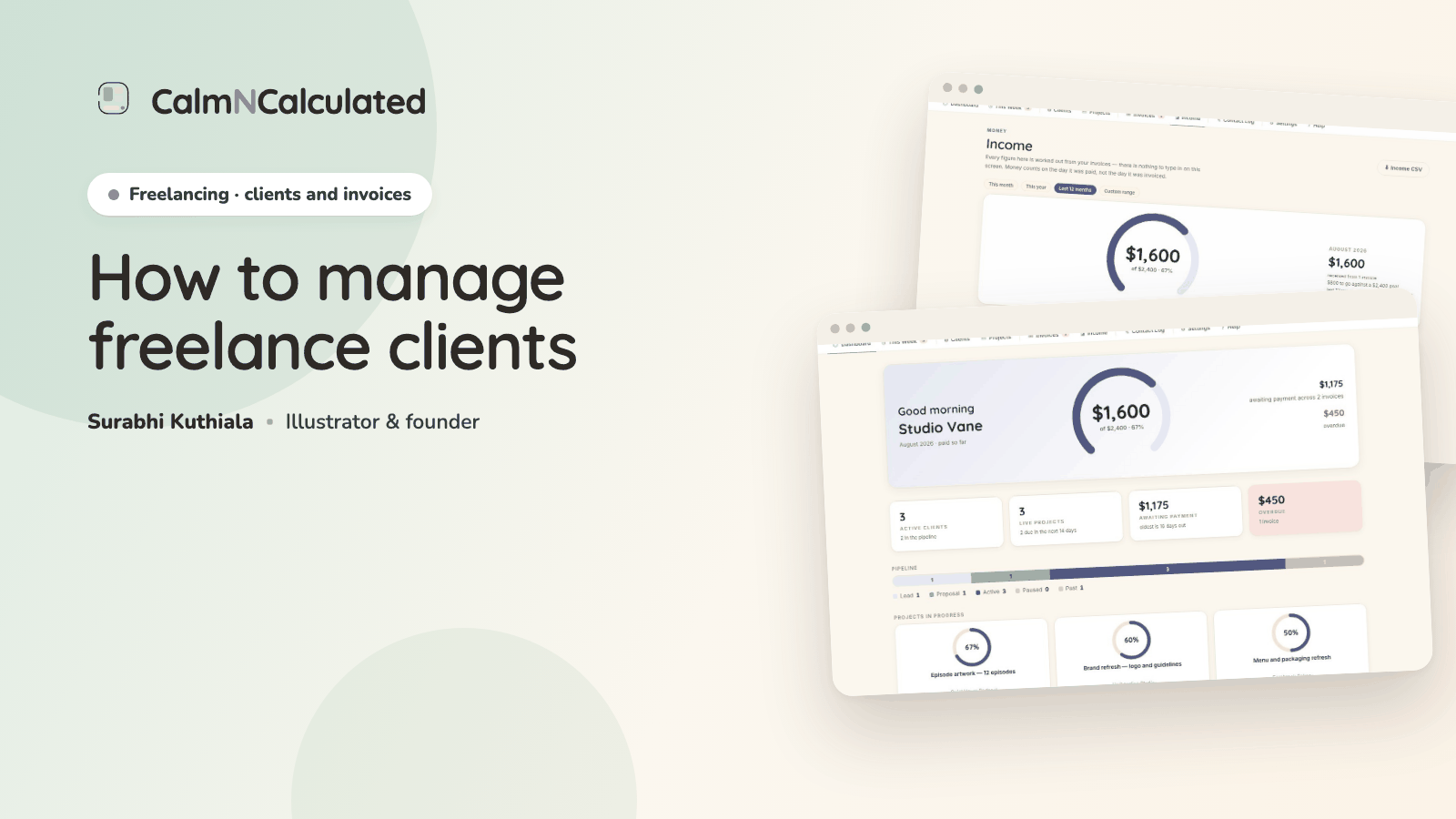
Keep one record per client and run three lists off it: the work you owe them, the invoices they owe you, and the follow-ups you promised. Put a short, stated due date on every invoice. Send one plain reminder before the money is due, not several after it. Count income on the day it lands, not the day you invoice.
I still work freelance as an illustrator, alongside the shops. So this is one guide where I am writing about my own kind of week rather than somebody else's.
When we built the Freelance Client Planner I had to describe a freelancer's week to a computer, and it turned out to be three lists that do not know about each other. Projects have milestones. Invoices have due dates. Conversations have follow-ups. Each one usually lives somewhere different — a project board, a spreadsheet, an inbox — and the thing that goes wrong is almost never on one list. It is in the gap between them.
- Work you owe: milestonesHow it slips: Slips quietly, because nothing announces it.
- Money you are owed: invoicesHow it slips: Sent, then forgotten until the month feels short.
- Things you promised: follow-upsHow it slips: Still in your head on Monday.
- Money that arrived: incomeHow it slips: Counted at invoice, not on the day it lands.
What does a freelancer actually need to track?
Five things, and all of them hang off the client. That is the structural point: the client who is waiting on your next draft is very often the same client who owes you for the last one, and you want to know that before you write the cheerful email, not after.
| Record | The question it answers | How it usually goes wrong |
|---|---|---|
| Clients | Who is a lead, who has a proposal, who is active, who has gone quiet. | Leads are never written down, so they are never followed up. |
| Projects | What is due, by when, and how far along it is. | Milestones slip quietly because nothing announces them. |
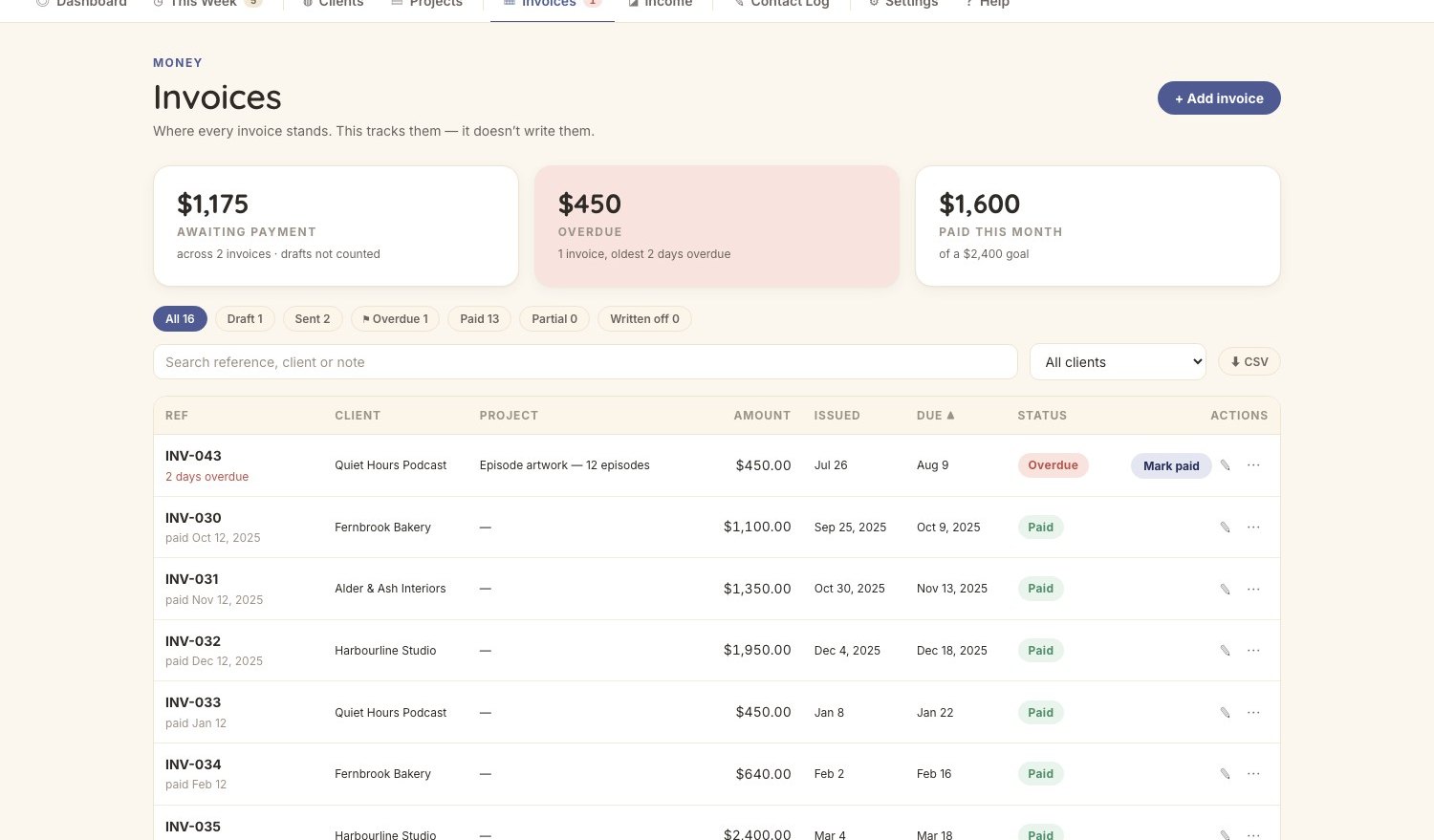
| Invoices | Who owes what, and since when. | An invoice is sent and then forgotten until the month feels short. |
| Follow-ups | What you said you would do next, and when. | The nudge you meant to send on Thursday is still in your head on Monday. |
| Income | What actually arrived this month. | It gets counted when you invoice, which makes every month look better than it was. |
Why do freelance invoices get paid late?
Mostly because late is normal. It is the ordinary state of small-business invoicing rather than a sign that you did something wrong.
Xero's small-business data for the December 2025 quarter put the average payment at 7.8 days late in the United States and 8.0 in the United Kingdom — and that was a good quarter by the series' own standards. Intuit's 2026 late-payments report found 59% of small businesses carrying invoices more than 30 days overdue, up from 47%. In the UK, half the businesses surveyed by the Federation of Small Businesses described late payment as an inevitable cost of doing business.
One honest caveat. All of those figures are about small businesses. I could not find anyone who measures freelancers on their own, so treat the numbers as the weather you are working in rather than a precise forecast. What they do settle is the tone: chasing an invoice is routine administration, and it is fine to treat it that way.
Being paid late is not a verdict on your work. It is the normal state of invoicing, and the useful question is what shortens it.
What can the invoice itself do to get paid faster?
State a short due date, plainly. That is the one finding with real size behind it.
FreshBooks looked at payment terms across more than a million small-business invoices. Invoices that said "7 days" were paid within a week 58% of the time, against 40% for invoices that said "30 days". Invoices that carried any stated term at all were paid more than 88% of the time, against about 79% across all invoices. A "thank you" on the invoice helped too, but only by a few points.
This is a correlation, not an experiment, so the careful way to say it is that invoices with a short, clear term were paid faster — not that the wording made anyone pay. People who write clear terms are probably also the people who invoice promptly. Either way, it costs nothing to be one of them.
When should you send a payment reminder?
Before the due date, once, and about the specific job.
The best-designed study I found is not about freelancers at all. The UK Behavioural Insights Team tested tax reminders on tens of thousands of people, and a letter sent ten days before the deadline lifted payment substantially. A reminder that referred to the person's own record beat a generic one, and the plain "here is how to pay" letter beat the one that leaned on what other people do. A separate study on savings found that extra reminders added on late did nothing.
The transfer from taxpayers to your clients is an argument, not a proof. But it points one way: a short note a few days before the due date, naming the project and the invoice number, with the payment details written out. Not a sequence of escalating chasers, and never a threat.
How should a freelancer count income?
On the day the money arrives. An invoice is a promise, and a month built out of promises is the month that surprises you.
Uneven income is not a personal failing either. The Federal Reserve's 2025 household survey found 58% of self-employed adults saying their income changed from month to month, against 28% of people with an employer. So a monthly goal is useful as a line on a chart, not as a test you pass or fail.
The behavioural research on money points at one habit: separate it into a named place when it arrives. That is where setting aside for tax belongs. How much to set aside is a question for an accountant where you live, and I am not going to guess at it here — the planner deliberately does not suggest a number either.
What does a good freelance week look like?
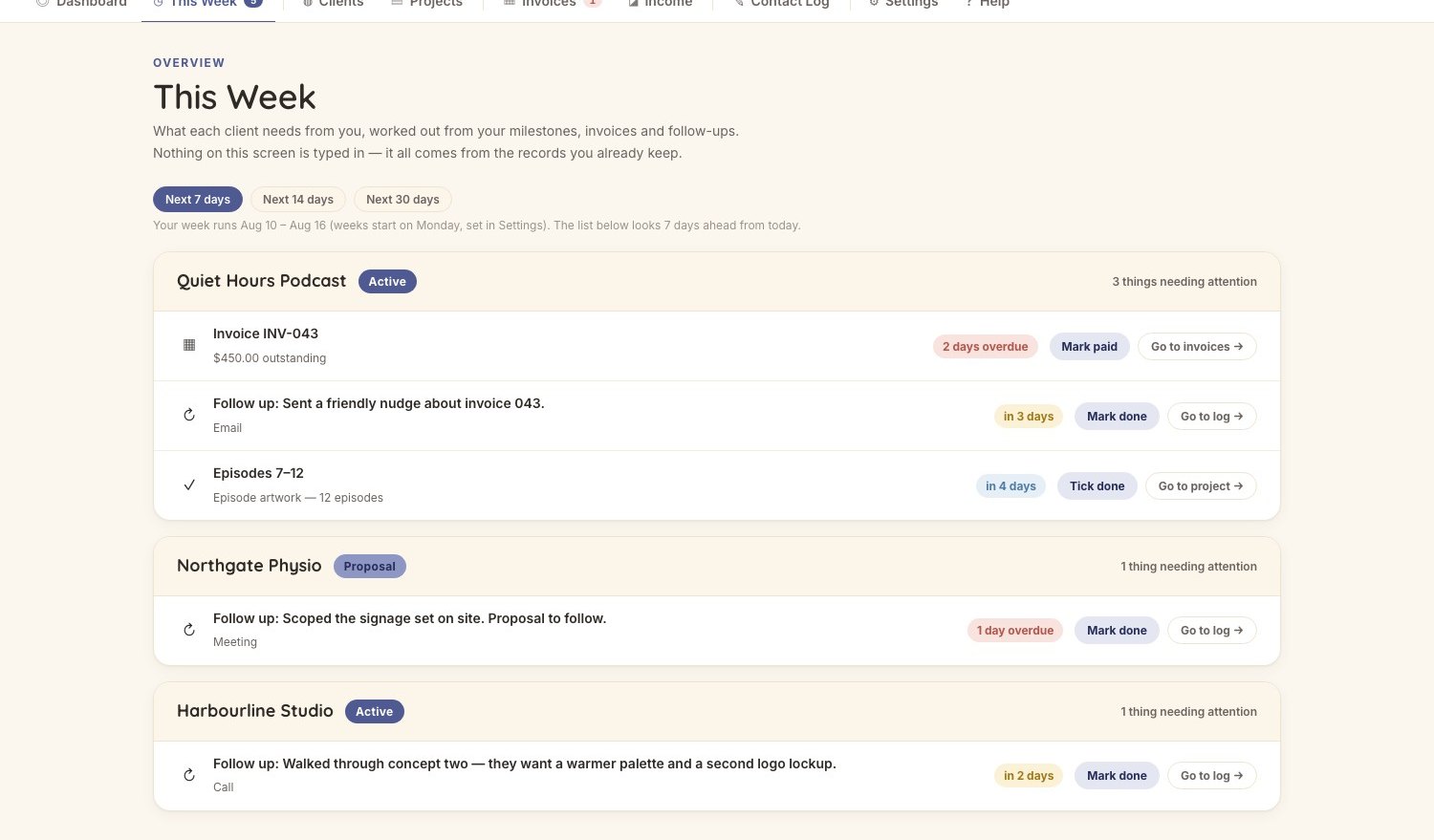
One short review that answers three questions: what do I owe, what am I owed, and what did I say I would do next.
That is the view we ended up building first, because it is the one the three separate lists can never give you. For each client it shows the milestone due this week, the invoice that is overdue and the follow-up you promised, side by side. Ten minutes on a Monday covers it. Criteria first: if your current system can answer those three questions in one place, keep it.
Where the planner fits
A spreadsheet with five tabs will do all of this if you keep it up. The Freelance Client Planner exists because of the gap between the lists — clients, projects, invoices, the contact log and income live in one file and feed one weekly view, so nothing has to be copied across. It tracks invoices rather than writing them, and it runs in your browser with nothing to install and no account to make. You can try it free with sample data first.
If what you sell is something you make by hand, the other half of the problem is the price, and how to price handmade items covers that. For the household side of an uneven income, the mechanism in how to make a budget that survives the month applies, and the Budget Planner holds it.
Common questions
What should a freelancer track for each client?
Five things: where the client is in your pipeline, the projects and their milestones, the invoices and their due dates, the follow-ups you have promised, and the income that has actually arrived. The useful part is keeping them together, because the client waiting on your work is often the client who owes you money.
Why do clients pay freelancers late?
Mostly because late payment is normal across small businesses. Xero's data for the December 2025 quarter put the average at 7.8 days late in the US and 8.0 in the UK, and Intuit's 2026 report found 59% of small businesses carrying invoices more than 30 days overdue. Those figures are for small businesses; nobody seems to measure freelancers separately.
What payment terms should go on a freelance invoice?
A short, clearly stated due date. In FreshBooks' analysis of more than a million invoices, those that said 7 days were paid within a week 58% of the time, against 40% for 30 days. It is a correlation rather than proof, but a clear short term costs nothing to write.
When should you send a payment reminder?
Before the due date rather than after it, and once. In a large UK trial on tax payments, a reminder sent ten days before the deadline lifted payment, and a reminder about the person's own record beat a generic one. Name the project and the invoice, and spell out how to pay.
Should freelance income be counted when you invoice or when you are paid?
When you are paid. An invoice is a promise, and counting promises makes every month look better than it was. Count money on the day it lands and compare that against your goal.
How much should a freelancer set aside for tax?
That depends on where you live and how your business is set up, so it is a question for an accountant. What the evidence does support is the habit: move the money into a separate, named place on the day it arrives, before it starts to look like spending money.
Try the Freelance Client Planner
Clients, projects, invoices, follow-ups and income in one place, with a This Week view that pulls them together — an app in your browser, plus a workbook and printable pack, no account to create.
Open the planner