Work backwards from the posting dates, not from Christmas Day. Set the total you will spend and divide it per person before you buy anything. Handmade and personalised gifts need ordering in October, cards and parcels posting in late November or early December, and food ordering weeks ahead. The day itself is the last deadline, not the first.
Christmas is unusual among the things people plan, because the date has been known for two thousand years and it still arrives as a surprise. Nobody is caught out by when it is. They are caught out by everything that had to happen several weeks before it.
What follows is the countdown and the arithmetic. It is not a post about doing Christmas properly — everybody's is different and most of the pressure around it is invented — but about the two mechanical things that go wrong every year in the same way.
When should you start planning Christmas?
The gift list in September, the shopping in October, and the food in late November. That sounds absurdly early in September and entirely reasonable on the fourteenth of December.
The reason is not organisation for its own sake. It is that the useful, thoughtful, cheaper version of nearly every gift has a lead time, and the December version of the same gift is whatever is still in stock. Starting early does not mean doing more. It means the same amount of work while there are still options.
| When | What this stretch is for | The things worth doing |
|---|---|---|
| September | Deciding, before spending. | Write the list of people · set the total you will spend · divide it per person · note anything that has to be made, personalised or ordered from far away |
| October | The long-lead items. | Order anything handmade, engraved or international · book travel while it is affordable · agree with family who is hosting and who is doing what |
| November | The bulk of it, at a sensible pace. | Buy most of the gifts · write and post cards, overseas first · plan the menu · order anything for the table that gets scarce · start wrapping |
| Early December | Deadlines, and only deadlines. | Last posting dates for parcels · order the food · confirm arrivals and who is sleeping where · finish wrapping |
| The final week | Cooking and being present. | Shop for fresh food · a timed plan for the day itself · deliberately nothing else in the diary |
What are the real deadlines?
The posting dates. They are the only hard ones, and they are the ones nobody has written down.
Christmas Day is not a deadline for most of what has to happen — it is the day the results are on display. The genuine deadlines fall weeks earlier and they belong to other people: the postal service, whoever is making the personalised thing, the butcher's order book, the courier cut-off, the last date the school play does not clash with. Miss one of those and no amount of effort in the last week recovers it.
The thing that ruins December is not running out of time. It is a deadline three weeks earlier that belonged to somebody else's calendar.
Look up the actual cut-offs for wherever you are sending to, write them down as dates, and work backwards from those. Overseas cards and parcels are the ones that go first, and by a much wider margin than people expect.
Why do Christmas budgets always go over?
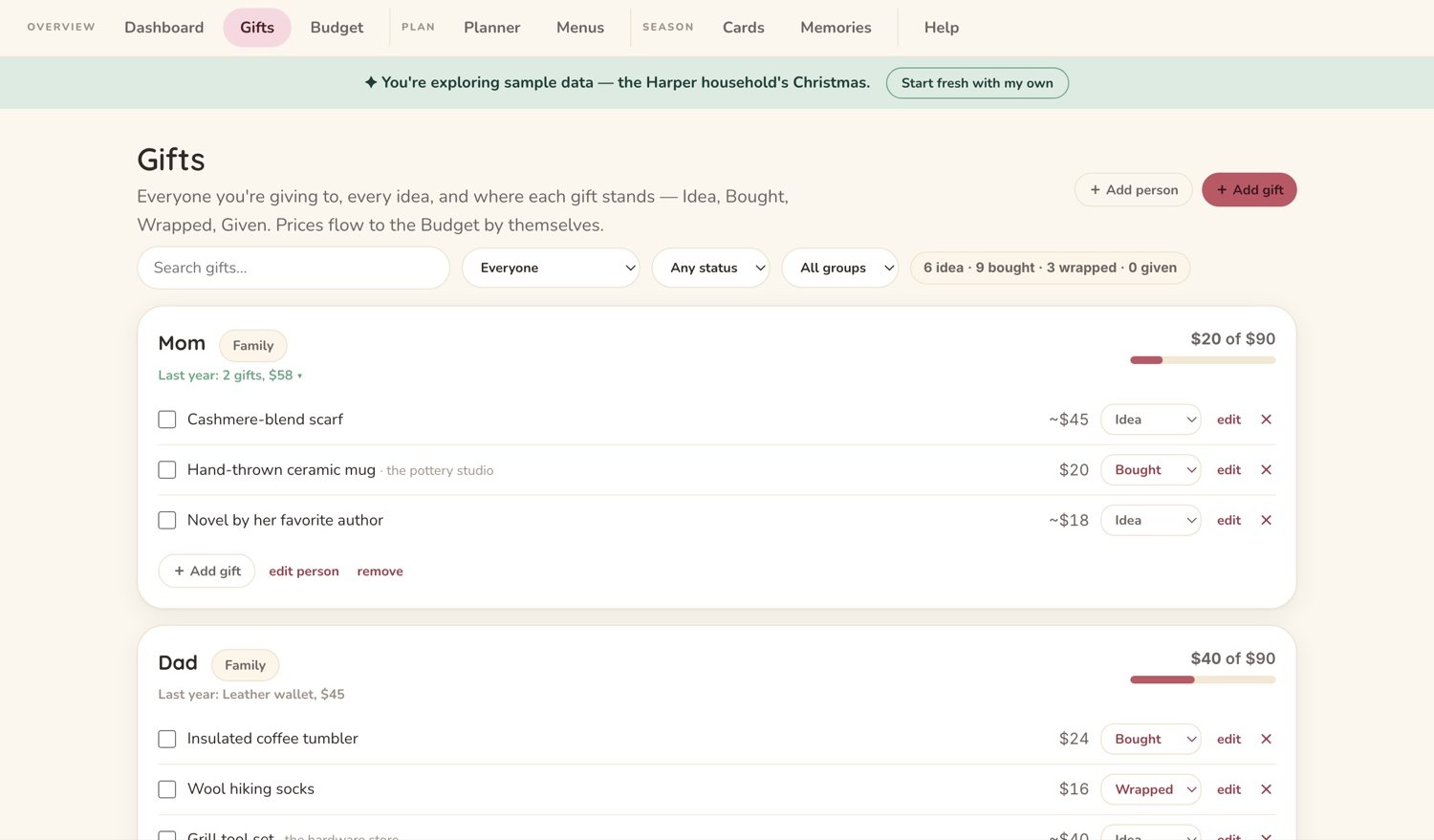
Because gift spending is per person, and nobody adds it up until it is finished.
It is the same structural problem as a wedding guest list, which surprised me when I first noticed it. Each individual decision is small and defensible. A little more for your sister because you found the right thing. Something extra for the children because it seemed mean not to. One more colleague added to the list in the second week of December. None of these feels like a budget decision, because each one is compared with the price of the item rather than with the total.
The fix is to set the total first and divide it by name before you buy anything. Then each purchase is measured against that person's figure, which is a number small enough to argue with. A single overall Christmas budget does not work, because by the time you are anywhere near it you have already bought most of the presents.
What actually causes the December panic?
Three things, and none of them are the shopping.
Wrapping. It is the most underestimated task of the season. Twenty presents is an entire evening, and it always happens on the wrong night because it can only be done when nobody is around. Wrap as you buy — it is the single highest-return habit in this entire post.
Cards. They take longer than anyone plans for, mostly because of addresses. Keep the list from year to year and the job halves. Rebuilding it every December from memory and old envelopes is why it is dreaded.
The day itself. Cooking several things that must be ready simultaneously is a scheduling problem, not a cooking problem. Write the timings backwards from when you want to eat, once, on paper. It is twenty minutes of work and it is the difference between a calm kitchen and four people asking whether the potatoes are in.
What can you safely not do?
- You do not have to match what anybody spent on you. That is an arms race with no finish, and everyone in it thinks somebody else started it.
- You do not need a gift for every acquaintance. Agreeing to stop is almost always mutual and almost always a relief.
- You do not need to make everything. Handmade is lovely and it takes genuine hours. Pick the two you actually want to make.
- You do not need to host if it is your turn but not your capacity. Say so in October, not in December, when it is still a conversation rather than an announcement.
The one thing I would not skip is deciding in advance what you want the day to feel like, and then removing the things that are not that. Most of what makes Christmas exhausting is obligation inherited from somebody else's version of it.
Where the planner fits
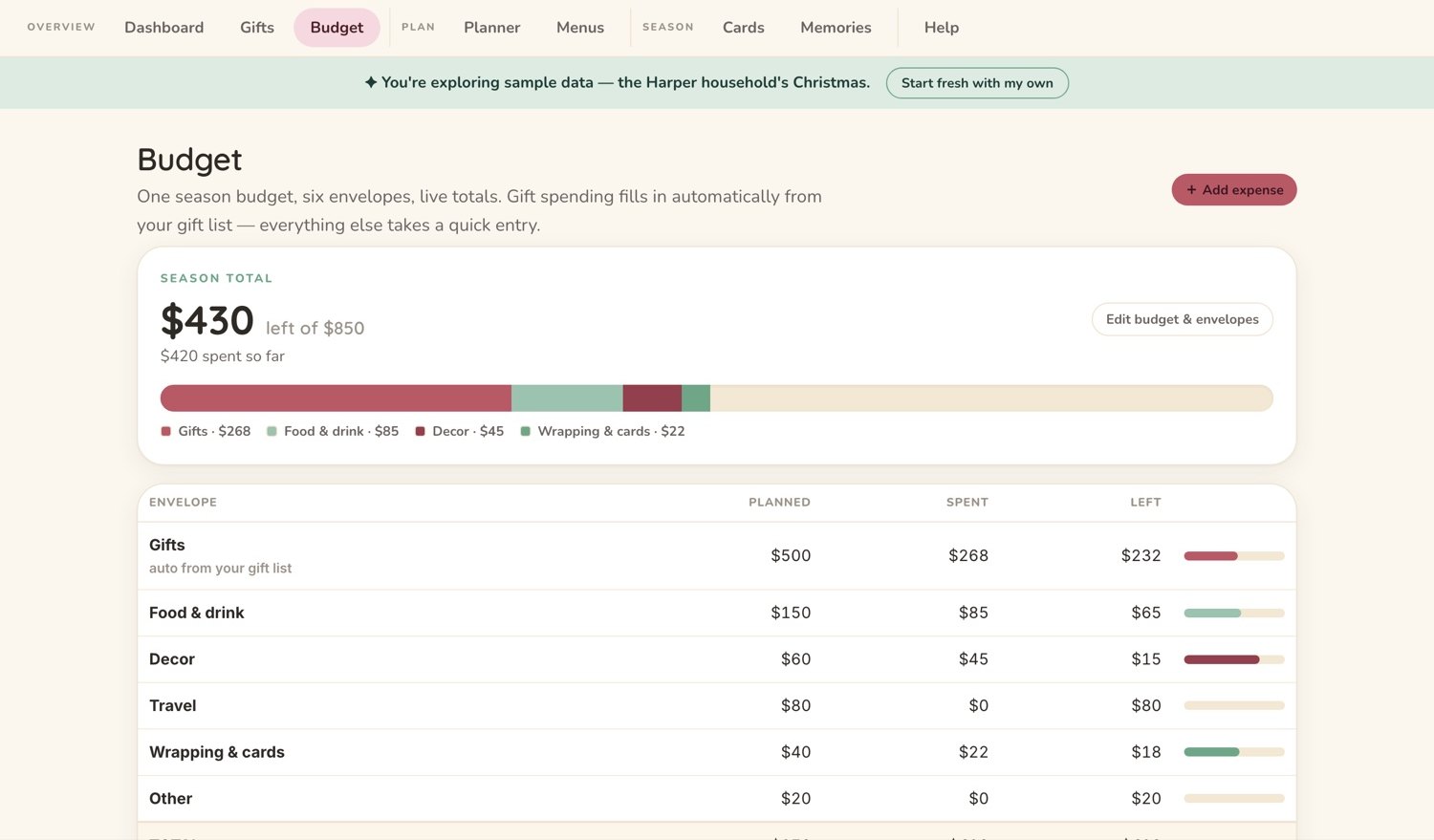
All of this is a list on the fridge and a note in your phone, and plenty of people run a very good Christmas that way. The Christmas Planner exists because of the per-person problem — the gift list and the budget are the same thing, so each person has a figure and a state, and the total is what those add up to rather than a number you check at the end. There are seven sections, covering gifts, the budget, the run-up plan, menus, cards and memories, and it runs in your browser with nothing to install and no account to make. You can try the whole thing free first.
If the money is the part that worries you, the underlying mechanism is ordinary budgeting and it is worth setting up before December rather than after — how to make a budget that survives the month covers it, and the Budget Planner handles the year around it. The hosting side of Christmas — the cleaning, the meals, the beds — sits more naturally in the Home Management Planner, and there is a guide to that in how to run a household without keeping it all in your head.
Common questions
When should you start planning Christmas?
The gift list in September, most of the shopping in October and November, and the food in late November or early December. Starting early does not mean doing more — it means the same amount of work while there are still options, because the thoughtful version of nearly every gift has a lead time and the December version is whatever is still in stock.
What are the real Christmas deadlines?
The posting dates, and the order books of anyone making something for you. Christmas Day is the day the results are on display, not the deadline for producing them. The genuine deadlines fall weeks earlier and belong to other people's calendars — overseas post goes first, by a wider margin than most people expect.
How do you set a Christmas budget that works?
Set the total first, then divide it by name before buying anything. A single overall budget fails because by the time you are near it you have already bought most of the presents. A per-person figure is small enough to argue with, which is what actually changes what you buy.
Why does Christmas spending always creep up?
Because each decision is compared with the price of the item rather than with the total. A little more for one person because you found the right thing, something extra for the children, one more name added in December — none of them feels like a budget decision, and nobody adds them up until it is over.
What is the most underestimated Christmas job?
Wrapping. Twenty presents is an entire evening, and it can only be done when nobody is around, so it always lands on the wrong night. Wrapping as you buy is the single highest-return habit of the season. Cards come a close second, and mostly because of the addresses.
How do you stop Christmas Day being chaotic in the kitchen?
Treat it as a scheduling problem rather than a cooking one. Write the timings backwards from when you want to eat, once, on paper, and stick it somewhere visible. It takes about twenty minutes and it is the difference between a calm kitchen and four people asking whether the potatoes are in.
Try the Christmas Planner
The gift list with a budget per person, what is bought and wrapped, the countdown, the menu plan and the card list — as a browser app, an Excel and Google Sheets workbook, or a printable pack. Nothing to install, no account to create.
Open the planner