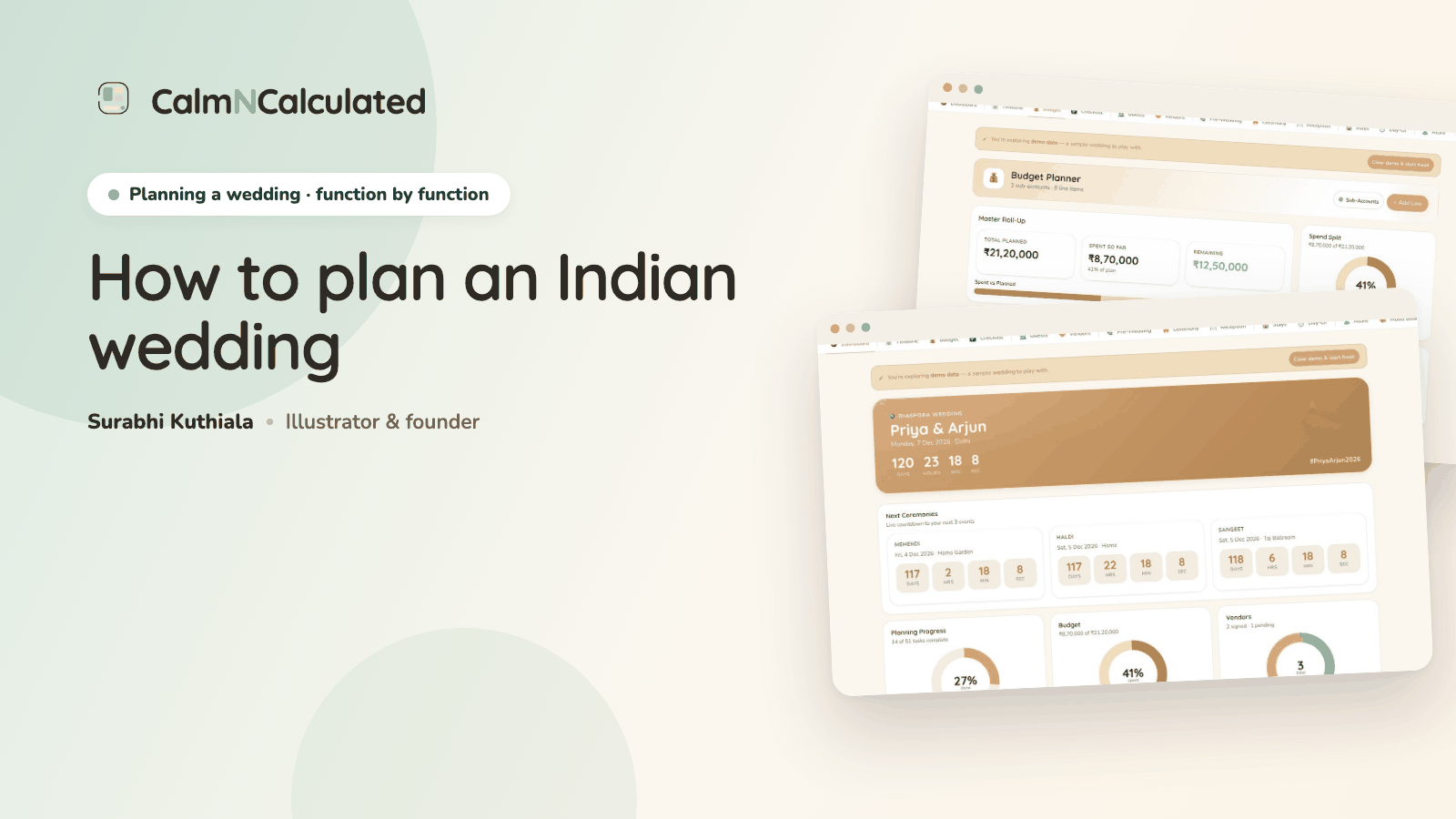
Plan an Indian wedding as several events, not one. Fix the function list first — which ceremonies are happening, on which days, and who each one is for. Only then build a guest list and a budget, both split by function. A single combined list is the mistake that costs the most, and it is the default in almost every planning tool.
I live in Gurugram, so this is not a wedding tradition I have learned about from a distance. And the first thing worth saying is that "an Indian wedding" is not one thing. What happens, in what order, and what it is called varies enormously by region, by community and by family. Nothing below is a prescription about anybody's rituals — those belong to your own family and to whoever advises them.
What I can offer is the organising problem, which is remarkably consistent whatever the ceremonies are called. And it is a genuinely different problem from the one Western wedding planners are built for.
Why is an Indian wedding harder to plan?
Not because it is bigger. Because it is plural.
A single-day wedding is one event: one venue, one guest list, one caterer, one budget. Every planning tool in existence assumes that shape. An Indian wedding is typically four to six distinct events across two to four days, and each one has its own venue, its own timing, its own suppliers, its own dress code, and — this is the part that matters — its own guest list.
The mehendi is family and close friends. The sangeet is larger. The wedding itself is larger again, or sometimes smaller and more formal. The reception may be a completely different set of people, often including the working world of whichever parent is hosting it. These lists overlap but they are not the same list, and treating them as one is what produces the two classic disasters: catering numbers that are wrong for three functions out of five, and somebody important who was never actually invited to the one event they most expected to attend.
The single guest list is the flaw. Not the size of the wedding — the assumption that there is one of everything.
What are the functions, and who is each one for?
Here is the common shape. Names, order and which of these you hold vary by region and family — this is a structure to adapt, not a schedule to follow.
| Function | Roughly who | What it needs of its own |
|---|---|---|
| Engagement / roka | Both families, close relatives | Its own date, often months earlier · a small guest list · photographs |
| Haldi | Immediate family, at home | Daytime timing · clothes that will be ruined · almost no formal catering |
| Mehendi | Family and close friends, mostly one side | Artists booked by the hour · seating · a long, slow timetable |
| Sangeet | Both families, wider friends | Performances and rehearsals · sound · a running order · late catering |
| The wedding | The full list | Muhurat timing · the priest · rituals and their materials · the largest catering number |
| Reception | Often a different set again, including work and community | Its own invitations · its own venue · frequently its own host and its own budget |
Read that last column again. Every row needs something the other rows do not. That is the whole argument for planning function by function rather than as one wedding with a long checklist bolted to it.
How should the budget be split?
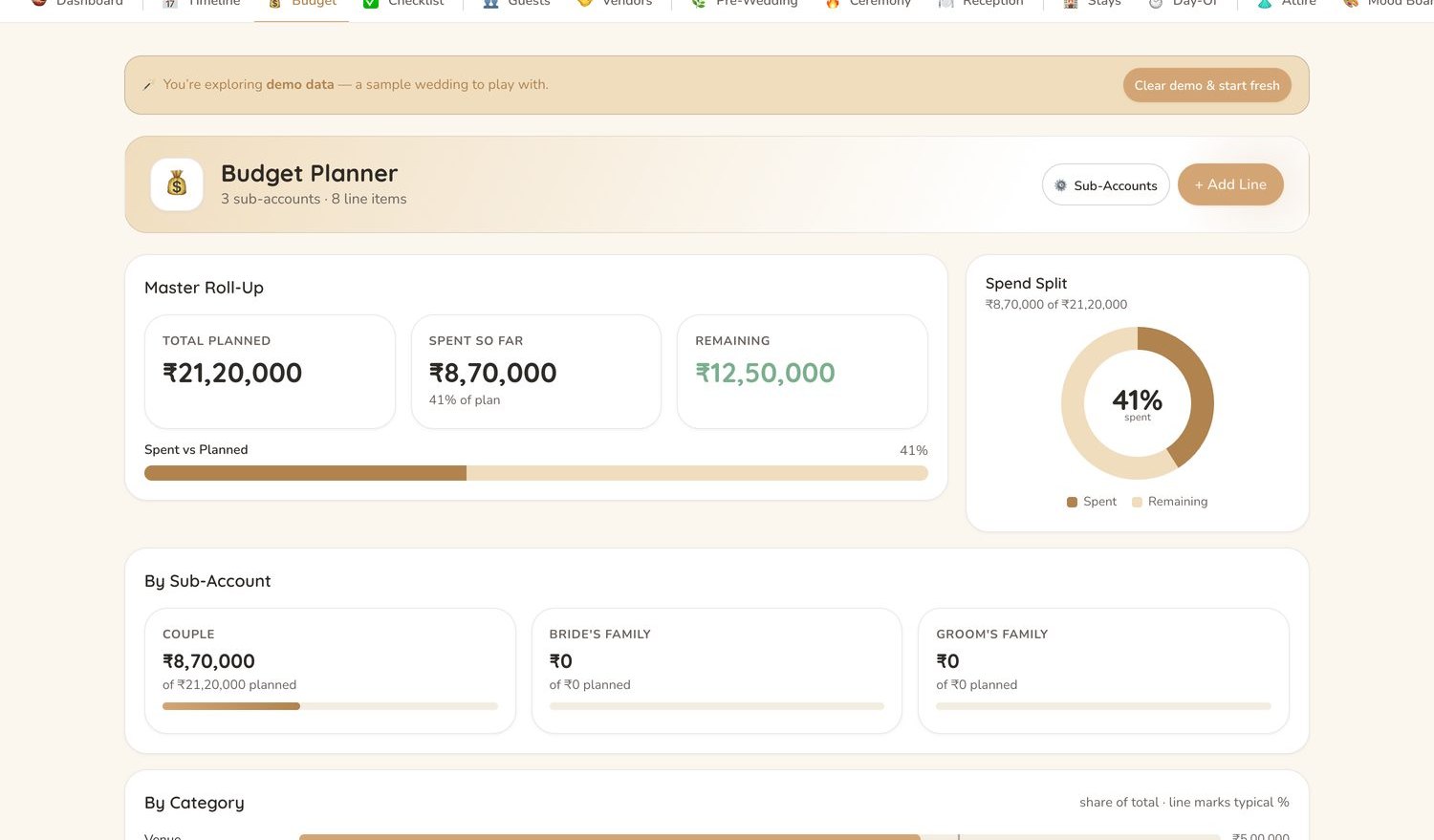
Per function first, in total second — and the order matters.
Indian weddings are frequently funded by more than one household, and rarely evenly. One family may host the sangeet, another the reception; an uncle may take on the catering for a single day. A single combined budget cannot express any of that. It gives you one total, which is the number nobody is actually responsible for, and it hides the number everyone is.
Split by function and two useful things happen at once. Each host can see their own event without wading through everybody else's, and you still get the grand total — because the total is simply the sum, rather than the only figure that exists.
What should you book first?
The date, and then everything that is scarce on that date.
Wedding dates in India cluster tightly around auspicious dates, which means the entire supply of good venues, priests, photographers, decorators and caterers is competed for by everybody at once in a handful of weeks each season. This is not like booking a Saturday in June. If your date is fixed by a muhurat, you are in a queue with a great many other families, and the queue forms early.
So: date, then venue for every function, then catering, then photography, then decor. In that order, and earlier than feels necessary. Outfits and jewellery run on their own long timeline — tailoring and alterations take longer than anyone plans for, and there are usually several outfits per person rather than one.
What actually goes wrong
- Numbers given to caterers too early. Each function needs its own count on its own date. One number given once, for "the wedding", will be wrong for most of the events it gets applied to.
- Invitations that do not say which functions. If the card does not make it clear, people will assume — in both directions — and you will find out at the door.
- Nobody owning the running order. Multi-day events have handovers, and handovers need one person per function who knows what happens next.
- Ritual materials left to the last week. The list is long, specific, and known well in advance by whoever is advising the family. Ask early and write it down.
- Guest stays treated as an afterthought. With relatives travelling for several days, accommodation and transport are a planning workstream, not a detail.
Where the planner fits
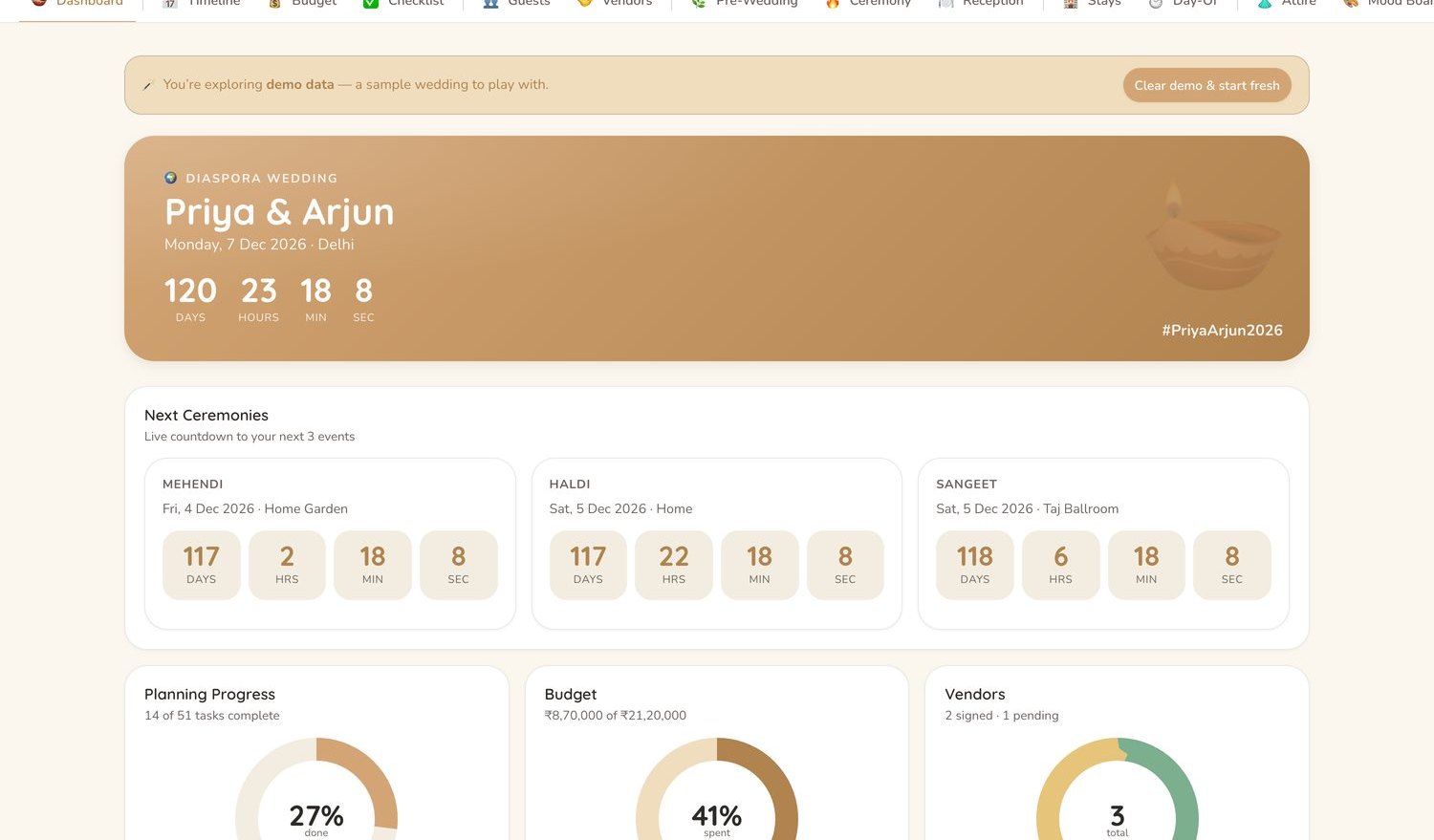
Plenty of families run all of this on a group chat and a shared sheet, and it can be made to work. The Indian Wedding Planner exists because of the plural problem — it is built around functions rather than around one wedding, so each event has its own guest list and RSVPs, its own budget and its own checklist, and the totals across the whole wedding come out of those rather than being maintained separately. There are thirteen sections, covering the timeline, guests, vendors, pre-wedding events, the ceremony, the reception, stays, the day-of running order, attire and a mood board. It runs in your browser, with nothing to install and no account to make. You can try the whole thing free first.
If your wedding is a single-day event, the simpler Wedding Planner is the better fit, and there is a month-by-month guide to that in how to plan a wedding. If the part keeping you up is the money rather than the schedule, most of it is ordinary budgeting under pressure — how to make a budget that survives the month covers the mechanism, and the Budget Planner handles the household side of it.
Common questions
How is planning an Indian wedding different?
It is plural rather than large. A single-day wedding is one venue, one guest list, one caterer and one budget, which is the shape every planning tool assumes. An Indian wedding is typically four to six events across several days, each with its own venue, timing, suppliers and — most importantly — its own guest list.
Should each function have its own guest list?
Yes, and this is the single most useful thing you can do. The mehendi, the sangeet, the wedding and the reception are usually different sets of people who overlap rather than one list used four times. Treating them as one produces wrong catering numbers for most of the events and guests who were never actually invited to the one they expected.
How far in advance should you book an Indian wedding?
Earlier than feels necessary, because dates cluster around auspicious ones and the entire supply of venues, priests, photographers, decorators and caterers is competed for by everyone at once in a few weeks each season. Book the date, then every venue, then catering, then photography, then decor.
How should the budget be divided between families?
Per function first and in total second. Indian weddings are often funded by more than one household and rarely evenly — one family may host the sangeet, another the reception. A single combined budget gives you one total that nobody is responsible for and hides the figures that everybody is.
What is most often left too late?
Outfits and ritual materials. Tailoring and alterations run on a long timeline and there are usually several outfits per person rather than one. The list of materials for the ceremonies is long and specific, and whoever is advising the family knows it well in advance — ask early and write it down.
Can you use an ordinary wedding planner for an Indian wedding?
You can, but you will be working against it. Ordinary planners hold one guest list, one budget and one timeline, so every multi-day structure has to be improvised on top — usually as extra columns or a second copy of the file. That improvisation is where the numbers start disagreeing with each other.
Try the Indian Wedding Planner
Every function, with its own guest list, its own budget and its own checklist — plus vendors, rituals, shopping and the day-of running order. One file, in your browser, no account to create.
Open the planner