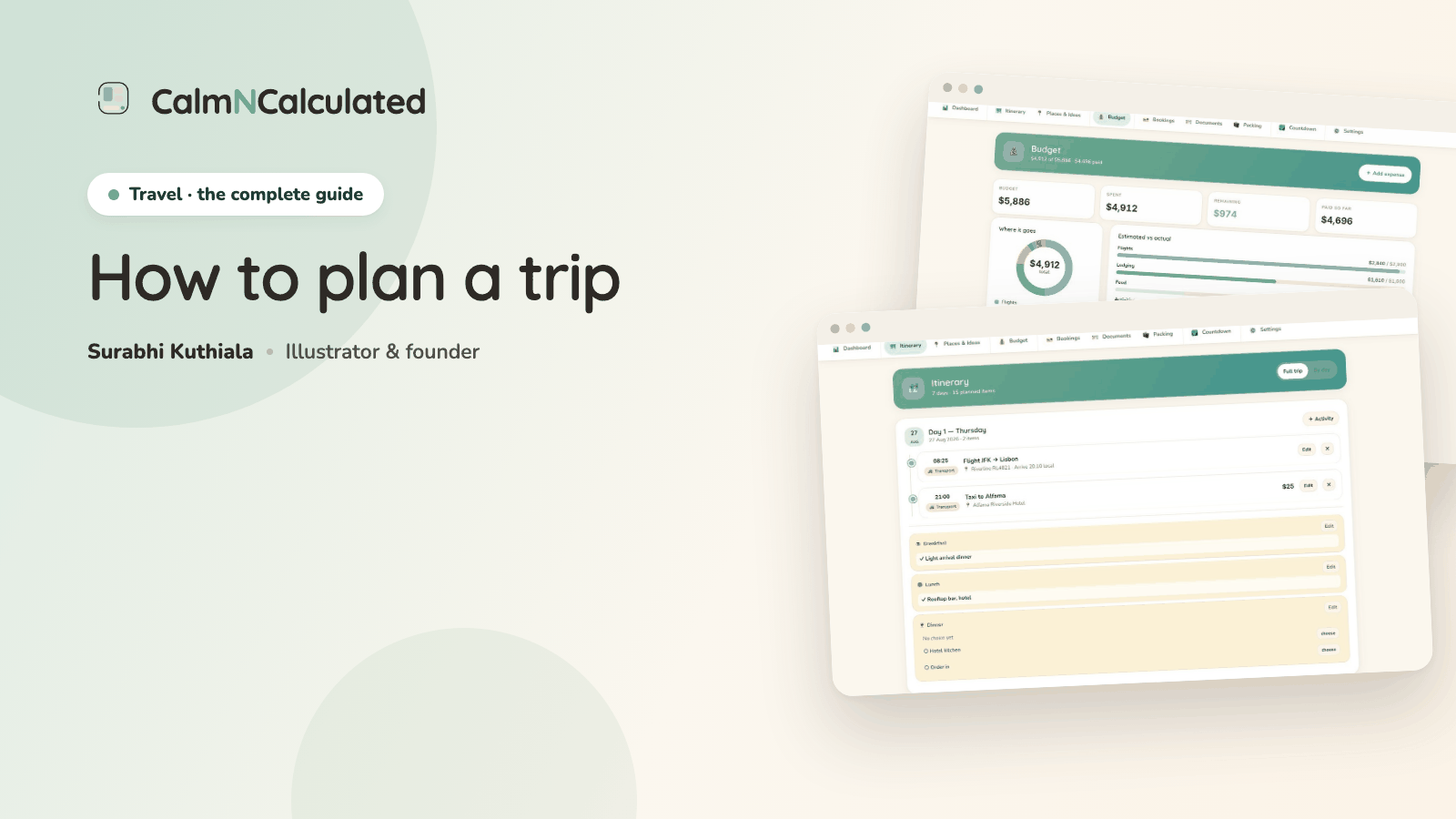
Plan a trip in four passes. Fix the dates and the total you are willing to spend. Book the things that get more expensive or run out — flights, the first night, anything with limited entry. Then build a day-by-day outline, not a schedule. Pack and confirm in the final week. Everything in the middle is negotiable and should stay that way.
Nearly everybody plans a trip twice. Once in the excited weeks beforehand, in tabs and screenshots and a note that says "look up the museum". And then again, badly, at seven in the morning in an unfamiliar city, trying to remember what any of it was for.
The gap between those two versions is the whole problem. And having had to build a trip planner — which means writing down what a trip actually consists of — I think the gap has one main cause, and it is not disorganisation.
Why do trip plans fall apart on the trip?
Because the plan and the money are kept in different places, and only one of them travels with you.
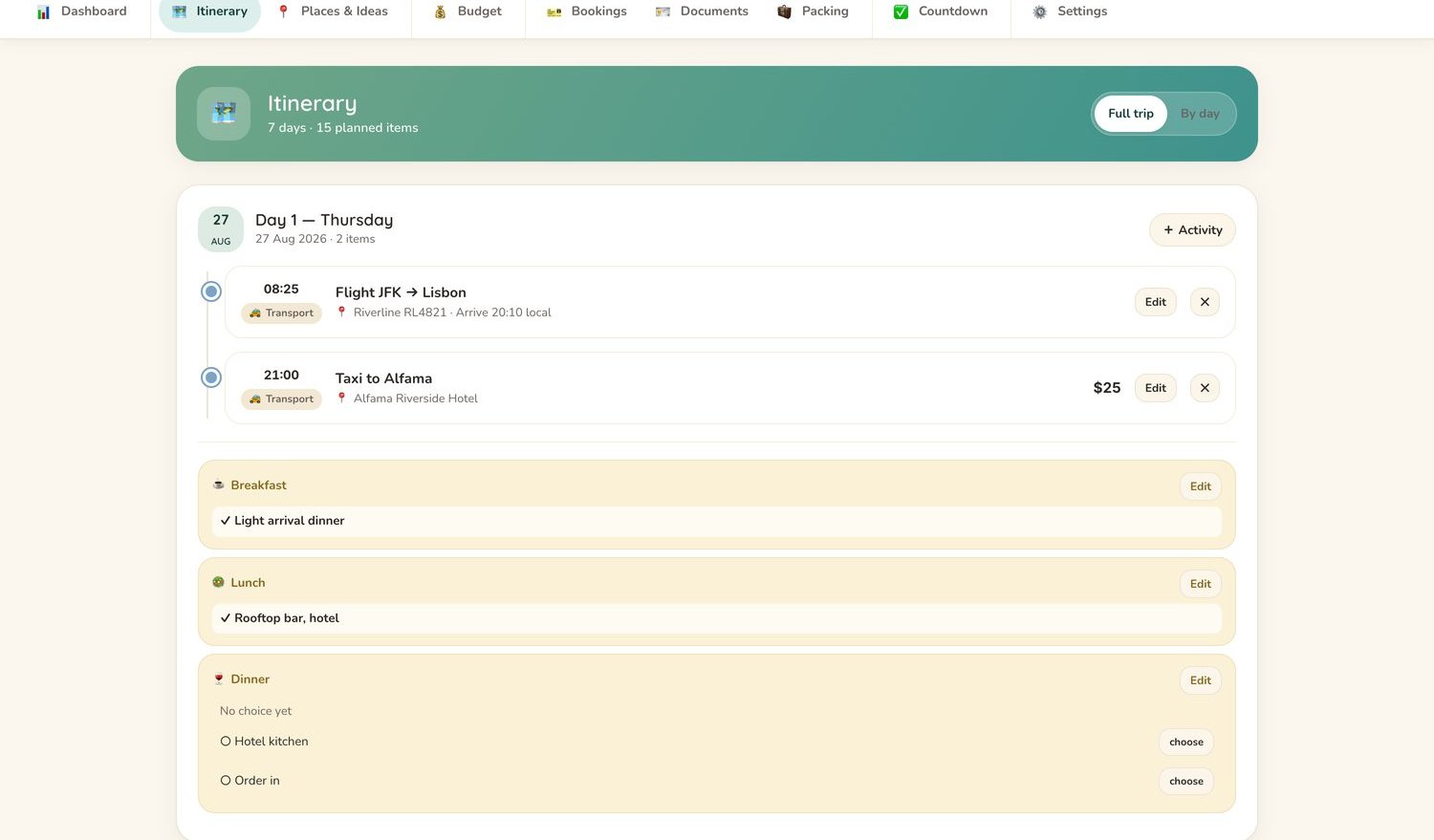
Every decision on a trip has two properties at once: it happens at a time, and it costs something. A restaurant booking is both. So is a train, a museum, a taxi from the airport, and the afternoon you decide to spend on nothing at all. Yet almost everyone keeps the times in one document and the costs in another, and the two are never reconciled until the credit card statement arrives.
An itinerary without money is a wish list. A budget without dates is a spreadsheet nobody will open on holiday. They are the same document, and splitting them is why neither survives.
Put them together and something genuinely useful happens. You can see that Thursday is expensive before Thursday, and move something. That is a decision you can only make if both facts are in front of you at once — which, on a phone, in a hurry, means they need to be in one file.
When should you book each part of a trip?
The rule is simple: book first whatever gets worse with time. Some things get more expensive, some run out entirely, and some do neither and can be left alone.
| What | When | Why then |
|---|---|---|
| Passports and visas | The moment the trip is real | Processing times are outside your control and are the one thing that can cancel a trip outright. |
| Flights | Early, and watch rather than wait | They rarely get cheaper close in. Set an alert rather than checking daily, which only makes you anxious. |
| The first night's accommodation | With the flights | Arriving without a bed is the one failure mode with no workaround. Later nights can stay flexible. |
| Anything with limited entry | As soon as the window opens | Timed tickets, popular restaurants and small tours sell out by date, not by price. |
| Trains and intercity transport | A few weeks out | Usually cheaper in advance, and it forces you to commit to a route while you still have options. |
| Everything else | On the trip | Day-to-day meals, local transport and most activities. Booking these in advance buys nothing and costs flexibility. |
How detailed should an itinerary be?
Two or three anchors a day. No more.
An hour-by-hour itinerary fails on day one, because one thing runs long and everything after it is wrong — and then you are not following a plan, you are failing to follow a plan, which is a much worse feeling than having no plan at all. A day with three anchors absorbs delay without breaking.
What is worth being precise about is the small number of things that genuinely cannot move: a timed ticket, a train, a check-out time, a restaurant that will give the table away. Those belong in the plan with their exact times. Everything else can be a list of possibilities attached to the day, in rough order of how much you want to do it.
One more thing, which I have come to think matters more than the plan itself: put a day with nothing on it in the middle. Not a rest day exactly — a day with no commitments, which will absorb whatever the trip has thrown at you by then.
Where do bookings actually go wrong?
Not in the booking. In the finding.
Every confirmation you will need is already in your email, which sounds like storage but is actually a search problem — and search is exactly what does not work at a check-in desk with a queue behind you and a bad connection. The reference number exists. It is in one of eleven emails from three different companies, two of which are called something other than the brand you booked with.
So the useful habit is a single list of the references themselves: what it is, the date, the reference number, the name it is under. Not the emails — the numbers. It takes five minutes per trip and it is the difference between a mild delay and a genuinely bad twenty minutes.
How do you keep a trip on budget?
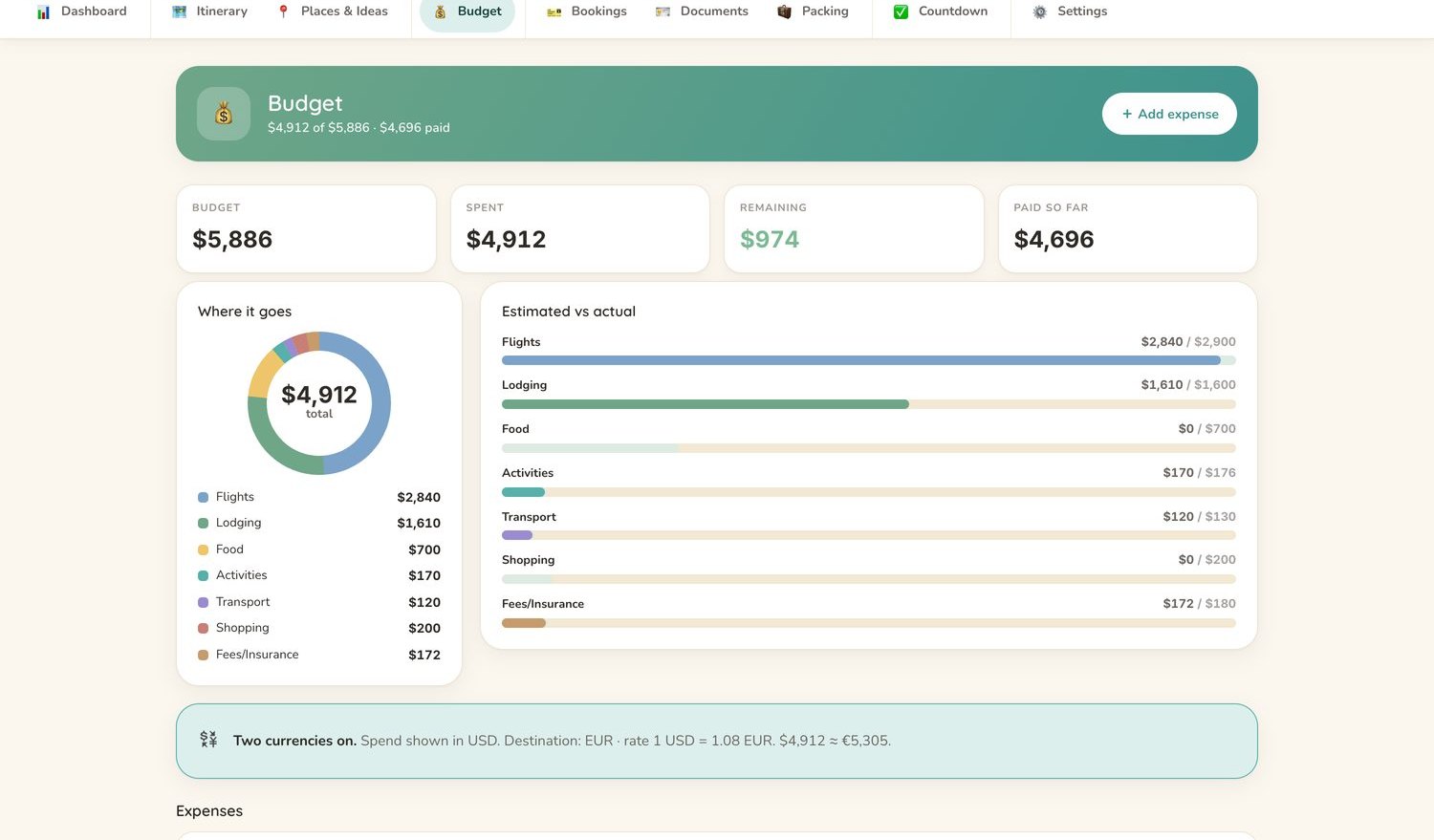
Decide the total first, then allocate — rather than adding things up and hoping.
The four blocks are travel, accommodation, food and everything else. The one that goes wrong is nearly always "everything else", because it is composed of many small decisions made while standing up. A tracked running total does not stop you spending; it stops you arriving at the last two days of a trip having quietly spent them already.
Two figures worth writing down before you go, both of them boring. The exchange rate you are assuming, so you know when you are being quoted a bad one. And what your card charges abroad, which for some cards is nothing and for others is several per cent per transaction, repeated every day for a fortnight.
What about packing?
Make the list once and keep it. Not for this trip — for every trip after it.
Packing is the most repeated task in travel and the one people rebuild from nothing every single time. A list you edit down from is faster and more reliable than a list you write from memory the night before, and it is the only realistic way to stop forgetting the one item you always forget. Everybody has one. Mine is an adaptor, every time.
If more than one person is travelling, give each of them their own list. A single shared list produces the classic outcome where two people both packed the toothpaste and nobody packed the charger.
Where the planner fits
All of this can be done with a note and a spreadsheet, and I have done exactly that. The Travel Planner exists because of the split above — it keeps the itinerary and the budget in the same file, with bookings, documents, packing lists per traveller and a countdown alongside them. There are eight sections, and because it is a single file that runs in your browser it keeps working with the internet switched off, which on a trip is not a technicality. You can try the whole thing free first.
If the trip is a honeymoon, the wedding side of it is covered in how to plan a wedding. And if the trip is the thing you are saving for rather than the thing you are booking, the mechanism in how to make a budget that survives the month is the one to start with — the Budget Planner handles the household side of it.
Common questions
What should you book first when planning a trip?
Whatever gets worse with time. Passports and visas first, because processing times are outside your control and are the one thing that can cancel a trip outright. Then flights and the first night's accommodation, then anything with timed or limited entry. Day-to-day meals and local transport are better left until you are there.
How detailed should a travel itinerary be?
Two or three anchors a day, no more. An hour-by-hour plan fails on the first day, because one thing runs long and everything after it is wrong — and then you are not following a plan, you are failing to follow one. Be precise only about what genuinely cannot move: timed tickets, trains, check-out times.
Why do travel plans fall apart during the trip?
Usually because the plan and the money are kept in different places and only one of them travels with you. Every decision on a trip happens at a time and costs something. Keeping the times in one document and the costs in another means you cannot see that Thursday is expensive until after Thursday.
How do you keep track of booking confirmations?
Keep a list of the reference numbers themselves rather than relying on the emails. The confirmations are all in your inbox, but that is a search problem, and search is exactly what fails at a check-in desk with a queue behind you. What it is, the date, the reference, the name it is under — five minutes per trip.
How do you set a travel budget?
Decide the total first and then allocate it across travel, accommodation, food and everything else, rather than adding things up and hoping. The block that overruns is almost always “everything else”, because it is made of small decisions taken while standing up. Also write down the exchange rate you are assuming and what your card charges abroad.
What is the best way to handle packing lists?
Write the list once and keep it for every future trip. Packing is the most repeated task in travel and the one people rebuild from scratch each time. If several people are travelling, give each of them their own list — a single shared one is how two people pack the toothpaste and nobody packs the charger.
Try the Travel Planner
The itinerary, the budget, bookings, documents, packing lists and a countdown to departure — one file, in your browser, working offline once you have it.
Open the planner