
Budget a renovation in four parts: the quoted work, the things a quote never includes, the things you buy yourself, and a contingency of ten to twenty per cent held as a real number. Then log every change as it is agreed. Overruns almost never come from one big mistake — they come from thirty small ones nobody totalled.
Everyone knows renovations go over budget. The figure is quoted so often that it has stopped being useful information. What is much less often described is how — the actual mechanism by which a project that was carefully costed in March is thirty per cent over by August.
When we built the renovation tracker I had to model that mechanism properly, because the software has to do the arithmetic that people do badly in their heads. And the mechanism turns out to be quite specific, and quite avoidable.
Why do renovations go over budget?
Through changes, agreed one at a time.
Here is how it actually happens. The quote is accepted. Three weeks in, a wall comes down and there is something behind it. Two hundred. The tiles you chose are out of stock and the alternative is dearer. Ninety. While the floor is up it makes obvious sense to move a socket. Sixty. Each of these is discussed on its own, in a corridor, and each is genuinely reasonable. Nobody ever adds them together.
Nobody approves a thirty per cent overrun. They approve thirty small changes, none of which was ever compared with the original total.
Which is why a change log is not administration — it is a budget instrument, and it is the single most useful thing you can keep. Not the amounts alone: the date, what changed, why, and the new running total. That last column is the entire point. It converts a series of reasonable small decisions into one visible number, at the moment you can still do something about it.
What does a renovation quote not include?
Quite a lot, and none of it is anybody being dishonest. A quote covers a defined scope of work, and most of the following are outside it by convention.
| Cost | Typically in the quote? | Notes |
|---|---|---|
| Labour and materials for the specified work | Yes | This is the number people mean when they say “the renovation costs”. |
| Fittings and finishes | Often only as an allowance | Tiles, taps, handles, lighting. A quote may assume a budget figure you will exceed the moment you choose anything. |
| Permits, drawings, surveys | Usually not | Separate professionals, separate invoices, and they come first. |
| Waste, skips, deliveries, parking | Sometimes | Small individually. Worth asking about explicitly rather than assuming. |
| What is behind the wall | No | Nobody can quote for what nobody has seen. This is what contingency is for. |
| Living costs while the work runs | No | Eating out with no kitchen, storage, somewhere to stay. Real money, never on any quote. |
Write those six as their own lines before you start. Not because the estimates will be right — they will not — but because a line with a wrong number in it still gets reviewed, and a line that does not exist never does.
How much contingency should you hold?
Ten per cent for cosmetic work, twenty for anything structural or in an older property, and more if you are opening up a floor or a roof and genuinely do not know what is under it.
Two rules about it, both learned from watching how it gets spent. First, it must be a number in the budget rather than a feeling that there is some slack. A contingency you have not written down will be spent on the second decision of the project and nobody will notice. Second, when you spend some, subtract it visibly. The useful figure is not what the contingency was, it is what is left of it — the same as with every other budget.
If you reach the end with contingency unspent, that is not a planning failure. That is what it was for.
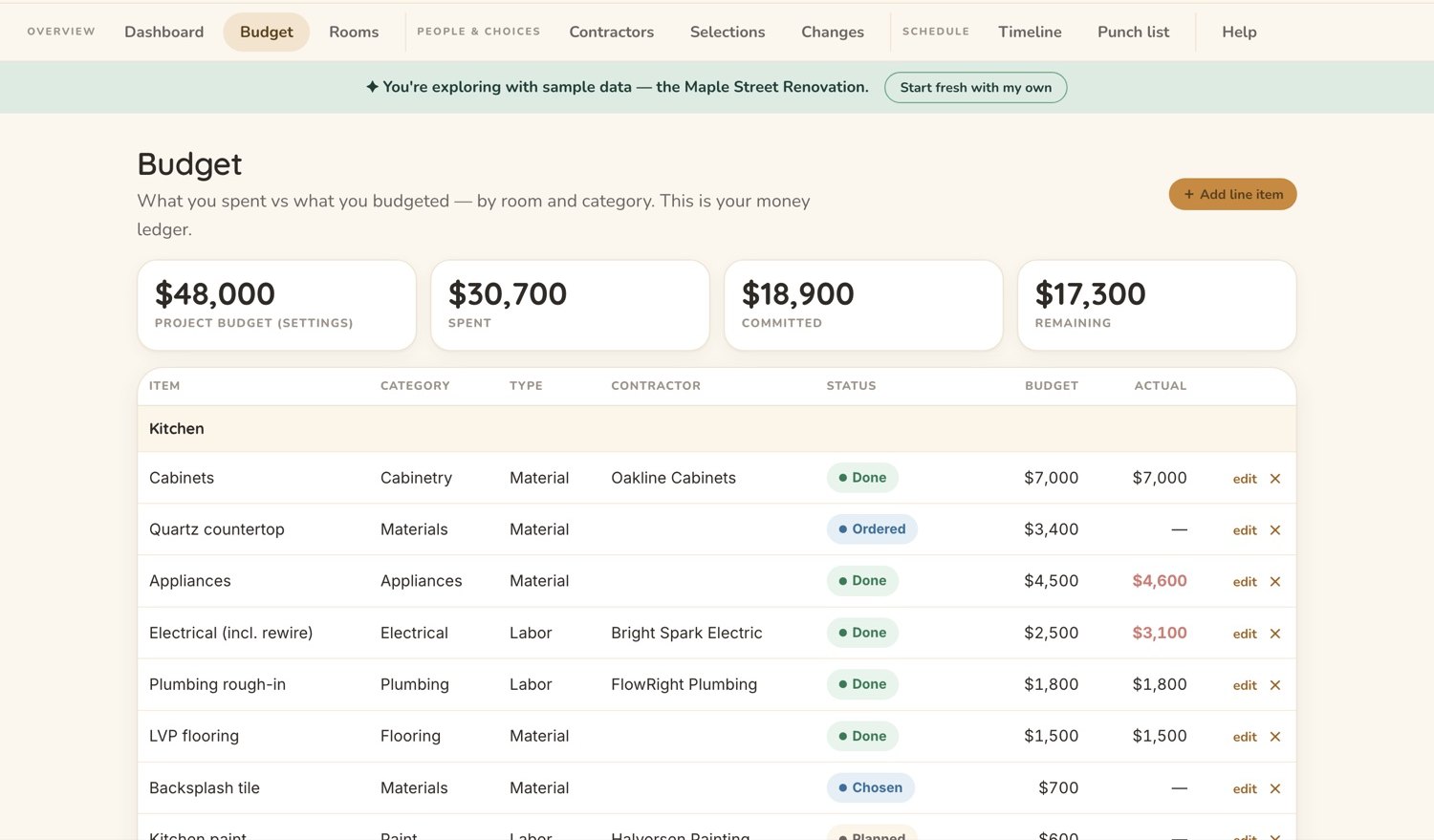
How should the budget be organised?
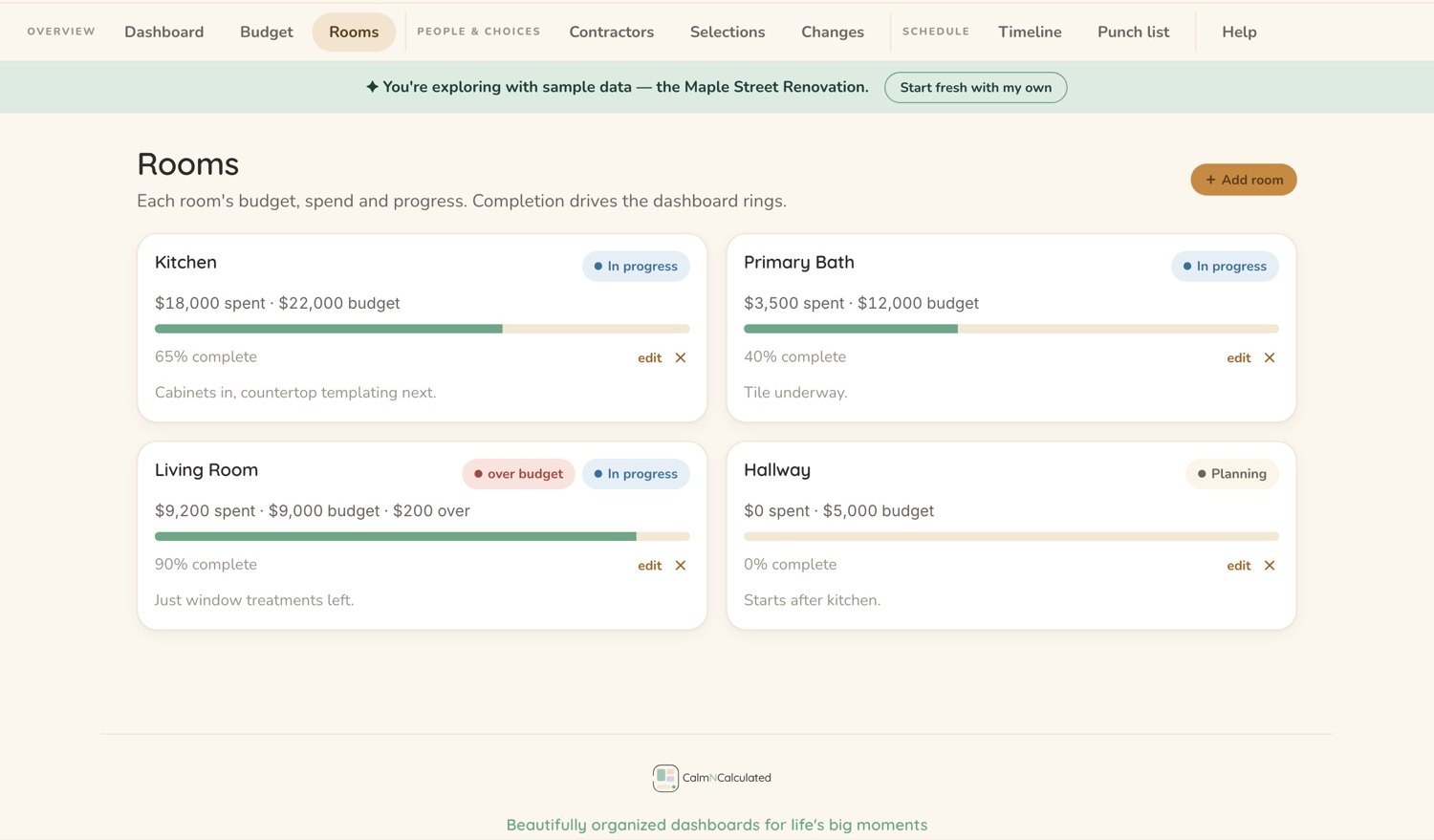
By room, with a total. Not by trade.
Trades are how the work is done and rooms are how the decisions are made. You will never wonder whether to spend another five hundred on plumbing in the abstract; you will wonder whether the bathroom is worth it. When the budget is arranged by room, that question has an answer on screen. When it is arranged by trade, you have to assemble the answer yourself, and in practice nobody does.
Room-level budgeting also makes the only real lever visible. When a project is running over, the choices are to reduce scope, reduce specification, or delay a room to a later year. That third option is by far the least painful and it is nearly invisible unless the numbers are already split room by room.
How do you compare contractors properly?
Get three quotes and make them comparable before you compare them, which is the step people skip.
Quotes for the same job routinely differ by a factor of two, and usually the reason is that they are not quotes for the same job. One includes making good and painting; another stops at plaster. One has an allowance for tiles; another expects you to supply them. Until you have put the three side by side and marked what each does and does not contain, the cheapest number tells you nothing at all.
Then judge them on four things beyond price: what is actually included, when they can start and how long they say it will take, what happens to the payment schedule if it runs long, and whether they have done this specific kind of work recently. The last one matters more than general experience.
One practical note that costs nothing: get the change process agreed in writing at the start. Not the changes — the process. How a variation is priced and confirmed before the work is done. Almost every renovation dispute I have heard about is a disagreement about a change nobody wrote down.
What is a punch list, and when do you start it?
It is the list of small unfinished things at the end — the missing handle, the paint that needs a second coat, the door that catches. Start it long before the end.
Walk each room and write down every small defect as you notice it, with a date. Two reasons. Things noticed on the day get fixed while the trades are still on site, which is when it costs nothing; and a written list agreed with the contractor is a far better conversation than a remembered one during the final payment.
Where the tracker fits
All of this can be done in a spreadsheet, and if you like spreadsheets it is a decent answer. The Renovation Planner exists because of the change problem — it holds the budget room by room with quotes against actuals, contractors side by side, a change log that keeps the running total honest, the timeline and the punch list. There are eight sections and it runs in your browser with nothing to install and no account to make. You can try the whole thing free first.
If the renovation is part of a move, the sequencing side of that is in how to plan a house move. Once the work is done, the maintenance it creates belongs in the Home Management Planner. And if the renovation is being funded month by month, the mechanism in how to make a budget that survives the month applies directly, alongside the Budget Planner.
Common questions
Why do home renovations go over budget?
Through changes agreed one at a time. Something is found behind a wall, the tiles are out of stock, it makes sense to move a socket while the floor is up. Each is discussed on its own and each is reasonable, and nobody ever adds them together. Nobody approves a thirty per cent overrun — they approve thirty small changes.
How much contingency should you allow for a renovation?
Ten per cent for cosmetic work, twenty for anything structural or in an older property, and more if you are opening up a floor or roof. It has to be a written number rather than a sense that there is slack, and when you spend some of it you should subtract it visibly — what matters is what is left.
What is not included in a renovation quote?
Usually permits, drawings and surveys; often fittings and finishes beyond an allowance; sometimes waste, deliveries and parking; and never what is behind the wall or what it costs to live through the work. None of that is anyone being dishonest — a quote covers a defined scope, and these sit outside it by convention.
Should a renovation budget be organised by room or by trade?
By room, with a total. Trades are how the work is done, but rooms are how decisions get made — you will never wonder about plumbing in the abstract, you will wonder whether the bathroom is worth it. Room-level budgets also make the least painful lever visible, which is delaying a room rather than cutting quality everywhere.
How do you compare builders' quotes?
Make them comparable first. Quotes for the same job routinely differ by a factor of two, usually because they are not quotes for the same job — one includes making good and painting, another stops at plaster. Mark what each does and does not contain, then judge on inclusions, timing, payment terms and recent experience of that specific work.
When should you start a snagging or punch list?
Long before the end. Walk each room and note every small defect as you see it, with a date. Things noticed while the trades are still on site get fixed at no cost, and a written list agreed with the contractor makes a far better conversation than a remembered one during the final payment.
This is not financial or construction advice. Structural work, permits, regulations and anything to do with safety are governed by the rules where you live and belong to a qualified professional there.
Try the Renovation Planner
The budget, room by room, with contractors and quotes side by side, a change log, the timeline and a punch list — as a browser app, an Excel and Google Sheets workbook, or a printable pack. Nothing to install, no account to create.
Open the planner