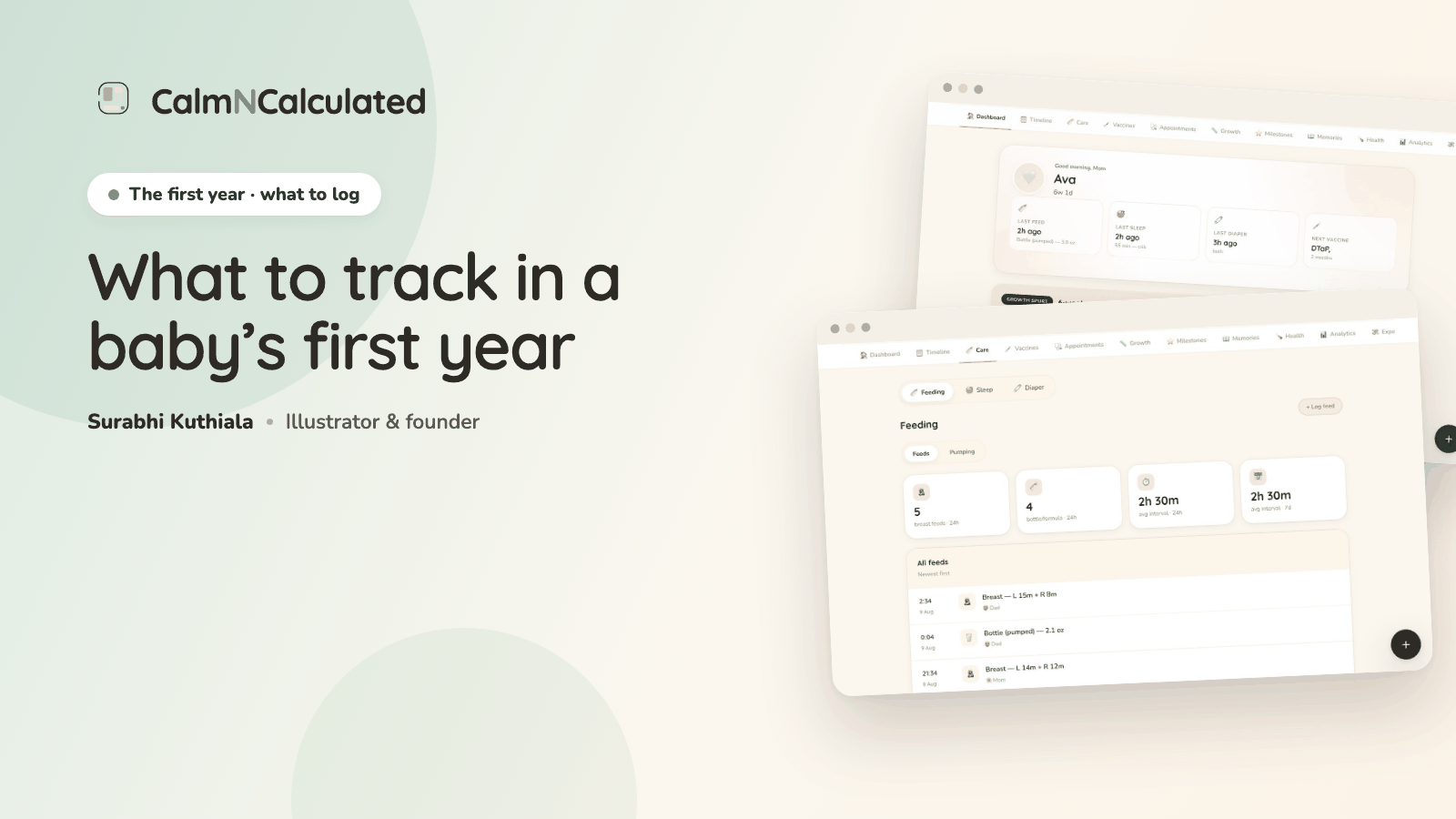
In the first six weeks, track four things: feeds, sleep, nappies and weight. Everything else — vaccines, milestones, appointments, what you are spending — is a record rather than a tracker, and belongs on a slower clock. Track in order to answer a question. When the question has been answered, stop.
I have two children. With both of them I wrote things down on whatever was nearest at the time — the back of an envelope, a note on my phone, twice on my own hand. It was not a system. It was a series of small panics, each one recorded separately, and none of them where I could find it again a week later.
Years later I sat down to help build a tracker for the first year, which meant describing that year to a computer. That turned out to be the useful exercise. You cannot describe something to a computer vaguely. It made me see the shape of the problem properly for the first time, and the shape is not what the app stores usually suggest.
What should you track in the first six weeks?
Four things, and I would resist adding a fifth.
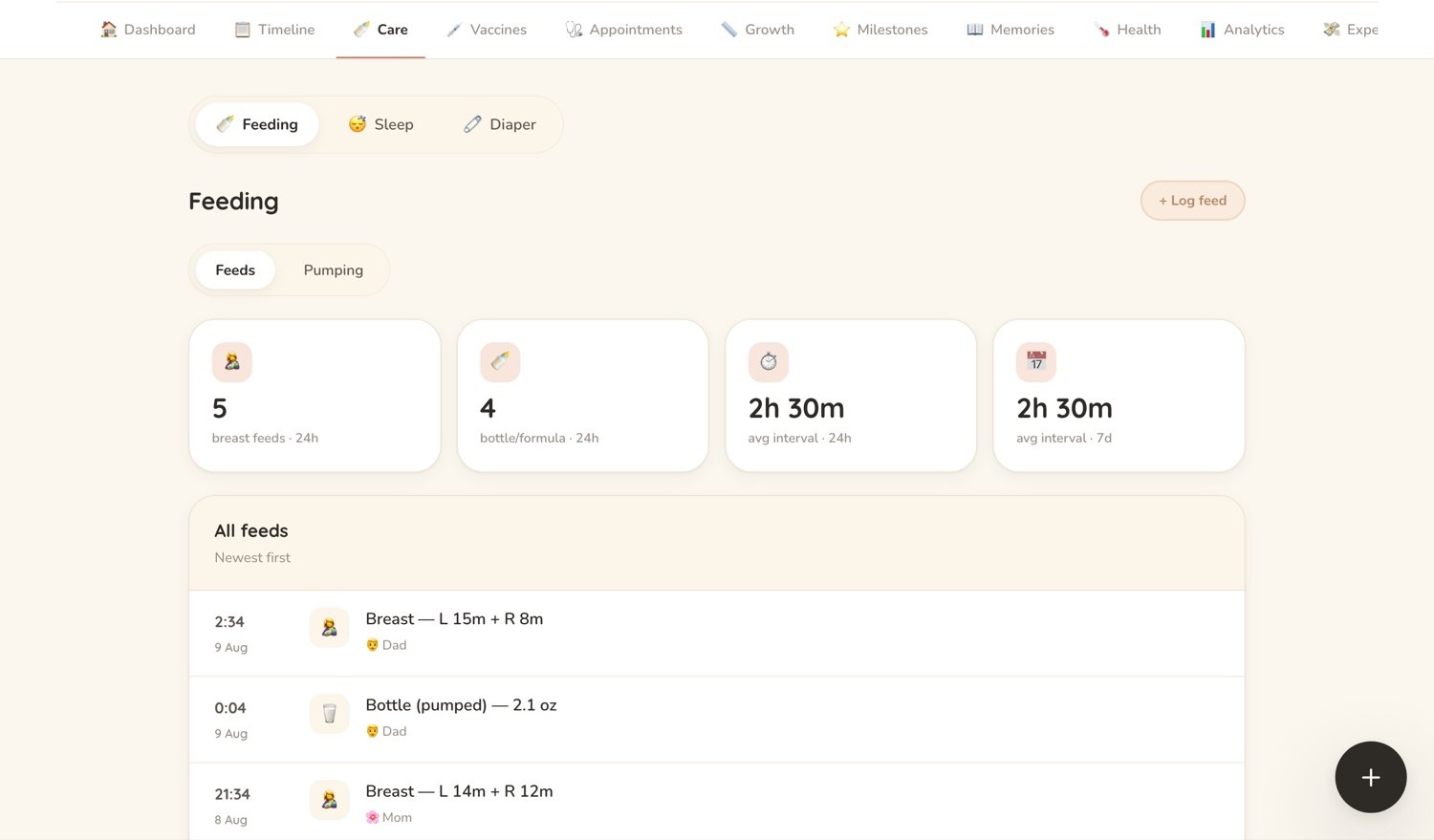
Feeds — when, and roughly how much or how long. Sleep — when it started and when it ended, not the quality of it. Nappies — wet and dirty, counted. Weight — whatever gets measured when you are weighed, written in the same place as the rest.
Those four exist for one reason: they are the four a health professional will ask you about, and they are the four you will not be able to answer from memory. Everything else you might be tempted to log in week two is either interesting or reassuring, and neither of those is a reason to fill in a form at four in the morning.
When should you stop tracking feeds and sleep?
When you stop needing the answer. For most people that is somewhere between six weeks and four months, and it is a much earlier date than anyone tells you.
A log is a diagnostic instrument. You keep it because there is an open question — is she feeding enough, is that gap normal, has anything actually changed since last week — and the log answers it. Once the question closes, the log becomes homework. And homework you set yourself, at three in the morning, in a fog, is homework you will abandon and then feel vaguely guilty about.
So my own rule, and it is a preference rather than a rule: every couple of weeks, ask what question the log is currently answering. If you cannot name one, stop that part of it. You can always start again in an afternoon.
Tracking is not a virtue. It is a tool with an expiry date, and nobody ever tells new parents when the expiry date is.
What belongs on the slow clock?
This is the part that gets muddled, and it is the whole reason the first year is harder to organise than it looks. The year does not run on one clock. It runs on two at the same time.
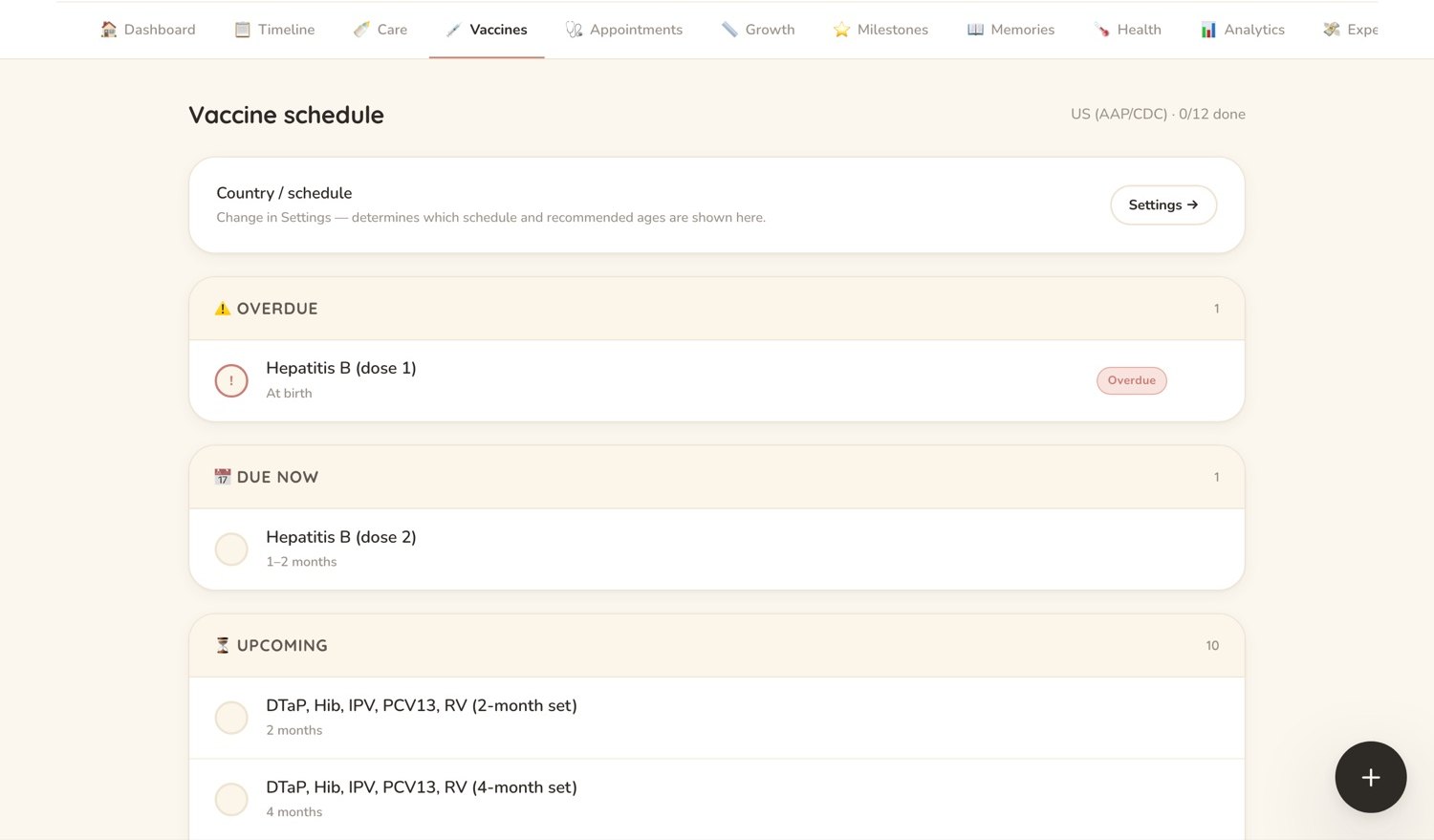
One is a twenty-four-hour clock — feeds, sleep, nappies, medicine. It is urgent, repetitive, and it matters most in the moment. The other is a twelve-month clock — vaccinations, checks, growth, milestones, expenses. It is not urgent on any given day and it is the one that quietly goes wrong, because nothing about today reminds you of it.
| Clock | What lives on it | How it fails |
|---|---|---|
| The 24-hour clock Now |
Feeds · sleep · nappies · medicine · today's mood | Over-tracked. Logged in detail long after the question it was answering has closed. |
| The 12-month clock The year |
Vaccinations · health checks · weight and length · milestones · appointments · what the year is costing | Under-tracked. Nothing about today reminds you, so it is remembered late or not at all. |
Almost every tracker I have looked at picks one clock and pretends the other does not exist. The feed-timer apps are excellent at the twenty-four-hour clock and have nowhere to put a vaccination. The printable first-year books are lovely on the twelve-month clock and cannot hold Tuesday night. So people end up running both, in two places, and lose the thread of each.
Why do baby trackers get abandoned?
Two reasons, and neither of them is laziness.
The first is the split above. A tool that only does one clock forces you to keep a second tool for the other, and the moment a system needs two places it starts losing things. The second is that most of them are designed for someone with two hands, good light and a spare minute, which describes nobody in week three.
That second one is worth saying plainly, because it is a design fact rather than an opinion. If a log takes more than a couple of taps, it will not be filled in at 3am — and 3am is exactly the entry that matters, because it is the one nobody remembers in the morning. Everything about how the entries work has to bend around that, or the record has a hole in it precisely where you needed it.
What is the log actually for?
Two things, and only one of them is the baby.
The first is the appointment. Someone will ask how often she is feeding and how many wet nappies there were yesterday, and "I think quite a lot?" is not an answer that helps anybody. A week of plain entries answers it in four seconds and you stop dreading the question.
The second is the handover, and it is the one people do not expect. If two of you are looking after a newborn, the log is how you stop interviewing each other. When did she last eat. Has she had the drops. Did anyone write down what the health visitor said. Without a shared record, all of that has to be asked out loud, usually by the person who has just woken up, to the person who has just fallen asleep. That is where the friction in the first month actually comes from, and it is fixable.
What you can safely not do
- You do not need to log every day of the first year. The dense stretch is weeks one to six. After that most of it thins out on its own, and it should.
- You do not need to record sleep quality. Start and end is a fact. Quality is a judgement made by an exhausted person and it will not be comparable week to week.
- You do not need a photograph for every milestone. The date is the part you will want later. The photograph is already on your phone.
- You do not need to catch up. A gap in a log is not a failure. Start again from today; the missing fortnight will not be missed.
Where the tracker fits
All of this works in a notebook, and mine was a notebook, twice. The Newborn Baby Tracker exists because of the two clocks — it holds both in one file, so the care log and the vaccine schedule are not in different apps run by different rules. There are eleven sections, from the daily care log to growth, milestones and the first-year timeline, and it runs in your browser with nothing to install and no account to make. Nothing you type leaves your device, which for a record of a baby's health seemed like the only sensible answer. You can try the whole thing free first.
If you are reading this before the birth rather than after it, the job is a completely different shape — forty weeks of decisions and money rather than a twenty-four-hour clock — and that is what the Pregnancy Planner is for. There is a longer guide to that side of it in how to plan for a baby.
And if you want to know why an illustrator started building things that add up, that is in the first post on this blog.
Common questions
What should you track in a baby's first year?
In the first six weeks, four things: feeds, sleep, nappies and weight. Those are the four a health professional will ask about and the four you cannot answer from memory. Vaccinations, growth, milestones and appointments also belong in the record, but they run on a much slower clock and do not need daily attention.
When should you stop tracking feeds and sleep?
When you no longer need the answer, which for most people is somewhere between six weeks and four months. A log is a diagnostic tool: you keep it because there is an open question. Once the question closes, the log becomes homework. Every couple of weeks, ask what question it is currently answering, and stop the parts that answer nothing.
Why do baby tracking apps get abandoned?
Usually because they only handle one of the two clocks the first year runs on. Feed timers are good at the twenty-four-hour clock and have nowhere to put a vaccination; printed first-year books are good at the twelve-month clock and cannot hold Tuesday night. Running both means two places, and a system with two places loses things.
Is it worth tracking nappies?
In the early weeks, yes — wet and dirty, simply counted. It is one of the first questions asked at a check-up and it is impossible to reconstruct afterwards. It is also one of the first things you can stop counting once feeding is established and nobody is asking.
Do both parents need to see the log?
It helps more than almost anything else. Without a shared record, every handover becomes an interview — when did she last eat, has she had the drops, what did the health visitor actually say — usually conducted by the person who has just woken up. A record both of you can read removes that conversation entirely.
What if there is a gap in the record?
Leave it. A gap is not a failure and there is no value in reconstructing a fortnight from memory, because reconstructed entries are guesses written down as facts. Start again from today. The log is there to answer questions about now, not to be complete.
This is not medical advice. Everything here is about record-keeping. Feeding, sleep, weight, vaccinations and anything that worries you belong to your health visitor, midwife or doctor — and where their advice differs from anything above, follow theirs.
Try the Newborn Baby Tracker
The care log, the vaccine schedule, growth, milestones and the first-year timeline in one file that runs in your browser. Nothing to install, no account to create.
Open the planner