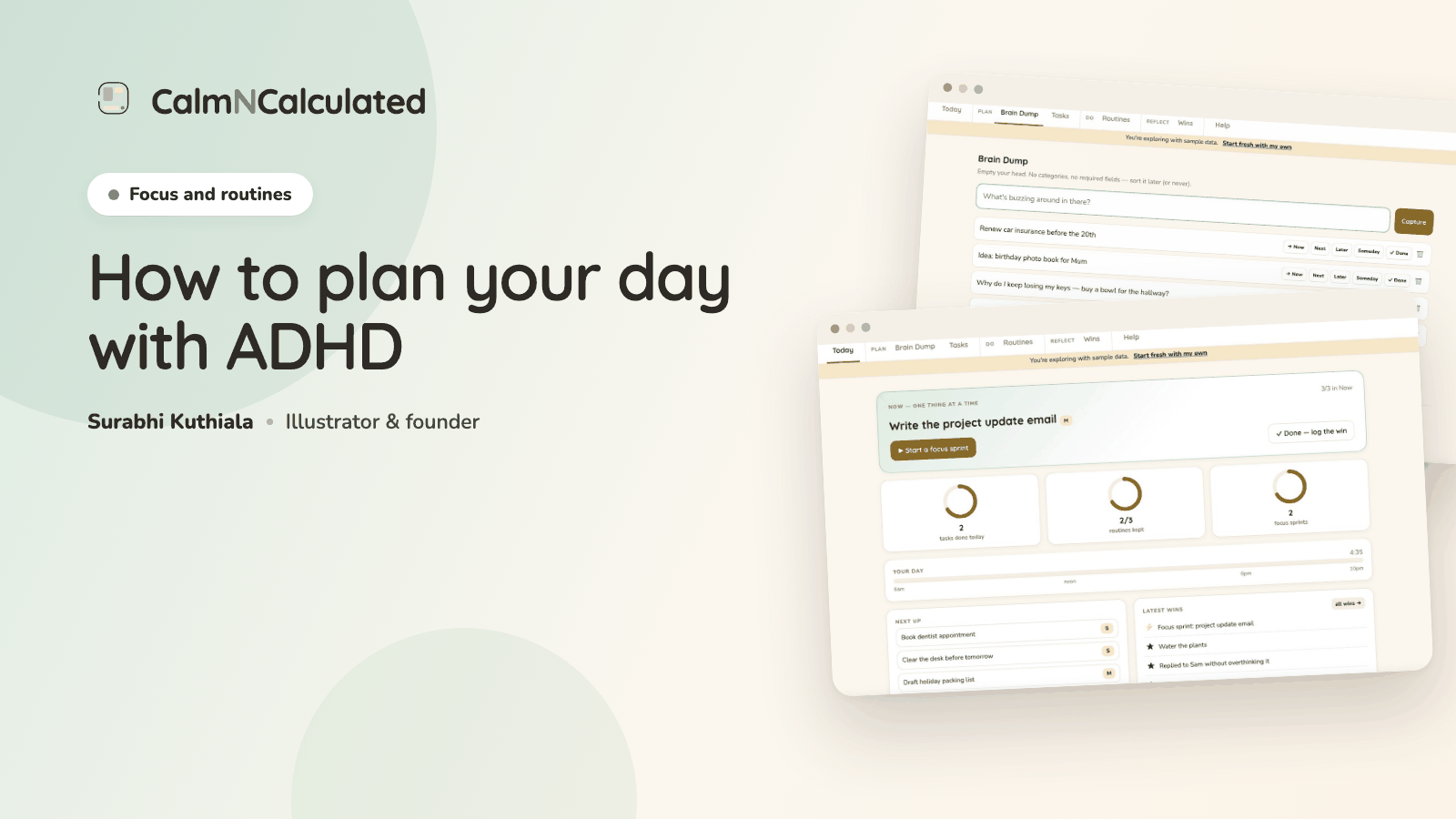
Split capturing from planning. Capture anything, any time, in one unstructured place with no categories to choose. Plan separately, once a day, and keep the day to three things. Let unfinished tasks roll forward without any mark of failure. Most planners fail not because the plan was wrong but because using them required a decision at the wrong moment.
Almost every planner sold to people with ADHD is a planner for people who are already organised, with a different colour scheme. It assumes you will sit down at a fixed time, sort your thoughts into categories, estimate durations, and then follow the result. If you could reliably do all of that, you would not be looking for the planner.
So this is not a productivity post. It is about the small number of structural things that make a system survivable, most of which are about lowering the cost of using it rather than increasing the effort you put in.
Why do planners get abandoned?
Because they ask for a decision at the exact moment you have none available.
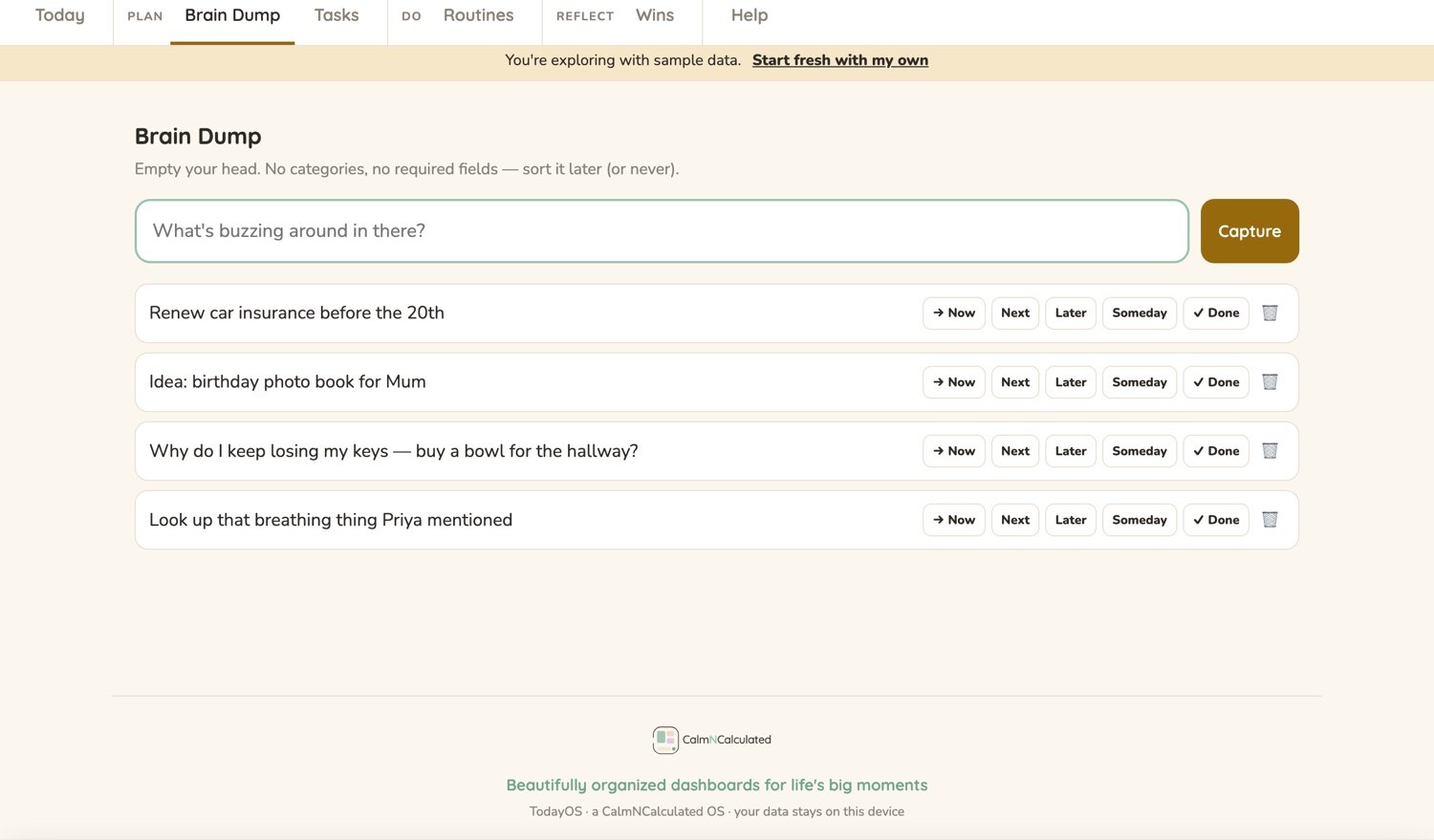
A thought arrives — the form, the call, the thing you promised your sister. To write it into a normal planner you must first decide which project it belongs to, when it is due, how long it will take and how important it is. Four decisions, in the two seconds before the thought is gone. Most of the time the thought wins, and the planner slowly becomes a record of the things you happened to be calm enough to file.
The gap is not between knowing and doing. It is between the thought arriving and the thought being written down, and every field you have to fill in makes that gap wider.
Which is why capture and planning have to be two different activities. Capture is instant, unstructured and judgement-free: a single place that accepts anything in any order, including half a sentence. Planning is a separate act, done once, when you have the attention for it. Trying to do both at once is what breaks the system, and it breaks it silently.
How many things should be on a day?
Three. Possibly two.
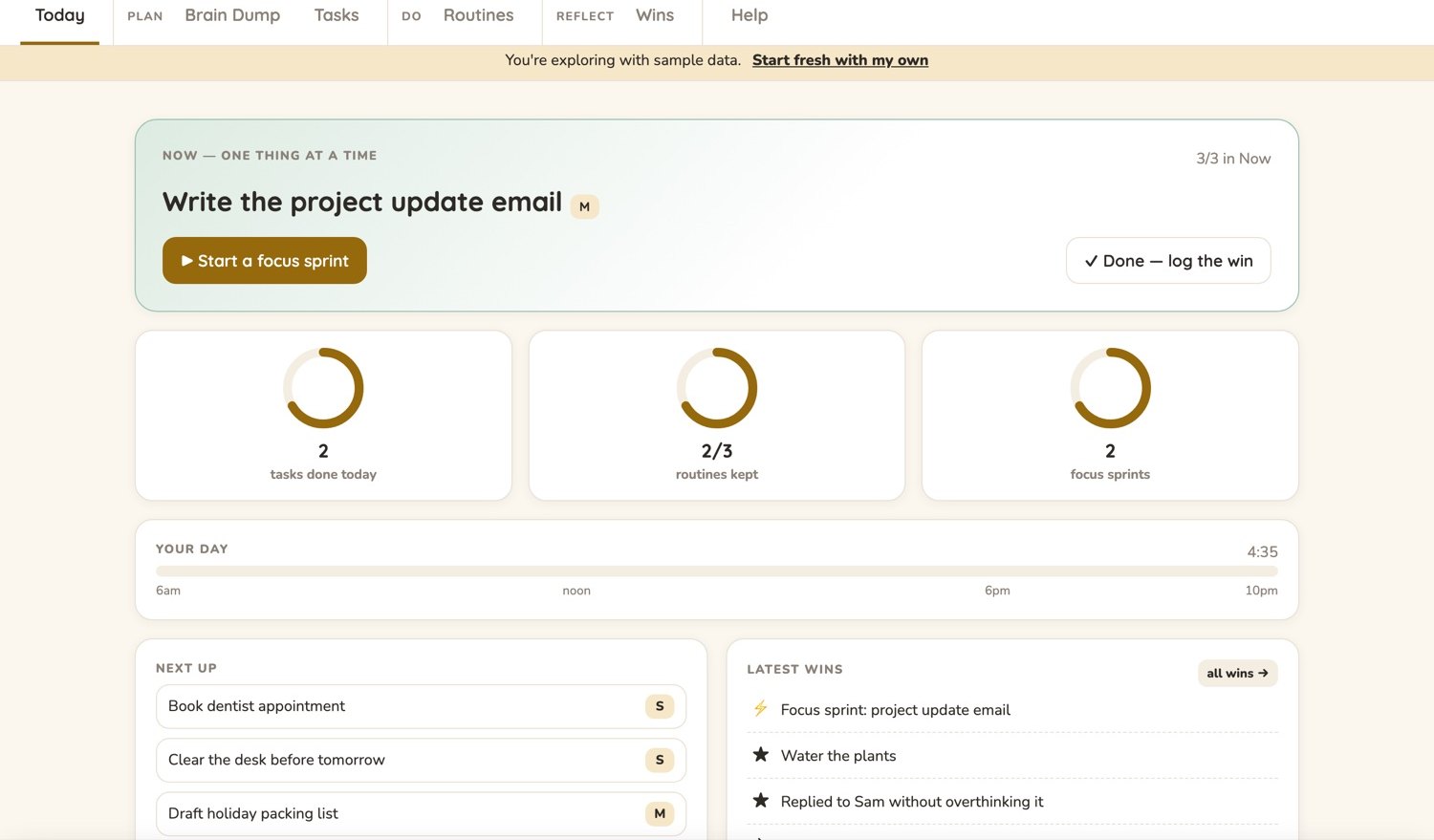
This is the recommendation people most often reject and it is the one that matters most. A list of twelve tasks is not a plan, it is a wish and a scoreboard — and at the end of the day it reports that you failed at nine things, which is not information anybody can use.
Three real tasks, chosen deliberately, do something different. They can all be done. When they are done the day is a success, and anything else is a bonus rather than a partial recovery. Over a fortnight that difference compounds, because the thing that stops people using a planner is almost never the planning. It is that opening it makes them feel worse.
What do you do when you cannot start?
Work out which stall it is, because they have different counter-moves and the wrong one does not help at all.
| The stall | What it feels like | What actually helps |
|---|---|---|
| The task is too big | Vague dread. You keep sliding past it on the list. | Cut it until the first step takes two minutes. “Do the taxes” is not a task; “find last year's return” is. |
| The next step is unclear | You reread it several times and do something else. | Write the literal next physical action, including who you have to contact and where. |
| There is no edge to it | It could be done any time, so it is never now. | Give it a time and a stopping point. A twenty-minute session that ends is easier to start than an open one. |
| Too many open loops | Everything feels urgent and nothing is possible. | Empty your head onto the page first. It is not a productivity technique, it is clearing the buffer. |
The four are genuinely different problems. Being told to break a task down when the real issue is that you have eleven unfinished things circling is advice that will not land, and it will feel like one more thing you cannot do properly.
Do routines help, or are they just another thing to fail at?
They help when they are short and they hurt when they are aspirational.
A morning routine of eleven items is a system designed to be broken by one slow start, and once it is broken there is no obvious way back into it, so it gets abandoned entirely. A routine of three items survives a bad morning, because two out of three still counts.
Two things I would suggest, both preferences rather than rules. Keep routines to the things that make the rest of the day cheaper — not the things you think you ought to do. And let the routine be partially done. A checklist that only means anything when every box is ticked quietly teaches you that most days are failures, which is precisely the belief that makes planning harder in the first place.
What should happen to unfinished tasks?
They roll forward, unmarked. No red, no counter, no note about how long it has been there.
Most tools treat an unfinished task as a small failure and display it accordingly. Do that for three weeks and the planner becomes a document about your shortcomings, and you will stop opening it — not through avoidance exactly, but because nobody voluntarily reads a list of their own failures every morning.
A task that moves silently to tomorrow is just a task. If it moves ten times, that is information: it is either not really a task, or it is one of the four stalls above wearing a disguise. Both of those are worth noticing, and neither of them needs a red flag to be noticed.
Why keep a record of what you did?
Because with ADHD, done work is unusually invisible.
The day ends and nothing is memorable, because the things that got done stopped being problems and the things that did not are still in front of you. That produces a persistent and quite unfair sense of having achieved nothing, on days when a lot was achieved.
A short list of what was actually finished — not a journal, a list — is the only reliable counterweight I know of. It takes a minute and it is the difference between "I got nothing done this week" and a page that says otherwise, in your own handwriting.
Where the planner fits
All of this works with a notebook and a pen, and for many people the notebook is genuinely the better tool because it has no notifications in it. The ADHD Daily Planner exists because of the capture problem — it puts an unstructured brain dump, a short daily plan, a focus timer, routines and a record of wins in one file, so capturing something takes one action rather than four decisions. It runs in your browser with nothing to install and no account to make, and nothing you type leaves your device. You can try the whole thing free first.
If the part that overwhelms you is the household rather than the day — the chores, the meals, the maintenance nobody scheduled — that is a different shape of problem and it is covered in how to run a household without keeping it all in your head, with the Home Management Planner alongside it.
The rest of what we make is on the planners page.
Common questions
Why do planners never work for me?
Usually because they ask for decisions at the moment a thought arrives. To file something you must pick a project, a due date, a duration and a priority — four decisions in the two seconds before the thought is gone. Separating capture from planning removes that: capture instantly and without structure, plan once a day when you have the attention.
How many tasks should be on a daily plan?
Three, possibly two. A list of twelve is not a plan, it is a scoreboard that reports nine failures at the end of the day. Three real tasks can all be finished, which makes finishing the normal outcome — and the reason people stop using planners is almost never the planning, it is that opening one makes them feel worse.
What do you do when you cannot start a task?
Work out which stall it is. If the task is too big, cut it until the first step takes two minutes. If the next step is unclear, write the literal next physical action. If it has no edge, give it a time and a stopping point. If too many things are circling, empty your head onto the page first — that one is clearing the buffer, not a productivity trick.
Are routines helpful with ADHD?
When they are short. An eleven-item morning routine is designed to be broken by one slow start, and once broken there is no way back into it. Three items survives a bad morning, because two out of three still counts. Let a routine be partially done rather than all-or-nothing.
What should happen to tasks you did not finish?
They should roll forward without any mark of failure — no red, no counter, no note about how long they have been sitting there. A task that moves silently to tomorrow is just a task. If it moves ten times, that is information worth noticing, and it does not need a warning colour to be noticed.
Is it worth keeping a record of what you got done?
Yes, and it is more useful than it sounds. Finished work is unusually invisible: it stops being a problem, while everything unfinished is still in front of you, which produces a quite unfair sense of having achieved nothing. A short list of what was actually completed is the only reliable counterweight.
This is not medical advice. ADHD is a clinical diagnosis and this post is about organising, not treating. Assessment, medication and therapy belong to a qualified professional, and nothing here is a substitute for one.
Try the ADHD Daily Planner
A brain dump, a Now list that holds three, focus sprints, routines that count the days you kept, and a record of what you actually got done — as a browser app, a spreadsheet workbook (.xlsx) or a printable pack. Nothing to install, no account to create.
Open the planner