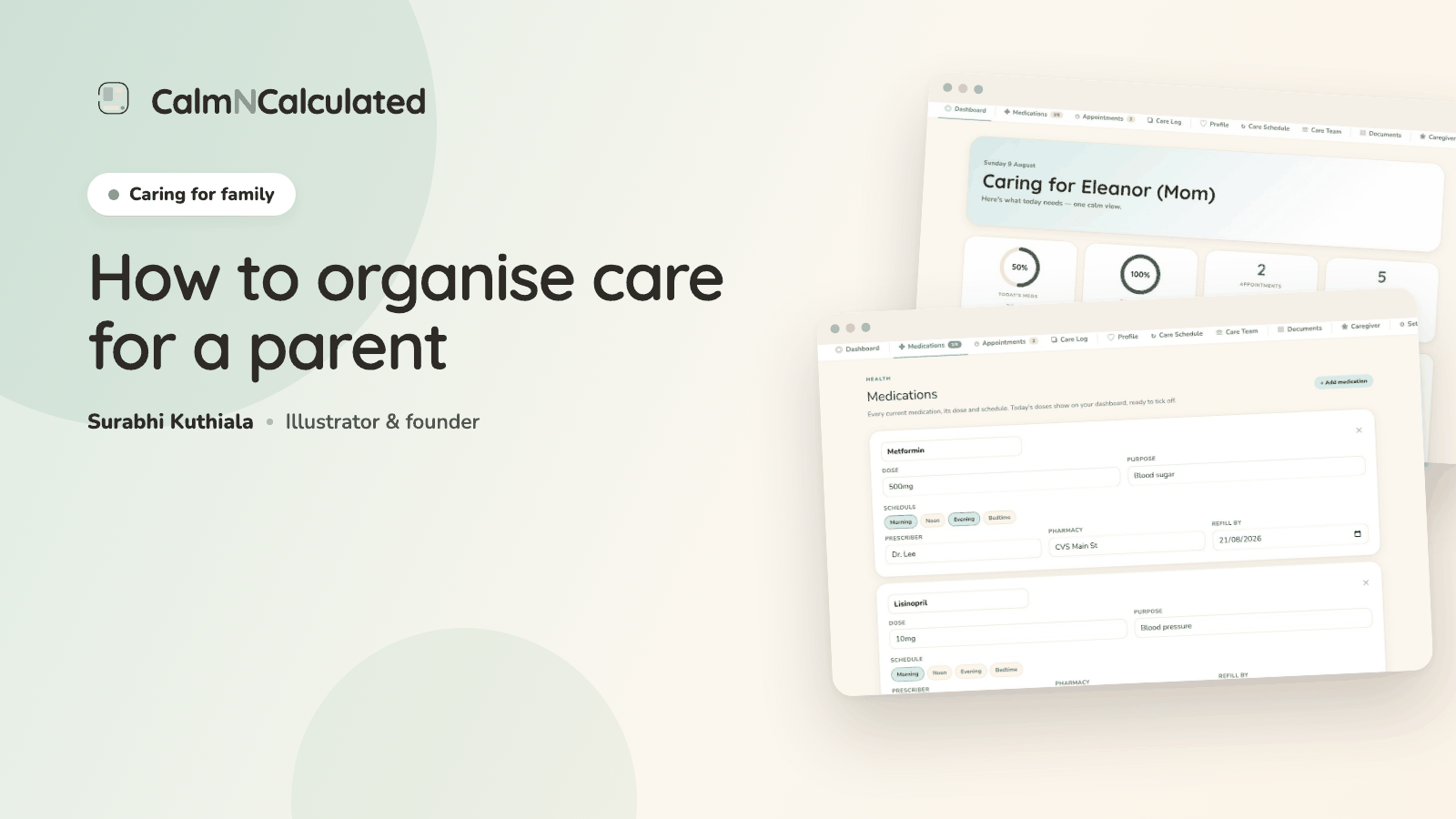
Build the record around the handover, not around the day. Whoever takes over next needs to know four things without phoning anyone: what medication was given and when, what happened today, what is coming up, and who to call. Most family caregiving fails at that gap rather than at the care itself.
Caring for a parent is rarely something anybody decides to start. It begins as helping out, it grows one small task at a time, and by the point anybody would call it caregiving it has usually been going on for a year and is being held together by one person's memory and a series of phone calls.
I want to be honest about the limits of what a planner can do here. It cannot make this easier emotionally, and nothing in this post is medical. What it can do is remove a specific, fixable kind of friction that makes an already hard job harder than it needs to be.
Where does family caregiving actually break down?
At the handover.
Very little home care is done by one person alone. There is a sibling who does weekends, a neighbour who looks in, a paid carer three mornings a week, a partner who covers when you cannot. Each of those is a handover, and the information travels by phone call, by message, or not at all.
So the same four questions get asked several times a day, usually by the person arriving, to the person leaving, who is tired. Has she had the tablets. Did she eat. Was there a call from the surgery. Is anyone taking her on Thursday. None of these are difficult questions. They are simply not written down anywhere, and so each one costs a phone call and a small amount of goodwill.
The record is not for the person being cared for. It is for the next person through the door, so they do not have to ring you to find out what happened.
What does the record have to answer?
Four things, and it is worth building it around exactly these rather than around a diary.
| Question | Who asks it | What it needs |
|---|---|---|
| Has the medication been given? | Whoever is next on shift | What, how much, when it is due, and a mark that it was actually given — not a plan, a record. |
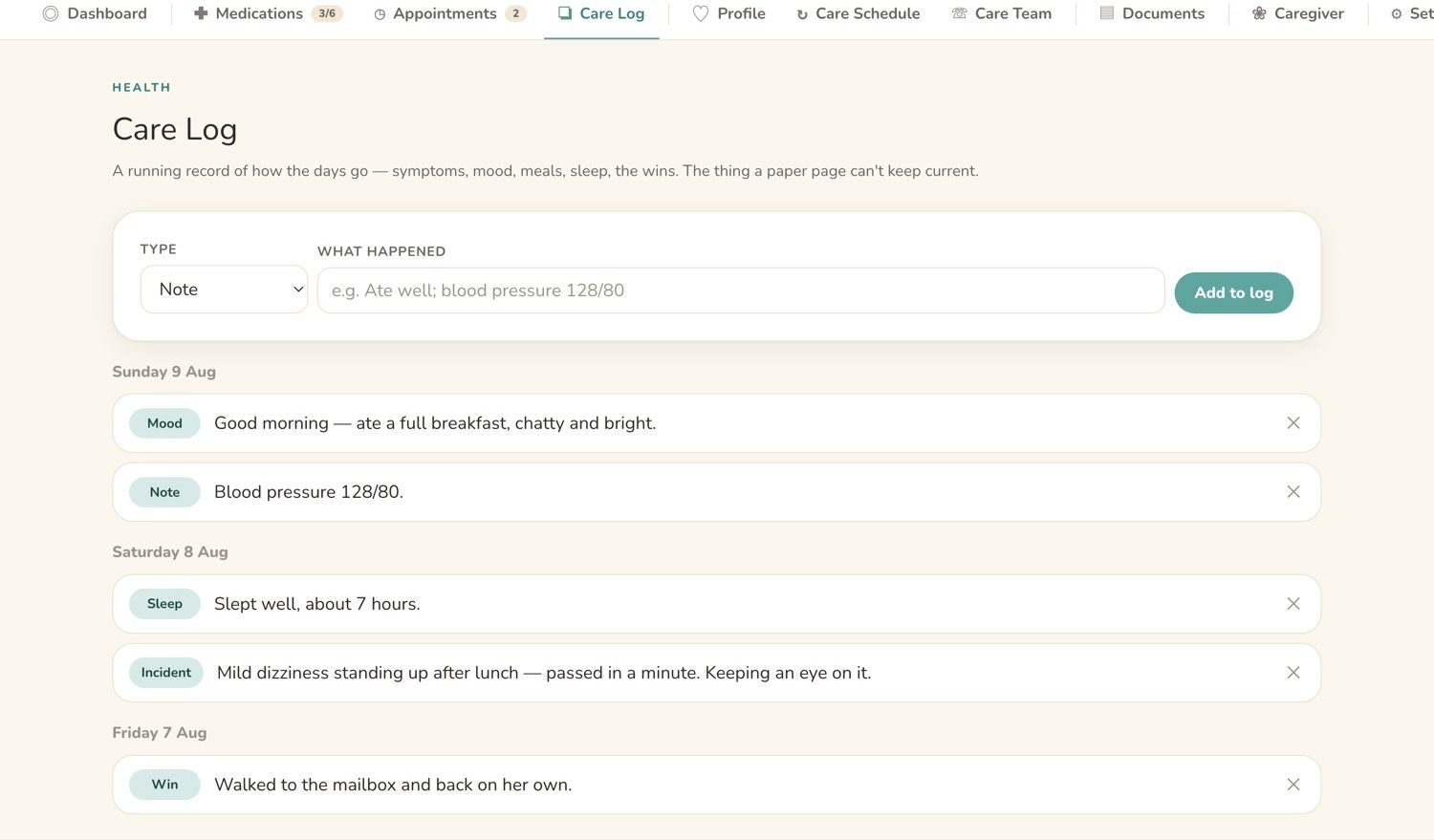
| What has been happening? | A doctor, a nurse, a worried sibling | Short daily notes: eating, sleep, mood, mobility, anything that changed. Facts rather than judgements. |
| What is coming up? | Everyone, constantly | Appointments with date, place, and who is taking them. The last part is where these fall over. |
| Who do I call? | Whoever is there when something happens | GP, pharmacy, out-of-hours, the care agency, family — with numbers, in one place, readable by anyone. |
Everything else is optional. If a record answers those four without a phone call, it is doing its job.
How should medication be tracked?
Carefully, and as a record of what happened rather than a list of what should happen.
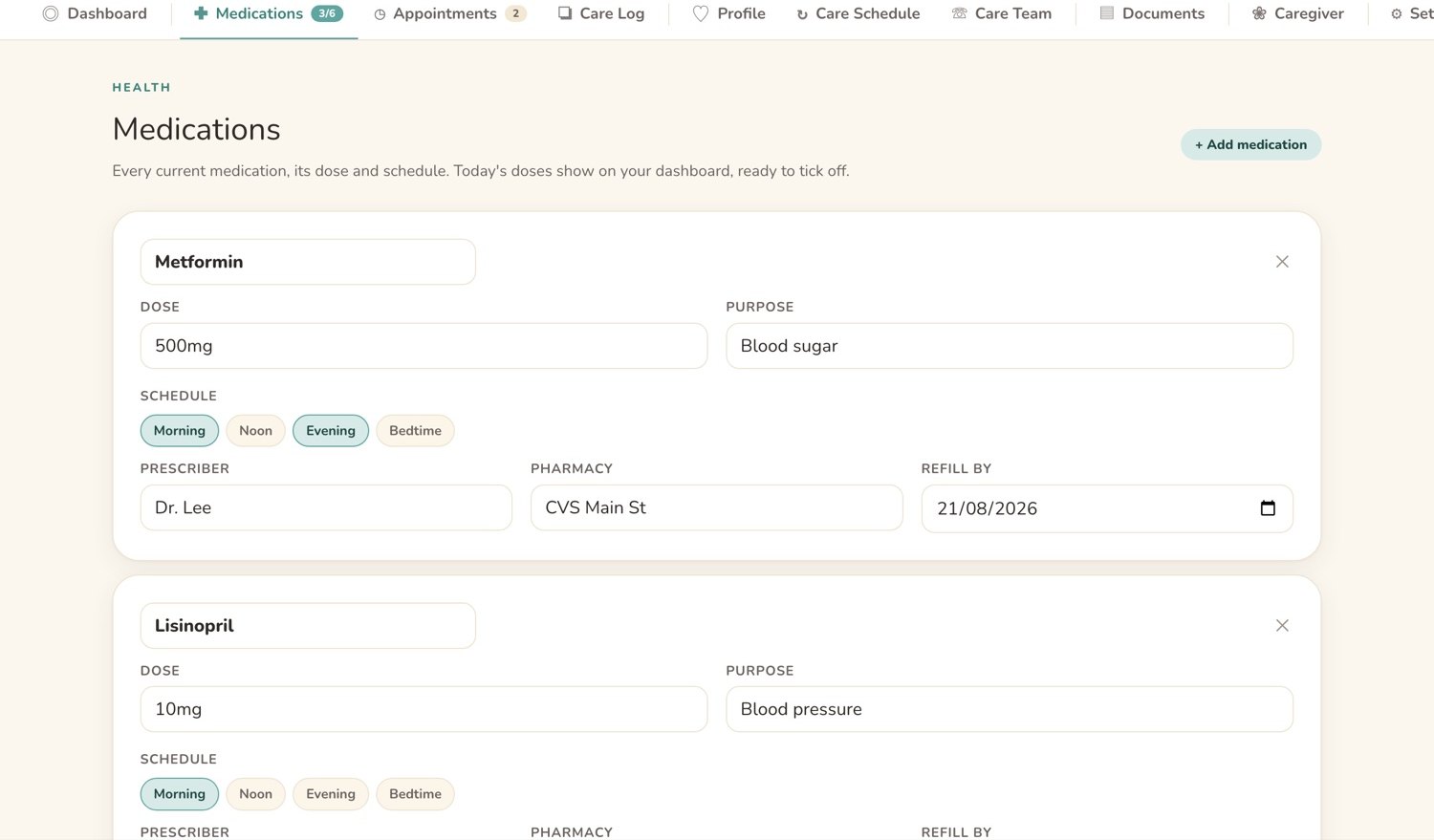
This is the highest-stakes and least interesting part of the whole exercise. A list of prescriptions tells you the intention. What the next carer needs is the fact: was the eight o'clock dose given, by whom, at what time. Those are different things, and confusing them is how a dose gets given twice — which happens most often not through carelessness but because nobody could tell whether it had been given at all.
Three things worth doing:
- Record the dose as given, at the time, by name. Ticking a box later from memory is how the record and reality separate.
- Keep the current list in one place and date it. Medications change more often than people expect, and an out-of-date list is worse than no list because it will be trusted.
- Take the list to every appointment. "What is she currently taking" is the first question asked and the hardest to answer accurately from memory, especially when several people manage different parts of it.
How do you split the work between family?
Explicitly, in writing, before anybody is angry about it.
Care almost always distributes itself unevenly, and it distributes by proximity rather than by fairness — whoever lives nearest ends up doing most of it, whether or not that was ever discussed. The resentment that follows is not really about the hours. It is about the fact that it was never agreed, so it cannot be renegotiated.
A written schedule fixes less than you would like and more than you would expect. It makes the imbalance visible, which is the precondition for anyone doing anything about it. And it gives the people at a distance something concrete to take on — appointments, prescriptions, paperwork, phone calls to the surgery — which are genuinely useful and can be done from anywhere.
One more thing, said plainly: whoever is doing the most needs time when they are not on call. That has to be scheduled like everything else, or it does not happen. It is not a luxury and treating it as one is how people end up unable to continue.
What should you take to an appointment?
Four things, and having them turns a stressful twelve minutes into a useful one.
The current medication list, dated. A short note of what has changed since the last visit — facts, with dates, rather than impressions. The questions you want answered, written down beforehand, because you will not remember the third one. And a way of recording what was said, since you will be asked to repeat it to at least two people later.
If more than one family member is involved, write down what was said the same day. The version that travels by phone at nine in the evening is not the version the doctor gave, through nobody's fault.
What about the paperwork?
It arrives gradually and then all at once. Powers of attorney, benefits, care assessments, insurance, pensions, the arrangements around the house. None of it is urgent on any given day, all of it is urgent eventually, and it is governed by the law where you live — so it is worth getting proper advice rather than a website's.
What is worth doing now, and costs nothing, is writing down what exists and where: which documents, held by whom, with which solicitor or adviser. That index is the thing families spend weeks reconstructing at the worst possible moment.
Where the planner fits
All of this can be a notebook left on the kitchen table, and for a household where everyone passes through that kitchen, a notebook is genuinely hard to beat. The Caregiver Planner exists because of the handover problem — medications, appointments, the daily care log, the care schedule and the care team in one file, so the next person can read it instead of ringing you. There are eight sections and it runs in your browser with nothing to install and no account to make. Because it holds somebody else's medical information, it seemed important that none of it goes anywhere: there is no server and no account, and everything stays on the device you type it into. You can try the whole thing free first.
The paperwork side — what exists, where it is, who holds it — is a different job and is covered in how to organise your affairs, with the End of Life Planner built around exactly that index. And if caring has been added on top of running a household, the Home Management Planner takes the ordinary domestic half of it off your head.
Common questions
What should a caregiver record include?
Four things: what medication was given and when, short daily notes on what has been happening, what appointments are coming up and who is taking them, and who to call. If the record answers those four without anyone needing to make a phone call, it is doing its job.
Where does family caregiving usually break down?
At the handover. Very little home care is done by one person alone — a sibling at weekends, a paid carer some mornings, a partner covering gaps. Each handover means the same four questions asked again by the person arriving, and they are usually not written down anywhere.
How do you track medication safely at home?
Record the dose as given, at the time, by name — a record of what happened rather than a list of what should happen. Keep the current list in one dated place, because medications change more often than people expect and an out-of-date list is worse than none since it will be trusted.
How should siblings divide caring for a parent?
In writing, before anyone is angry about it. Care distributes by proximity rather than by fairness, and the resentment that follows is usually about it never having been agreed rather than about the hours. A written schedule makes the imbalance visible, and gives people at a distance concrete jobs — appointments, prescriptions, paperwork, phone calls.
What should you take to a medical appointment?
The current medication list with a date on it, a short factual note of what has changed since the last visit, the questions you want answered written down beforehand, and a way of recording what was said. You will be asked to repeat it to at least two people afterwards.
How do you avoid caregiver burnout?
Schedule the time off rather than hoping for it. Whoever is doing the most needs periods when they are not on call, and if that is not written into the rota like everything else it does not happen. It is not a luxury, and treating it as one is how people reach the point of being unable to continue.
This is not medical advice. It is about record-keeping. Doses, symptoms, treatment and anything that concerns you belong to a doctor, pharmacist or nurse — and where their instructions differ from anything above, follow theirs.
Try the Caregiver Planner
Medications, appointments, a daily care log, the care schedule and the care team — as a browser app, an Excel and Google Sheets workbook, or a printable pack. Nothing to install, no account to create.
Open the planner