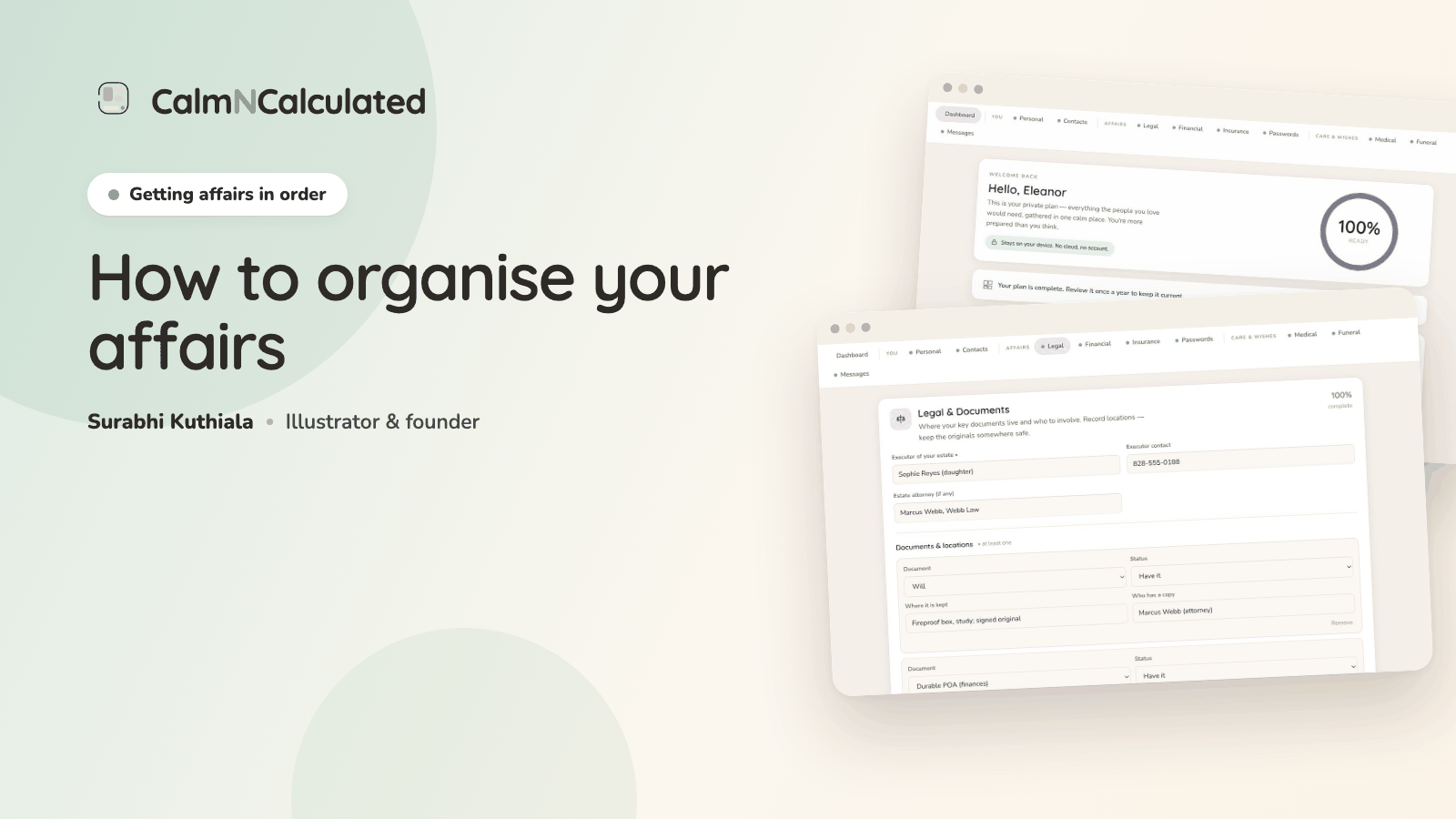
Start with the index, not the will. Write down where every document is, who to contact, what accounts exist and where the keys are. Most families do not struggle with the legal questions — those have professionals attached. They struggle with finding things, in a fortnight when nobody is thinking clearly.
This is not a comfortable subject and I am not going to pretend otherwise. But the reason it gets put off is not really the subject. It is that "getting your affairs in order" sounds like a legal project — something requiring a solicitor, an appointment and a decision about your own death — when most of it is a filing job that takes an afternoon.
The useful way in, I think, is to stop asking what you should decide and start asking what somebody else will have to find.
What does a family actually struggle with?
Location, not law.
When we built this planner I expected the hard part to be the legal structure. It is not. Wills, probate and estates are complicated but they come with professionals attached, and those professionals know what they are doing. What they cannot do is tell your family which bank you were with, whether there was a second pension from a job in your thirties, where the house deeds are, who the insurance was through, or what the boiler service contract was called.
A will answers who gets what. Almost nothing answers where anything is — and that is the question that actually consumes the first month.
So the single most valuable document you can leave is not the will. It is the index to everything else: a plain list of what exists and where it lives. It requires no legal knowledge, it costs nothing, and it can be written this afternoon.
What has to be found, and in what order?
The order matters more than people expect, because the needs arrive in waves and the early ones arrive very fast.
| When | What is needed | Where it usually is |
|---|---|---|
| The first days | Who to tell · any wishes about the funeral · whether there is a plan or policy paid for · immediate documents for registration | In one person's memory, or in nobody's. This is the gap that hurts most. |
| The first fortnight | The will and who holds it · the executor · the solicitor · the funeral itself · notifying employers and authorities | Usually findable, usually only after several phone calls to work out who to ask. |
| The first months | Bank and savings accounts · pensions · insurance policies · the mortgage · utilities and subscriptions · property deeds · anything owned jointly | Spread across decades of paperwork and a dozen companies, several of which have changed name. |
| Whenever it surfaces | Old accounts · a small pension from a former job · digital accounts and photographs · anything with a recurring payment | Frequently never found at all. This is the category that quietly loses money. |
Read the first row again. Almost everything in it is a wish rather than a document — what someone wanted, told to one person, once, possibly years ago. It is the least legally significant part of the whole exercise and by a distance the most emotionally significant, and it is the part most likely to be missing.
Who needs to be told, and in what order?
Make the list while it is a calm exercise, because it is not a calm exercise later.
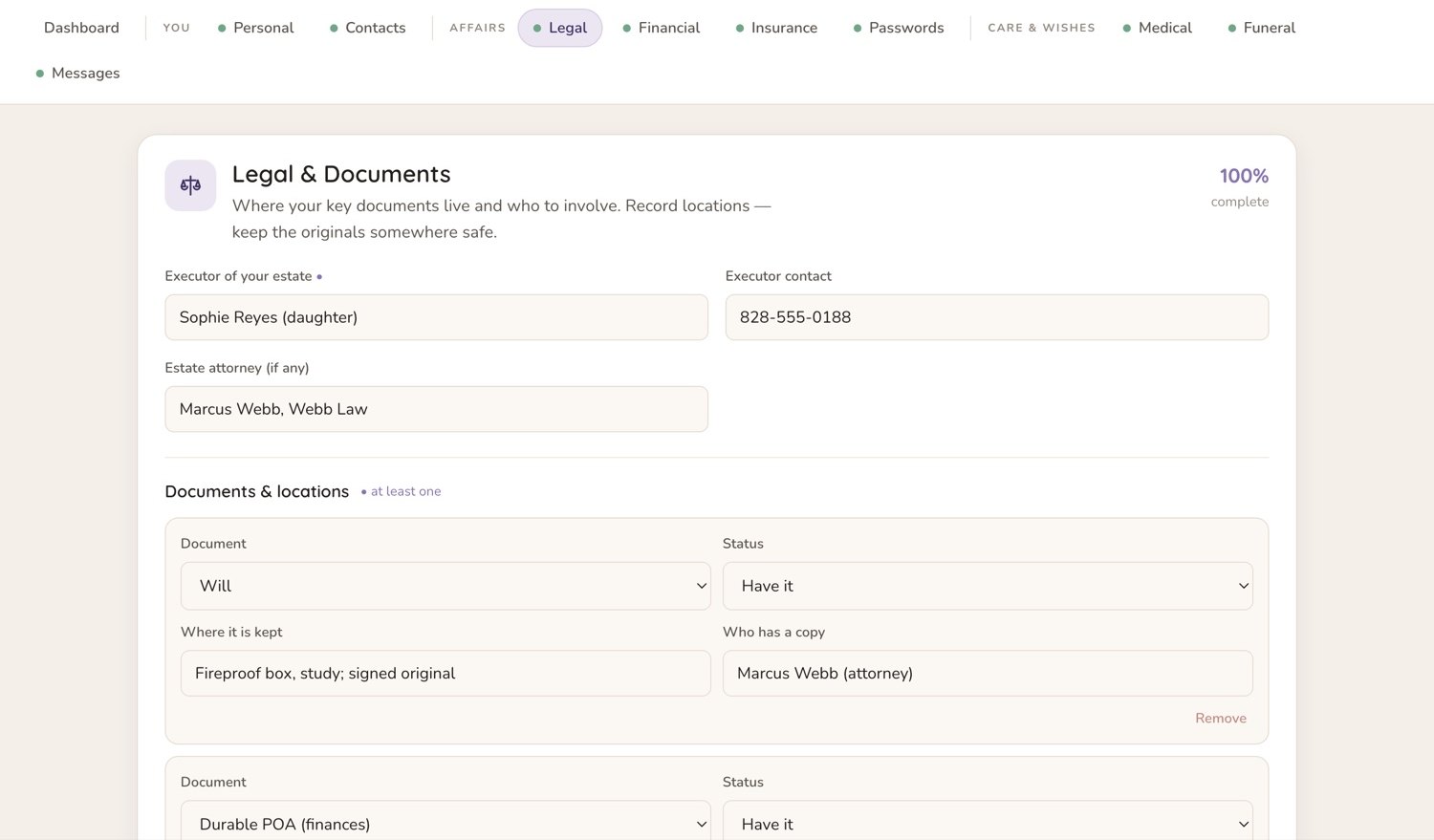
Three tiers, and it is worth writing them as tiers. The people who need to know within hours, and who should hear it from a person rather than a message. The people who need to know within a few days. And the organisations — employer, bank, pension, insurer, authorities, doctor — which are not urgent but are numerous and easy to lose track of halfway through.
Put a phone number next to every name. It sounds obvious. It is the thing most often missing, because everyone's numbers live in a locked phone.
What about digital accounts and passwords?
This is the newest part of the problem and the most awkward, because the advice pulls in two directions at once. Your family needs to reach some of these accounts. Nobody should be able to reach them while you are alive.
A few things that are true regardless of what you use:
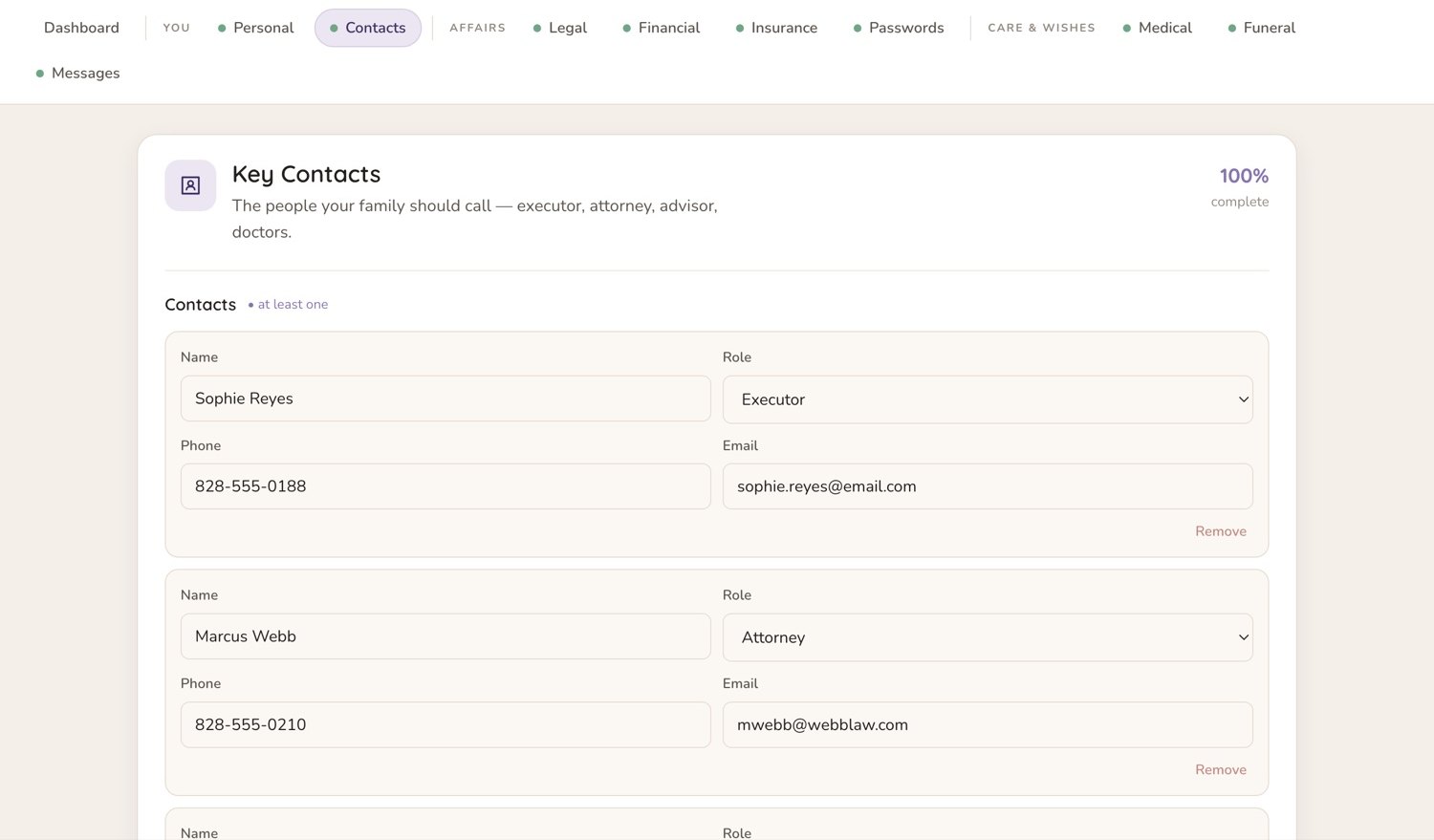
- Recording where an account exists is safe and useful. "There is an email account here, a photo archive there, a subscription with this company" costs nothing to write down and is enormously helpful. Most of what gets lost is lost because nobody knew it existed.
- Credentials are a different question from locations. Several password managers have a legacy or emergency access feature designed precisely for this, and for the accounts that matter most that is a better mechanism than a written list.
- If you do write anything down, keep it somewhere you control. A document of passwords in a shared cloud folder is available to considerably more people than you intended, permanently.
- Tell one person the record exists. A perfect record nobody knows about is the same as no record.
Our own planner keeps everything, including that section, in the browser on your own device. Nothing is sent anywhere, because there is nowhere for it to be sent — there is no server and no account. That is a deliberate design decision for this product in particular, and it is also the reason a backup matters: if the file is only in one browser on one machine, it is one spilled cup of tea away from not existing.
What is worth writing down that nobody asks for?
The things that are not administrative at all.
What you would like to happen, in as much or as little detail as you want. Whether there is music. Whether there is a preference about burial or cremation, which is the single most common thing families end up guessing at. Who should be told personally rather than by announcement. What should happen to a pet.
And if you want to, letters. There is a section for them in our planner and I was uncertain about including it, because it felt like overreach for a piece of software. I have come round to it. It is the one part of this exercise that is for the people you are leaving rather than for the paperwork, and it turns out to be the part most people are pleased to find.
How often should it be updated?
Once a year, and after anything that changes the facts — a move, a new account, a new job, a death in the family, a new will. Put it next to something you already do annually so it does not depend on remembering.
An out-of-date record is still enormously better than none. Three-year-old bank details still tell someone which bank to ring. Do not let the fear of it being imperfect stop you making it; that is the failure mode that leaves families with nothing at all.
Where the planner fits
All of this can be a folder in a drawer, and a folder in a drawer that somebody knows about is a genuinely good solution. The End of Life Planner exists because of the locational problem — it is built as an index rather than an archive, with ten sections covering personal details, contacts, legal and financial papers, insurance, medical wishes, funeral preferences and messages, and a view of how complete the record is so you can see what is still missing. It runs in your browser, on your own device, with no account and no server. You can try the whole thing free first.
If you are doing this because you are looking after somebody else rather than for yourself, that is a related but different job — medications, appointments and a care record that more than one person can read — and it is what the Caregiver Planner is for. And a good deal of the household detail people go hunting for later — service contracts, warranties, who fixed the boiler — lives more naturally in the Home Management Planner.
The rest of what we make is on the planners page.
Common questions
What does getting your affairs in order actually mean?
Mostly it means writing down where things are. Wills, probate and estates are legal questions with professionals attached, but no professional can tell your family which bank you were with, where the deeds are, or that there was a small pension from a job in your thirties. The index to everything else is the part only you can write.
Is a will enough on its own?
A will answers who gets what. It does not answer where anything is, who to contact, what accounts exist or what you wanted to happen at the funeral. Those are the questions that consume the first month, and they are the ones a plain list solves better than any legal document.
What do families most often struggle to find?
Wishes about the funeral, and old accounts. Wishes because they usually live in one person's memory rather than on paper; old accounts because a pension or policy from decades ago is frequently never found at all. The first is the most upsetting gap, the second is the one that quietly loses money.
How should passwords and digital accounts be handled?
Recording that an account exists is safe and genuinely useful — most of what gets lost is lost because nobody knew it was there. Credentials are a separate question: several password managers have legacy or emergency access built for exactly this, which is a better mechanism than a written list. Anything you do write down should be somewhere you control, not a shared cloud folder.
How often should this be updated?
Once a year, and after anything that changes the facts — a move, a new account, a new job, a new will. Attach it to something you already do annually so it does not rely on remembering. An out-of-date record is still far better than none: three-year-old details still tell someone which bank to ring.
Is it morbid to write this down?
It is administrative, mostly. The parts that are not administrative — what you would like to happen, who should be told personally, whether there is a preference about burial or cremation — are the parts families most often end up guessing at, and being spared that guess is a kindness rather than a burden.
This is not legal or financial advice. Wills, probate, estates, tax and powers of attorney are governed by the law where you live and differ enormously between countries. Anything binding belongs to a qualified professional. What follows is about organising, not deciding.
Try the End of Life Planner
Documents and where they're kept, accounts and beneficiaries, passwords, medical and funeral wishes, and messages to the people you love — as a browser app, an Excel and Google Sheets workbook, or a printable pack. Nothing to install, no account to create.
Open the planner